


Analysis
Supreme Court or ‘a sort of peripatetic court’?
Were the framers not prescient enough to understand the travails of litigants in accessing final justice?
Recently, Tamil Nadu Chief Minister C. Joseph Vijay wrote a letter to Prime Minister Narendra Modi, reviving a long-pending proposal to set up a Supreme Court Bench in Chennai.
He argued that the remedy under Article 32 was “practically available only to citizens who are geographically close to the Supreme Court of India” and could afford litigation and travel. He said a Chennai bench would “reflect the true federal character of our Nation”.
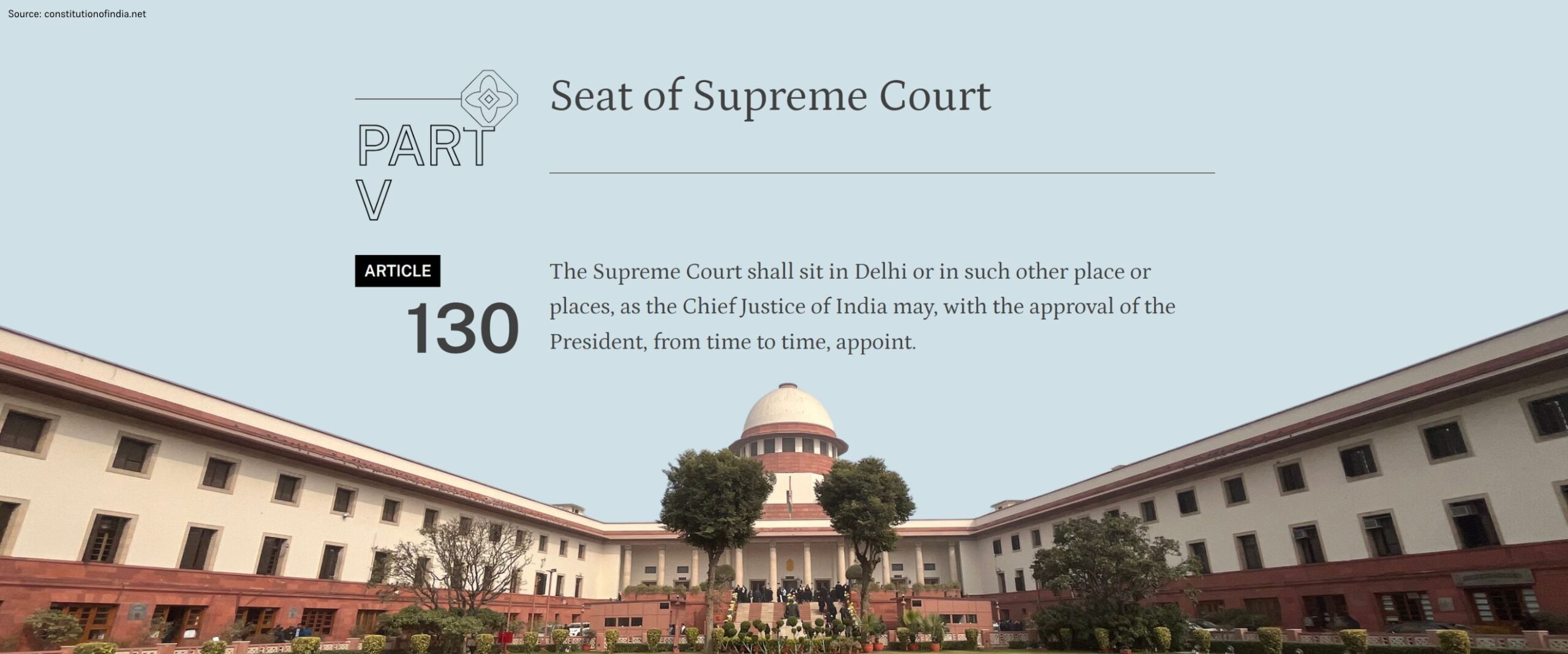
The proposal to set up a Regional Bench dates back to the Constituent Assembly Debates. Article 130 of the Constitution reads: “The Supreme Court shall sit in Delhi or in such other place or places, as the Chief Justice of India may, with the approval of the President, from time to time, appoint.”
The provision was debated on 27 May 1949. Jaspat Roy Kapoor, while discussing the draft provision Article 108-A, which became Article 130, sought a clarification from Dr B. R. Ambedkar: “Will it be open to the Supreme Court so long as it is sitting in Delhi, to have a circuit court anywhere else in this country simultaneously?” To this, Ambedkar replied: “Yes, certainly. A circuit court is only a Bench.”
Article 130 is worded this way because, at that time, it was not certain whether Delhi would continue to be the National Capital. The draft Article 108-A was made to accommodate a possible change in the Capital’s location. Therefore, the seat of the Supreme Court could be “at such other place which Parliament may decide as the capital”.
However, Ambedkar also endorsed the view of T.T. Krishnamachari, a member of the drafting committee, who said the provision allowed the Court, while seated in Delhi, to sit elsewhere as “a sort of peripatetic court”.
As we mark the 77th anniversary of the Constitution’s adoption, it makes sense to look back at the assembly and ask whether the idea was as preposterous to the Constituent Assembly as it seems to its critics in subsequent years.
Tracing the history of regional benches
Interestingly, the Supreme Court has sat outside Delhi twice.
First in Hyderabad in 1950. Justice Mehr Chand Mahajan sometimes sat with Chief Justice R.S. Naik of the Hyderabad High Court on a two-judge bench. He also sat with Chief Justice Naik and Justice Khalil-uz-Zaman Siddiqui of the same High Court, who functioned as ad hoc judges of the Supreme Court. The Hyderabad sitting took place because it had a Judicial Committee to hear appeals from its High Court—akin to the Privy Council. After the Constitution came into force, the Supreme Court took over appeals pending before them under Article 374(4). Because their records were in Urdu, the Court set up an ad hoc bench in Hyderabad to dispose of them.
The second occasion arose in 1954. CJI Mahajan sat with Justices S.R. Das and Ghulam Hasan in Srinagar.
Why?
Jammu and Kashmir’s Board of Judicial Advisers, which advised the ruler on appeals from the High Court, had 17 appeals pending before it was abolished. The Supreme Court constituted a Special Bench to dispose of them, as the appellants could not afford to travel to Delhi.
This time, a notification published in the Gazette of India on 10 July 1954 expressly invoked Article 130 for the Srinagar sitting. No such notification surfaced for Hyderabad. Both were temporary benches set up to clear inherited appeals. Whether the provision supports a permanent regional bench remains disputed.
Ambedkar told the Constituent Assembly that “a court must have a defined place where it shall sit and the litigants must know where to go and whom to approach”. He also meant that some Supreme Court judges could hear cases elsewhere as a bench of the same institution while its Delhi sittings continued. But the framers did not have a permanent bench outside Delhi in mind when they debated the draft Article 108-A.
On 7 August 2007, the Full Court of the Supreme Court, comprising all the judges, unanimously refused to sit in Chennai on a trial basis, as the Union government suggested. The Law Commission’s similar proposal was rejected on 18 February 2010.
In March 2023, CJI D.Y. Chandrachud highlighted hybrid hearings when the demand resurfaced in Tamil Nadu. He suggested that lawyers outside Delhi could appear remotely, saving travel and accommodation expenses.
Video hearings have improved access, but the cost of pursuing a case extends well beyond appearing before judges. Litigants must attend conferences with their counsel, and their physical presence during hearings often matters to the outcome.
In Anita Kushwaha v Pushpa Sudan (2016), the court identified reasonable distance, affordability, speed, and effective adjudication as essential features of access to justice protected by the Constitution.
Why the judiciary has resisted
In 2010, CJI K.G. Balakrishnan argued that regional benches could dilute the institution’s integrity and create a hierarchy among judges posted to different places. He interpreted Article 130 as intended for extraordinary circumstances.
In November 2014, Senior Advocate Arvind Datar called splitting the Supreme Court “a very regrettable step”. He preferred the Supreme Court in one location while strengthening the High Courts. He acknowledged the difficulties southern litigants faced. Advocate Dr M.P. Raju disagrees. To him, whether a Supreme Court bench sits in Tilak Marg or in Chennai would hardly matter to the majesty of the Court in this era of improved communications. Raju adds that regional benches could substantially reduce litigation costs by cutting what litigants spend on travel and legal consultations.
Senior Advocate Ranvir Singh sees both constitutional and practical problems in the request. “Article 130 has to be read with Article 124, which mandates that there shall be ‘a Supreme Court’,” he says. In his reading, Vijay is asking for a second Supreme Court. Such a bench, he warns, “will also lead to regional bias” and fracture the Court’s law-making process, leaving “no unity of institutional response”. Other States, he adds, would soon make the same demand.
Senior Advocate Mohan V. Katarki draws a line between the two tiers of the higher judiciary. “Decentralisation of the judiciary is necessary, but the Supreme Court stands on a different footing from the High Courts,” he says. “The Supreme Court is a single apex court with a unity of jurisdiction. Splitting it into regional benches may fracture that unity.” With travel easier and online appearance freely permitted, he considers such a split inadvisable today.
S.R. Hiremath, founder of Samaj Parivartana Samudaya, which brought the Karnataka mining case before the Supreme Court, supports a Chennai bench because it would make the Court easier and less costly for ordinary litigants to access. In his view, video hearings are a poor substitute for in-person appearances. A lawyer’s presence and body language matter, he says, as does the ability to gauge how judges receive an argument and respond to opposing counsel.
Vijay argues that judicial independence would be preserved because the Chennai bench would remain under the CJI’s control. A Chennai bench would be part of the same Supreme Court. Any declarations of law will be binding under Article 141.
Ambedkar’s reply to Kapoor in 1949, that “a circuit court is only a Bench”, supports that reading. But a permanent regional bench is not a circuit court, where judges hear matters for a few days before returning to the Court’s main seat in the Capital.
Arghya Sengupta, Research Director at the Vidhi Centre for Legal Policy, says: “Since the Supreme Court functions with a sanctioned strength of 38 judges, a proposal to set up a Bench in Chennai is sensible. The total strength should be bifurcated based on the data on the number of cases coming to the court from states in closer proximity to Chennai than Delhi without adding any new judges.”
The Law Commission’s 229th Report, in 2009, proposed four regional appellate benches of the Supreme Court. Constitutional matters will be heard in Delhi. It added that a liberal reading of Article 130 might make a constitutional amendment unnecessary. A legislation or an amendment would be needed only if that reading proved unworkable. A National Court of Appeal would instead create an intermediate institution between High Courts and the Supreme Court, with regional benches deciding ordinary appeals.
Vijay also cites advocate V. Vasanthakumar’s case, in which Chief Justice T.S. Thakur’s bench referred 11 questions concerning regional sittings to a Constitution Bench on 13 July 2016. Such a court is proposed to lessen the burden on the Supreme Court, so it can concentrate on deciding constitutional cases expeditiously.
A regional bench in Chennai could make the Supreme Court more accessible to litigants from the South. The question is whether it can do so while preserving the advantages of a unified court. As Singh puts it, “Having a unified Supreme Court has its own advantage, in particular in areas of development of law, with the involvement of a Bar which represents the entire country”.