


Analysis
Strike down or read down?
Justice Nagarathna says Section 17A of the anti-corruption law stifles inquiries; Justice Viswanathan finds that it protects honest officers
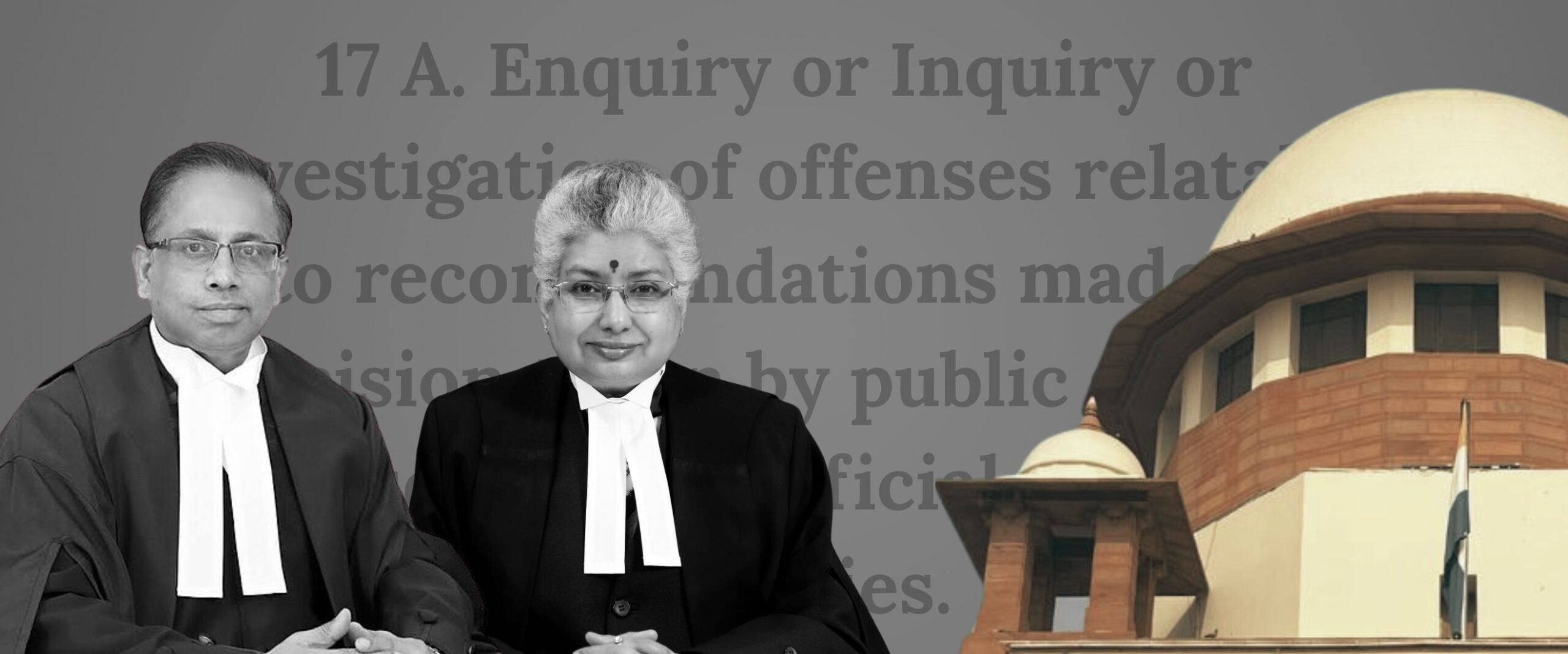
On 13 January, a Bench of Justices B.V. Nagarathna and K.V. Viswanathan delivered a split verdict on the constitutionality of Section 17A of the Prevention of Corruption Act, 1988 (PCA). Inserted by a 2018 amendment, this provision mandates authorities to obtain prior approval before conducting “any enquiry, inquiry or investigation” into decisions taken by public servants.
Justice Nagarathna’s 146-page opinion advocates striking down Section 17A as the provision imposes a restrictive pre-condition that effectively strips police officers of the power to even conduct a preliminary “enquiry”. By shutting out “enquiry” at inception, the provision “protects the corrupt rather than seeking to protect the honest.”
Justice Nagarathna rejects the Union’s argument that approvals filter out frivolous complaints. If the approval is denied, the matter will remain “hanging in suspense”. In practice, it often leads to a situation where a subordinate is required to approve an inquiry against a superior they may not wish to displease. This conflict of interest extends to instances where the approving authority may have participated in the decision under scrutiny. The requirement of a greenlight, therefore, allows offences to be covered up and remain under wraps.
In Justice Nagarathna’s view, Section 17A is an attempt to “obviate” the decisions in Vineet Narain v Union of India (1997) and Dr. Subramanian Swamy v Dr. Manmohan Singh (2012), which struck down the ‘Single Directive’ and Section 6A of the Delhi Special Police Establishment Act, 1946, respectively. These dealt with approval to initiate investigations against senior officers of the Central Bureau of Investigation. Justice Nagarathna stated that Section 17A was nothing but “old wine in a new bottle”—by vesting discretion in the executive to halt “enquiry” at inception, the provision is “manifestly arbitrary” and violates Article 14 of the Constitution.
Justice Viswanathan takes a contrary view in his 124-page opinion. According to him, Section 17A prevents harassment of honest officers who make bona fide decisions. Since the mechanism limits the “enquiry” process to acts done in discharge of official duty, striking it down would amount to “throw[ing] the baby out with the bathwater.”
Justice Viswanathan notes that the mere possibility of abuse cannot be sufficient to declare a provision unconstitutional. Section 17A operates as a safeguard against reckless and motivated investigations. The object of the provision, he says, is to prevent “irreparable harm”, especially in an era of heightened visibility on social media, where reputational damage follows soon after an unproved allegation is made public.
In his view, Vineet Narain and Subramanian Swamy do not address prior approval per se, but executive control over investigation. He holds that government sanction should be substituted with screening by an independent body, such as the Lokpal at the Union level or the Lokayukta at the state level. This way, concerns of prior approval by a “biased” body would not arise. Justice Nagarathna rejects this suggestion on the ground that the word “government” in the PCA provision cannot be substituted with “Lokpal” by the Court.
Justice Viswanathan pushes for a “fine balance” between public probity and preventing bad-faith prosecution—without a provision like Section 17A, he says that “policy paralysis” could set in and public servants will “play it safe” to avoid conflict.
The split verdict is a compelling demonstration of the diverging consequences of a single provision. A larger bench of three judges will now have to break the deadlock. The question before them is one of high relevance to improve probity in public life: does Section 17A impede investigation of credible allegations or does it put an unspoken fetter on decision-making? And if it does both, which is the greater harm?
This article was first featured in SCO’s Weekly newsletter. Sign up now!
Related articles
Analysis
Judgment Pronouncement: Validity of Circumstantial Evidence in Bribery Cases
The Constitution Bench led by Justice Nazeer held that public officials can be convicted for bribery without direct evidence.
Analysis
Immunity from Bribery Charges?
High Court rules against MLA Sita Soren holding that she did not have immunity from prosecution under Article 105(2) of the Constitution.
Analysis
Supreme Court refuses interim bail to Arvind Kejriwal in CBI’s corruption-related arrest
Kejriwal’s counsel argued that the CBI’s last minute arrest was like an “insurance arrest”

Analysis
Does the Constitution protect MLAs from charges of bribery?
A 7-judge Bench will examine if MLAs who accept bribes to vote in a house of legislature enjoy immunity from prosecution.