

Analysis
Monthly Review: January 2026
From UGC guidelines to AI harms, January witnessed the Court grappling with regulation and reforms
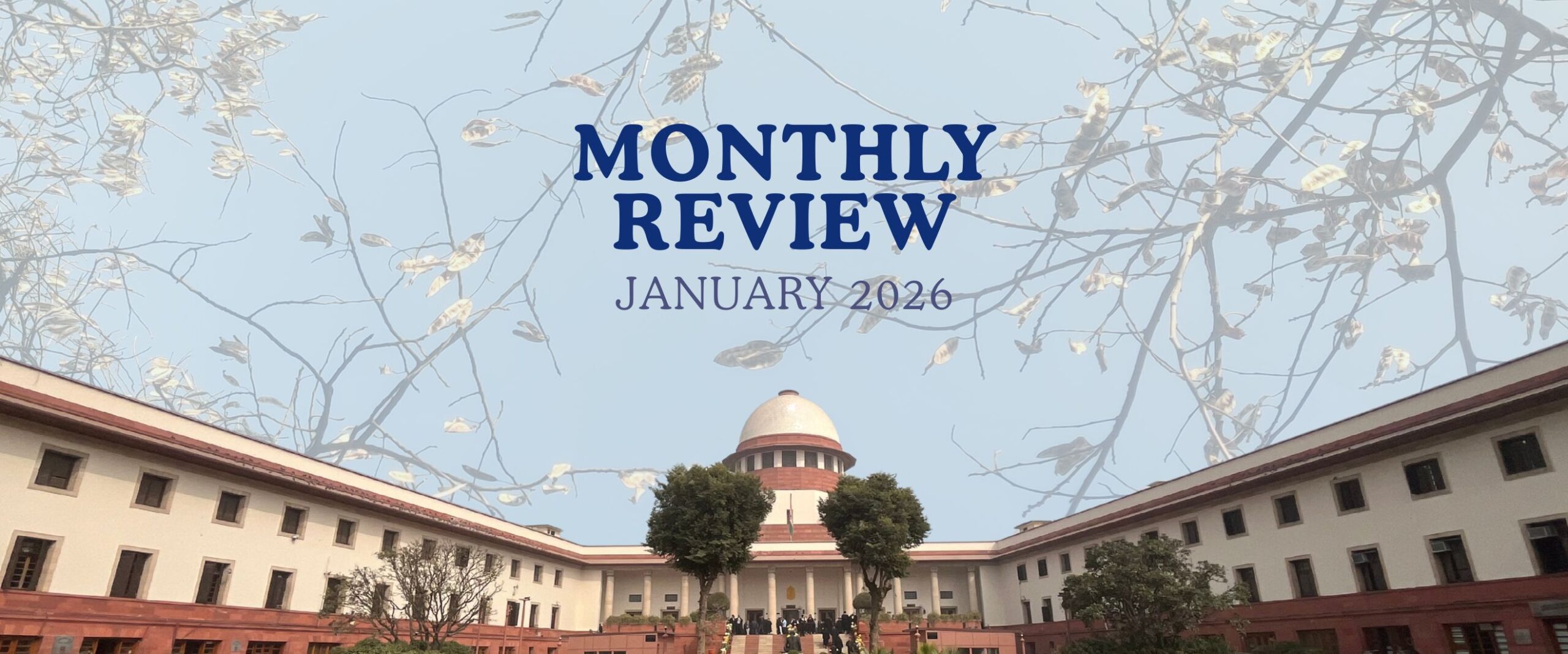
In January, the Supreme Court addressed regulatory hurdles with the University Grants Commission (UGC) guidelines, decided on the validity of the Parliamentary Inquiry Committee in Justice Yashwant Verma’s plea and passed an interim order in Directorate of Enforcement (ED) v State of West Bengal.
UGC guideline debacle
On 29 January, a Division Bench of Chief Justice Surya Kant and Joymalya Bagchi stayed the University Grants Commission (Promotion of Equity in Higher Education Institutions) Regulations, 2026, on the grounds that they were prima facie “vague” and “easy to misuse.” Notified on 13 January, the Regulations were challenged for allegedly being “unfair” to students belonging to the General category. Major contentions against the Regulations center on Clause 3(c), which defines “caste-based discrimination” as discrimination against members of the Scheduled Caste, Scheduled Tribe and Other Backward Classes, to the exclusion of General Category. The petitioners argued that such exclusion could be potentially misused, leading to harassment.
Parallelly, the Supreme Court issued a defined set of directions on the increased suicide rates among students. In comparison to the July 2025 guidelines, the latest directions issued by the Court tackle the issues of scholarship backlogs, critical vacancies and the student suicide epidemic more concretely.
No relief for Justice Yashwant Varma
On 16 January, the Supreme Court dismissed Justice Yashwant Varma’s challenge to the constitution of a Parliamentary Inquiry Committee, formed under Section 3(2) of the Judges (Inquiry) Act, 1968, in the probe of corruption allegations against him. Justice Verma argued that the Lok Sabha cannot constitute a committee under the provision unless the motion is admitted in both houses of the Parliament on the same day. The court interpreted Section 3(2) of the act to hold that the Speaker of the Lok Sabha acted within jurisdiction.
A State-Center dilemma
On 15 January, the Division Bench of Justices P.K. Mishra and V.M. Pancholi issued an interim order, staying FIRs against ED officers while also directing the preservation of digital data from the search site. The Court expressed concerns over interference of State Agencies in investigations conducted by the ED and other Central Agencies.
The next hearing is scheduled for 10 February.
Continued judicial restraint
On 5 January, the Division Bench of Justices Aravind Kumar and N.V. Anjaria denied bail to Umar Khalid and Sharjeel Imam while granting bail to five other accused in the 2020 Delhi Riots conspiracy case. The Court reasoned that Khalid and Imam stand on a different footing compared to the others accused in the ‘conspiracy.’ It observed that the conventional principle ‘bail is the rule, jail is the exception’ does not find place under the Unlawful Activities (Prevention) Act, 1967 regime.
Our bail application tracker provides a timeline for easy reference.
Attempt at speedy justice
The Supreme Court issued a Standard Operating Procedure (SOP) during the final week of 2025 capping written and oral submissions to ensure speedy and proper administration of justice. The procedure mandated filing a brief note, not exceeding five pages for written submission, to be filed at least three days prior to the hearing. Further, the Court required lawyers to file a note disclosing how much time they may need for oral arguments.
We analysed the SOP and its potential implications on the heavy burden of cases in the Supreme Court in our first newsletter of 2026!
Directions on air pollution
On 21 January, the Commission for Air Quality Management (CAQM) submitted a status report on long term measures to combat the Delhi air pollution crisis. Consequently, a three-judge Bench of CJI Surya Kant and Justices Bagchi and Pancholi mandated immediate implementation of the CAQM recommendations directing concerned stakeholders to submit their respective plans within the next four weeks.
Government pulls up Grok
January witnessed significant development on platform responsibility surrounding X (formerly Twitter) after a sudden influx of non-consensual AI generated images flooded the platform. The Ministry of Electronics and Information Technology (MeitY) issued a notice to the platform for failing to “observe statutory due diligence.” It demanded a report detailing corrective actions undertaken by X and emphasised that non-compliance would result in loss of intermediary protection under the Information Technology Act, 2000.
Our analysis provides an insight on the uncertainty surrounding intermediary liability with respect to AI systems.
Battle of national symbols
On India’s 77th Republic Day, our newsletter explored the Supreme Court’s dynamic approach to the protection of national symbols while resisting the coercive imposition of symbolism. We look back at myriad judgements where the Court addressed a complex question: what does it mean to respect the nation through its symbols?
SCO.LR this January
In January, we published Volume 1 of the Supreme Court Observer Law Reports (SCO.LR), bringing you the five best judgements from each week of the month. Read Issue 1, Issue 2, Issue 3, and Issue 4 here.
Reader friendly summaries can be accessed on our landing page with mind maps and HTML versions of each judgement to enhance accessibility and user experience.
(Sudhiksha Innanje is an intern at the Supreme Court Observer)
Related articles
Analysis
Monthly Review: December 2025
In December, we reflected on the Court’s activity in 2025 as it continued hearing urgent matters during its winter break
Analysis
Monthly Review: November 2025
An opinion on a Presidential Reference, two Constitution Bench judgements and the beginning of a long tenure for a new CJI
Analysis
Monthly Review: October 2025
Despite two weeks of calendar holidays, October witnessed an array of hearings on key matters, including a Constitution Bench judgement
Analysis
Monthly Review: September 2025
In September, the SC reserved judgement in two Constitution Bench matters and heard key cases on electoral revision, bail and animal welfare