


Analysis
Many a slip: Supreme Court clamps down on adjournments again
CJI Gavai had restored the practice through letters or slips; a new circular raises the compliance burden to curb their use
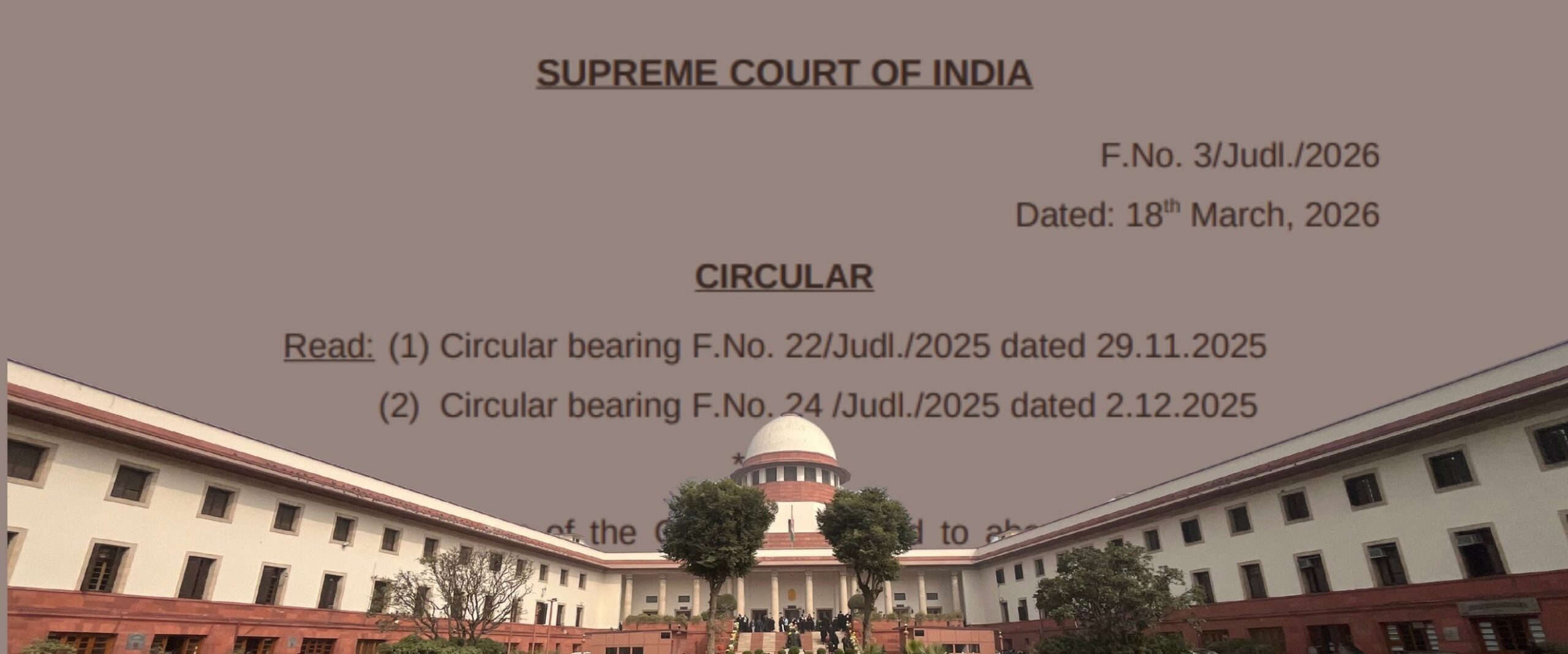
On 18 March, the Supreme Court issued a circular, under the directions of the Chief Justice Surya Kant, laying down new modalities for letters seeking adjournment. The circular supersedes two circulars issued on 29 November and 2 December last year, and it does three things: it insists on advance notice to the other side and proof of service, requires disclosure of prior adjournments, and draws a hard line between “fresh and after-notice matters” on the one hand and “regular matters” on the other. In regular matters, no adjournment letters at all will be permitted.
A party seeking adjournment must state a specific reason and disclose how many adjournments have already been sought. The request must be served in advance on the other side and filed with proof of service by 11am on the previous working day of the listing. The other side may object by noon the next day, and that objection too will be placed before the Court.
The circular also says adjournment will be considered only in “exceptional circumstances” such as bereavement, medical or health conditions, or “such other genuine reason satisfactory to the Court.” In fresh cases, letters seeking adjournments will only be permitted once. Two consecutive adjournments—irrespective of which party is seeking it—will not be permitted without the case being listed before the Court.
The November circular had required a no-objection from the other side before an adjournment request could even be considered, and it excluded fixed-date (as opposed to “list in week starting…” directions) and mentioned matters. The Court had modified the arrangement just days later to provide that advance intimation and proof of service were enough—if the other side objected, the matter would be heard on the notified date.
Restoring judicial control
The new circular retains the notice-and-objection structure, but instead of making an objection automatically fatal to the request, it ensures that both the request and the objection are circulated before the judges. That restores the final decision to the Court.
This matters because adjournments are not just about lawyers’ convenience; they shape the Court’s control over its docket. Since 1 December 2025, the Supreme Court has already moved toward automatic listing of fresh cases: urgent matters involving bail, death penalty, habeas corpus, eviction or dispossession, demolition, and other urgent interim relief are to be listed within two working days after verification and curing of defects, while other fresh cases are listed automatically on the next Monday or Friday after defects are cured.
The message behind the latest circular is consistent with that shift. If listing is to become rule-bound and less dependent on oral mentioning, adjournments too must become more disciplined and less informal.
The circular is in line with the Court’s own jurisprudence. In Shiv Cotex v Tirgun Auto Plast (2011) the Court warned against a litigation culture in which adjournments are granted “at the drop of the hat”. In Noor Mohammed v Jethanand (2013), the Court described delay in disposal as a threat to the rule of law. In Gayathri v M. Girish (2016), while describing the petitioner’s conduct as mastering “the art of adjournment”, the Supreme Court dismissed the SLP with ₹50,000 costs.
The revision also closes off the Registry route in regular matters. Since December 2024, regular hearing matters have been listed on Thursdays till further orders. The new circular says that in such regular matters, no letters seeking adjournment will be permitted at all. Anyone seeking time in a regular matter will now have to make the request personally to the Bench in open court.
What changes for lawyers
On the one hand, the revised procedure is fairer than a regime that makes the opposite side’s consent a gateway condition. A party should not be able to veto another’s genuine medical emergency. By allowing objections to be placed before the Court instead, the new system is more transparent.
On the other hand, it raises the compliance burden on Advocates-on-Record, who must now ensure advance service, proof of service, precise reasons and disclosure of prior adjournments. It also makes serial deferment harder, which may affect the practice of seeking accommodation because a Senior Counsel is unavailable or engaged elsewhere. Even so, the procedure retains flexibility: the Court may still accept “such other genuine reason” as satisfies it.
The advocates the Supreme Court Observer spoke to welcomed the shift. “The new system marks a right balance,” Balaji Srinivasan said. “There is no institutional memory. In 2023, CJI Chandrachud became very strict and sought to close the door on adjournments by permitting it only on specific grounds. In 2024, CJI Sanjiv Khanna sought to discourage re-circulation of adjournment letters. This led to an informal understanding among lawyers making it less transparent.” Prashant Padmanabhan echoed this view: “The new circular will accommodate genuine circumstances while curbing frequent requests.” Paras Nath Singh added that the circular could reduce the need for judges to read case files in matters likely to be adjourned, thereby saving valuable judicial time.
How we got here
In a letter dated 30 December 2023 to the then CJI, the Supreme Court Bar Association had raised concerns over circulars issued on 5 and 22 December 2023, which discontinued the practice of seeking adjournments through letters or slips. This was followed by a modified procedure on 14 February 2024, allowing adjournment letters to be circulated only once and barring them altogether in certain categories, including bail matters and cases where interim relief had been granted to the adjourning party.
The practice was eventually restored—with conditions—under CJI B.R. Gavai. Soon after assuming office, Supreme Court Advocates-on-Record Association (SCAORA), through its Honorary Secretary Nikhil Jain, urged him to reinstate adjournment letter circulation, following which the Supreme Court issued a circular on 17 May 2025 easing the earlier restrictions.
Related articles
Analysis
100 days of CJI Surya Kant
What was promised? What has been achieved? What can we expect? A brief look at the 53rd Chief Justice’s first 100 days.
Analysis
The CJI Surya Kant era begins
CJI Surya Kant’s first week sets the tone for his 14-month long tenure
Analysis
The shake-up: Will CJI Khanna’s decisions on listing resolve pendency and delay troubles?
Even as advocates predict that the measure to not list regular matters is temporary, they demand the bar be consulted on listing issues
Analysis
The Listing Game
Listing at the SC has been plagued by uncertainty. As the Chief nears the end of his tenure, the call for reform is reaching its crescendo