


Analysis
Supreme Court reiterates that confession to Customs officer is admissible as evidence
This decision came in a 40-year-old smuggling case, where the officers have separately been accused of custodial torture of the confessor
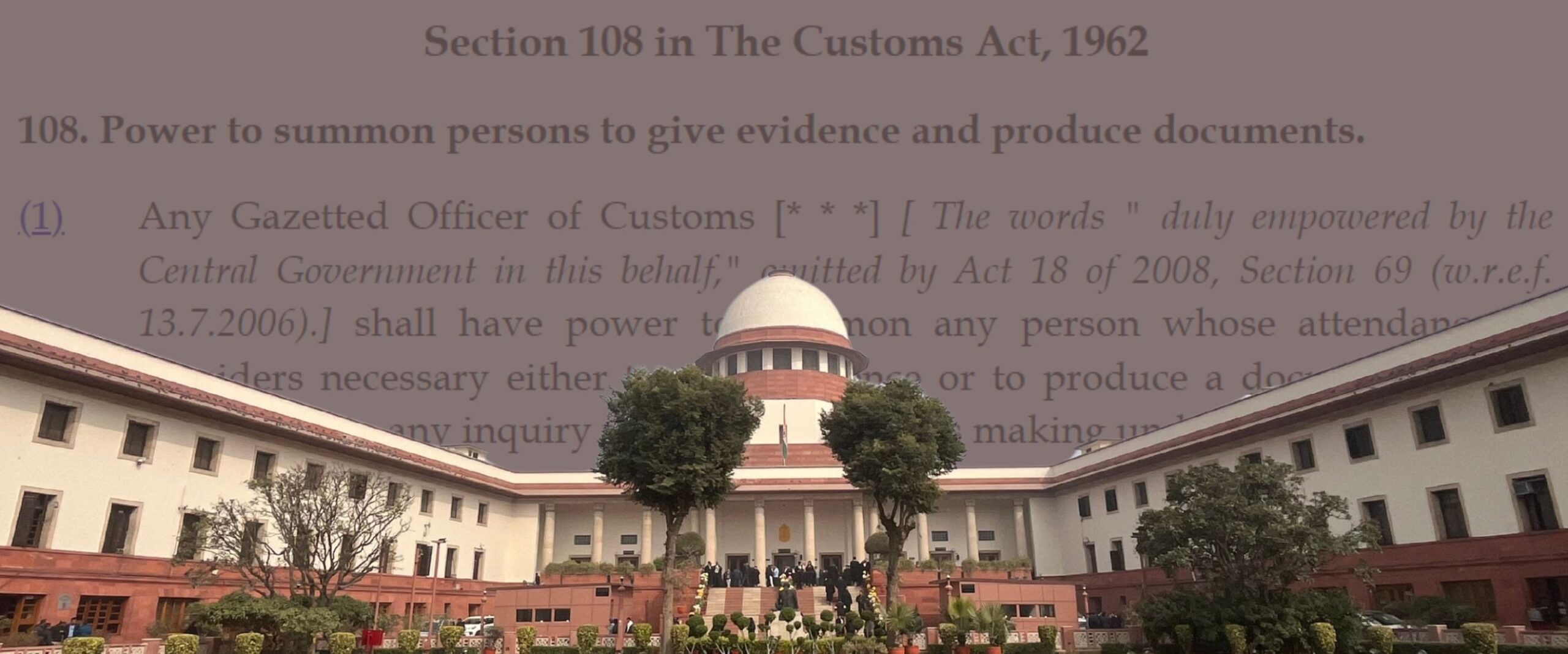
In India’s enforcement landscape, few legal provisions are as powerful as Section 108 of the Customs Act, 1962. It allows Customs officers to summon any person for inquiry, treats those proceedings as “judicial proceedings” equivalent to testimony before a court and permits the statements to be used as substantive evidence in a trial.
A confession made to a police officer is inadmissible in court. A confession made to a customs officer, if deemed voluntary, is admissible. That distinction—settled by a line of Constitution Bench judgements going back to Ramesh Chandra Mehta v State of West Bengal and Illias v Collector of Customs in the late 1960s—means that a confession recorded by a Customs officer carries full evidentiary weight as substantive evidence, provided it is found to be voluntary.
This precedent has long troubled civil liberty lawyers. The Bombay High Court gave voice to those concerns most pointedly in Paragraph 11 of The Assistant Collector of Customs v Hasanali Rumi (2019), where Justice K.R. Shriram, upholding an acquittal, asked: If courts were to simply accept Section 108 statements as “gospel truth”, why would there be a need to hold a trial at all?
The accused in that case—crew members of a vessel carrying smuggled gold—had been in Customs custody for three days before being produced before a Magistrate. They retracted those statements, alleging duress. Justice Shriram found the detention itself to be unconstitutional, and held that it was reasonable to infer coercion.
The issue of Section 108 confessions returned to the Supreme Court this week. On 23 February, the Court closed Amad Noormamad Bakali v State of Gujarat, which had been travelling through the courts since 1985. The matter involved 777 foreign wristwatches, 879 wrist-watch straps, a fishing vessel called Safina-Tul-Firdaus H.M.V. 643 and a key witness who allegedly died under torture at the hands of the Customs officers who obtained his statement.
The Bench of Justices Vikram Nath and Sandeep Mehta upheld the conviction of the surviving accused but reduced their sentence to time already served.
The confession that built the case
On the night of 30 April 1985, customs officers in Mandvi, Gujarat, acting on secret intelligence, excavated two pits on a newly laid road opposite to Government Guest House. They recovered two jute sacks with the contraband, which was valued at ₹2,22,190.
Investigation revealed that the goods had been smuggled into India aboard Safina-Tul-Firdaus H.M.V. 643 in February 1985. Two individuals, Aamad Alimamad Paleja and Amad Noormamad Bakali, were identified as the ship’s owners. A third accused, Ismail Alimamad Paleja, was its captain. Four others were alleged to have stored, transported or sold the contraband.
The seven convicted men were implicated primarily through the confessional statement of one Hussein Mamad Bhadala, recorded under Section 108 of the Customs Act. Bhadala never lived to testify. According to the defence, he was subjected to severe custodial torture by the Customs officers, and subsequently died from the injuries inflicted upon him. An FIR was registered against the Customs officials for offences including murder. The Supreme Court’s verdict is conspicuously silent on what became of that FIR.
Bench: ‘No coercion in obtaining statement’
The admissibility of Bhadala’s statement was contested across four courts and four decades. The defence consistently argued that a conviction could not be founded solely on a statement extracted under coercion from a witness who died in custody, with no independent corroborative evidence to support it.
The Supreme Court disagreed, and in doing so, reaffirmed one of the most contested principles in Indian evidence law. Placing reliance on K.I. Pavunny v Assistant Collector (HQ), Central Excise Collectorate, Cochin (1997), the Court held that statements recorded by customs officers are admissible as substantive evidence provided they are made voluntarily, and do not attract the bar under Sections 24, 25, or 30 of the Indian Evidence Act. The basis for this distinction is that Customs officers are not police officers and therefore the Evidence Act’s bar on police confessions does not apply to them.
The Court further held that the appellants had failed to establish that Bhadala’s statement was obtained under coercion. In any case, the confession had led to independent discoveries—contraband articles, seized cash and panchnamas—which the court held constituted corroborative evidence under Sections 6, 10 and 11 of the Evidence Act.
But that decision doesn’t contend with the discomfiting fact at the heart of the defence’s case: the officers who recorded Bhadala’s statement have been accused of murdering him. It is true that the Court did not uphold the conviction on the confession alone—it found corroboration in the discoveries that flowed from that confession. But those discoveries existed only because of Bhadala’s statement. If that statement is tainted, would it not bring those discoveries under a cloud?
A provision under scrutiny
The Mandvi watches verdict arrives at a moment when Section 108 is under renewed judicial scrutiny. Last year, in Radhika Agarwal v Union of India, a three-judge Bench comprising then-CJI Sanjiv Khanna, Justice M.M. Sundresh, and Justice Bela M. Trivedi addressed a batch of 279 petitions challenging the arrest and interrogation powers of Customs and GST officers.
The Court upheld those powers but insisted on procedural safeguards such as recorded reasons for arrest, adherence to constitutional guarantees and protection against coercive pre-adjudicatory action. Crucially, it reaffirmed that Customs officers are not police officers, meaning Section 108 statements retain their full evidentiary weight.
In Poolpandi v Superintendent, Central Excise (1992), the Supreme Court rejected the argument that questioning a person in a Customs office—without the presence of a lawyer or friends—violates Article 21. The Court held that such interrogation does not, by itself, infringe the right to life and personal liberty. Civil liberties lawyers have long criticised this view.
Additionally, the burden of proving that a statement was involuntary lies entirely on the accused. In the Mandvi watch case, the accused did not have a chance to disown his statement because he died in custody.
Four courts, four decades
The Chief Judicial Magistrate, Bhuj-Kachchh convicted the accused on 26 March 2003—18 years after the watches were seized. The Additional Sessions Judge, Bhuj dismissed their appeals on 21 May 2005. The Gujarat High Court rejected their criminal revisions on 21 December 2010. The Supreme Court appeals, filed in 2011, were decided only on 23 February.
The accused had been sentenced to three years rigorous imprisonment. The two appellants who had owned the ship—Aamad Alimamad Paleja and Ismail Alimamad Paleja—had both died during the pendency of the Supreme Court proceedings. The remaining accused are now elderly, having already served approximately one year in custody, more than the statutory minimum of six months prescribed under the proviso to Section 135(1)(b)(i) of the Customs Act as it then stood.
The Supreme Court, noting the advanced age of the surviving accused, the passage of decades since the date of recovery, and the fact that conscious possession of the smuggled goods was never directly attributed to them, reduced the sentence to time already served.
Custodial violence and delay
The factual matrix of the case raises questions that the verdict does not answer. If a key witness dies in Customs custody, and an FIR for murder is registered against the officers who recorded his statement, what is the evidentiary weight of that statement? If it takes four courts and four decades to resolve a case involving 777 wristwatches, what does that say about the system that produced this outcome? India’s criminal justice system has long struggled with the problems of custodial violence and glacial delay. This case embodies both.
Related articles
Analysis
SC calls for stricter regulation of warrantless arrests by revenue officers
The Court held that CrPC provisions apply to arrests under GST and Customs laws while clarifying that revenue officers are not “police"

Analysis
PMLA and the Supreme Court: A Timeline from Vijay Madanlal
SCO tracks how the Supreme Court may have brought incremental relaxations to the Prevention of Money Laundering Act since 2022
Analysis
The “need and necessity” of arrest
The Court’s decision to refer an issue around the legality of Kejriwal’s arrest to a larger bench could widen the scope of judicial review.

Analysis
Supreme Court Review 2025: Walking the tightrope of jail and bail
The Court served up a mixed bag of bail orders—some baffling for their onerousness and others providing relief before the start of trial