


Analysis
The Nicobar Project and the question of locus standi
The Calcutta HC’s ruling on a PIL challenging the Nicobar project is a step forward to addressing the concerns of indigenous communities
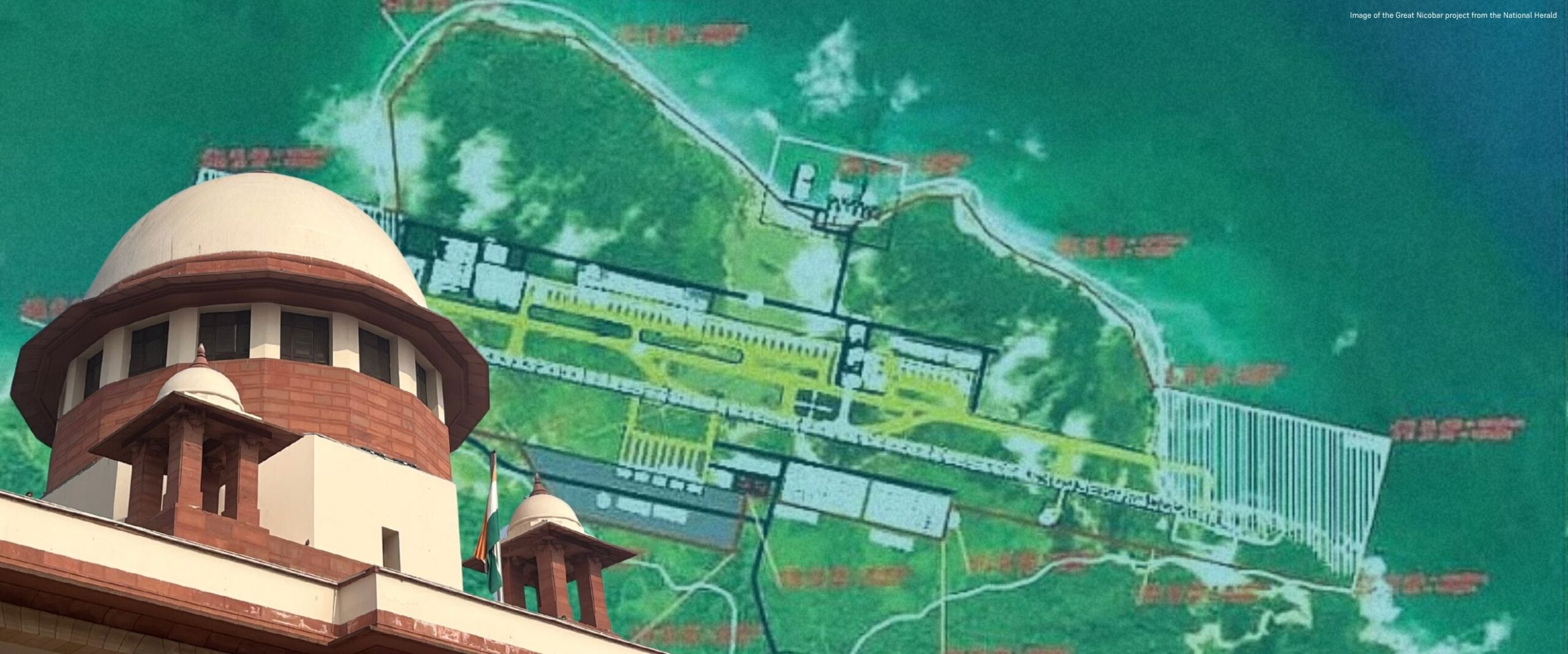
On 6 May 2026, the Calcutta High Court circuit bench at Port Blair upheld the maintainability of a petition opposing the multi-crore Great Nicobar Islands (GNI) project. The writ petition, filed by former IAS officer Meena Gupta, argued that the proposed project violated the Forest Rights Act, (FRA) 2006 as it infringed upon the rights of two indigenous tribal communities —the Shompen and the Nicobarese. The indigenous communities are dependent on the island’s tropical evergreen forests and coastal ecosystem for sustenance. The population of the indigenous tribes inhabiting the GNI is around 1200, with the vulnerable Shompen on the brink of extinction accounting for about 300 persons.
The Bench consisting of Chief Justice Sujoy Paul and Justice Partha Sarathi Sen rejected the Additional Solicitor General’s argument that the appellant did not have locus standi in the case as no forest-dwelling tribal persons authorised her petition. The judgement is significant on several counts, most importantly for emphasising the value of representation in cases involving vulnerable communities without the resources to fight legal battles.
What is the project about?
The GNI project, valued at a whopping Rs. 72,000 crores, is strategically planned next to the Malacca Strait, a crucial trade route. It is described as a critical move to promote India’s maritime trade and geopolitical military interests in the context of China’s expanding presence in the Indo-Pacific ocean region. The Union government aims to develop an International Container Transhipment Terminal, a Greenfield International Airport, a gas and thermal power complex and an urban township that would accommodate up to 6,50,000 people in the island. A government release notes that 130.75 sq. km of pristine forest area is proposed to be diverted for the project which is only about two per cent of the total forest area of Andaman & Nicobar Islands, but accounts for nearly one-fifth of the GNI. The project entails felling of around 7-8 lakh trees.
Representation matters
The Shompen tribes are classified as Particularly Vulnerable Tribal Groups (PVTGs) as per government norms. The term implies a specialised sub-category of Scheduled Tribes facing extreme marginalisation, isolation and demographic decline compared to other tribal groups. The court endorsed Gupta’s plea to examine the violation of the tribal people’s customary rights to the forest as a result of the proposed project.
Gupta previously worked as a secretary in the Ministry of Tribal Affairs and the Ministry of Environment and Forests where she contributed to the drafting of the FRA by including this term in the law, among other inputs. The court acknowledged that Gupta’s background showed her keen interest in the matter, having also lived in the Andaman and Nicobar Islands, and being deeply involved with the drafting of relevant laws and expertise on the subject. This validated her right to file the case on behalf of the tribal communities. The High Court relied on People’s Union For Democratic Rights (PUDR) v Union Of India (1982) in this regard where three social scientists had highlighted the poor working conditions of construction labourers engaged in projects for the Asian Games in Delhi. Taking cognisance of the violation of fundamental rights, the Supreme Court eventually ruled in favour of the aggrieved workers.
In the Nicobar case, the Calcutta High Court also relied on Rule 56 of the High Court PIL rules and noted: “if a person or class of persons by reason of poverty, helplessness or disability or socially or economically disadvantageous positions, is unable to approach the Court for relief…any member of the public can approach the Court”. It further observed that the State or public authority should welcome such interventions as it provides an opportunity to right a wrong or to redress an injustice which remains the prime concern of the State.
Several precedents exist where the Supreme Court has recognised locus standi of concerned citizens to fight cases on behalf of an aggrieved community. In Olga Tellis v. Bombay Municipal Corporation (1985), the Supreme Court made it clear that writ petitions filed by Tellis, a journalist, and two others were maintainable for enforcing the fundamental rights of pavement and slum dwellers under Articles 21, 37, 39A and 41 of the Constitution against their forcible eviction and the removal of their hutments under the Bombay Municipal Corporation Act, 1888. The Court had noted that in the absence of such representation the right to life and right to livelihood of the slum dwellers would be deprived after their eviction.
Environmental justice
The High Court seeks to address a crucial issue: how did various public authorities approve the project without the consent of the forest-dwelling tribals? The writ petition has challenged the validity of the special gram panchayat resolutions and approvals from the Sub Divisional Level Committee constituted in 2022 to approve diversion of forest land, due to inadequate representation of indigenous tribal peoples in these forums. The Andaman and Nicobar Administration’s preliminary notification for land acquisition to build the Greenfield International Airport, published on 6 November 2025, has raised several concerns from the local community, which includes settler populations as well. The proposed GNI project area comprises the “habitat” of the indigenous tribes as defined under Section 2(h) of the FRA as “the areas traditionally inhabited by primitive tribal groups and pre-agricultural communities”. Under Section 3(1)(e) of the FRA, PVTGs are specifically granted habitat rights, which secure their traditional territories, socio-cultural practices, livelihoods and protection of their natural and cultural heritage.
Further, to clarify the term “habitation,” the Indian government issued a directive dated 23 April 2015, under the Ministry of Tribal Affairs noting “the right to community tenure to habitat and habitation may be recognised over customary territories used by the PVTG for habitation, livelihood, social, economic, spiritual, sacred, religious and other purposes”. Former Union Environment Minister Jairam Ramesh recently raised questions over the validity of the Environmental Impact Assessments carried out to clear the GNI project in 2022. In February 2026, the GNI project received a go-ahead from the National Green Tribunal, which focussed more on the strategic importance of the project over scrutinising its ecological harm. Though the NGT recommended strict adherence to environmental safeguards relating to protection of flora and fauna, such as coral colonies and leatherback turtles and compensatory afforestation, activists are skeptical it will halt the ecological destruction and violation of indigenous rights to be wreaked by the project.
The Calcutta High Court judgement presents a valuable opportunity to revisit the larger question of the extent to which communities entirely dependent on forests for their living have been protected under the FRA 2006. The progressive environmental legislation adopted two decades ago marked a departure from the colonial-era bias against forest-dwelling communities and sought to recognise their individual and community rights to the forest including habitation rights.
In 2024, a fact-finding committee on implementation of FRA across India led by Justice (Retd.) S.N. Dhingra discovered a high number of rejections of Community Forest Rights (CFR) claims from legitimate groups, and even where Individual Forest Rights had been granted under the law, the land area allocated was too meagre to allow the community members to scrape a living. In such situations, the PIL route and the courts have become the last resort for the affected community to seek justice. An important precedent in this regard is the Supreme Court’s 2013 verdict, in Orissa Mining Corporation v Ministry of Environment and Forest, against bauxite mining in the Niyamgiri hills in Odisha where the right of the gram sabhas to protect the sacred hills of the Dongria Kondh tribal community (also classified as PVTGs) was upheld. In Samatha v. State of Andhra Pradesh (1997), a case concerning acquisition of tribal land for mining, the Supreme Court upheld the right of tribal communities to their land and forests. Acknowledging that land lies at the heart of tribal identity, the court went on to hold that if land were indiscriminately acquired by non- adivasis, it would ‘wipe out the very identity of the tribals’.
Environmental justice is a constitutional guarantee for denizens of this country deriving from Article 21 promising right to life, Article 48A (Directive Principle) mandating the State to protect and improve the environment and safeguard forests and wildlife, and Article 51A(g) obligating citizens to protect and improve the natural environment. The present High Court ruling sets a useful precedent to address questions regarding how a vulnerable tribal community on the verge of extinction can seek justice within the current framework of environmental justice in India.
The judgement belongs in the list of cases where the court traditionally championed the cause of environmental justice on behalf of vulnerable persons. In 1986, in MC Mehta v. Union of India, the lawyer and environmental activist successfully used the PIL as a tool to ensure justice for the victims of a deadly Delhi factory gas leak, two years after the infamous Bhopal Gas Tragedy had similarly claimed the lives of unknowing citizens. The 1986 judgment established the principle of absolute liability of the polluter becoming a landmark judgement in environmental activism in India. The latest Calcutta HC ruling offers a similar glimmer of hope for justice for the indigenous tribes of Nicobar.
Vidya Venkat is an award-winning social anthropologist with a PhD from SOAS University of London. She has previously worked as a journalist and a communications consultant for non-profits in India since 2004.
Related articles
Analysis
2026 Supreme Court mid-year review: Environmental and animal rights
The Supreme Court restructured decade-old litigations and delivered a range of firm environmental rulings in the first-half

Analysis
Supreme Court Review 2025: Lacking a principled stance on environmental rights
In trying to strike balance between environmental rights and the development imperative, the SC delivered a mixed bag of verdicts in 2025

Analysis
Supreme Court Review 2024: Speaking green, acting grey on key environmental issues
While the Court strongly pushed for conservation in crucial environmental cases, it prioritised development projects in others

Analysis
3,525 PILs, no stopwatch: Parliament’s data, M.C. Mehta, and the continuing mandamus question
If the government doesn't know how long PILs take, M.C. Mehta's 39-year wait is the answer it never bothered to record.