


Analysis
From questionnaire to committee: Himachal’s ecology case turns a year old
A year after warning Himachal Pradesh could vanish, the Court handed its ecology case to the Central Empowered Committee.
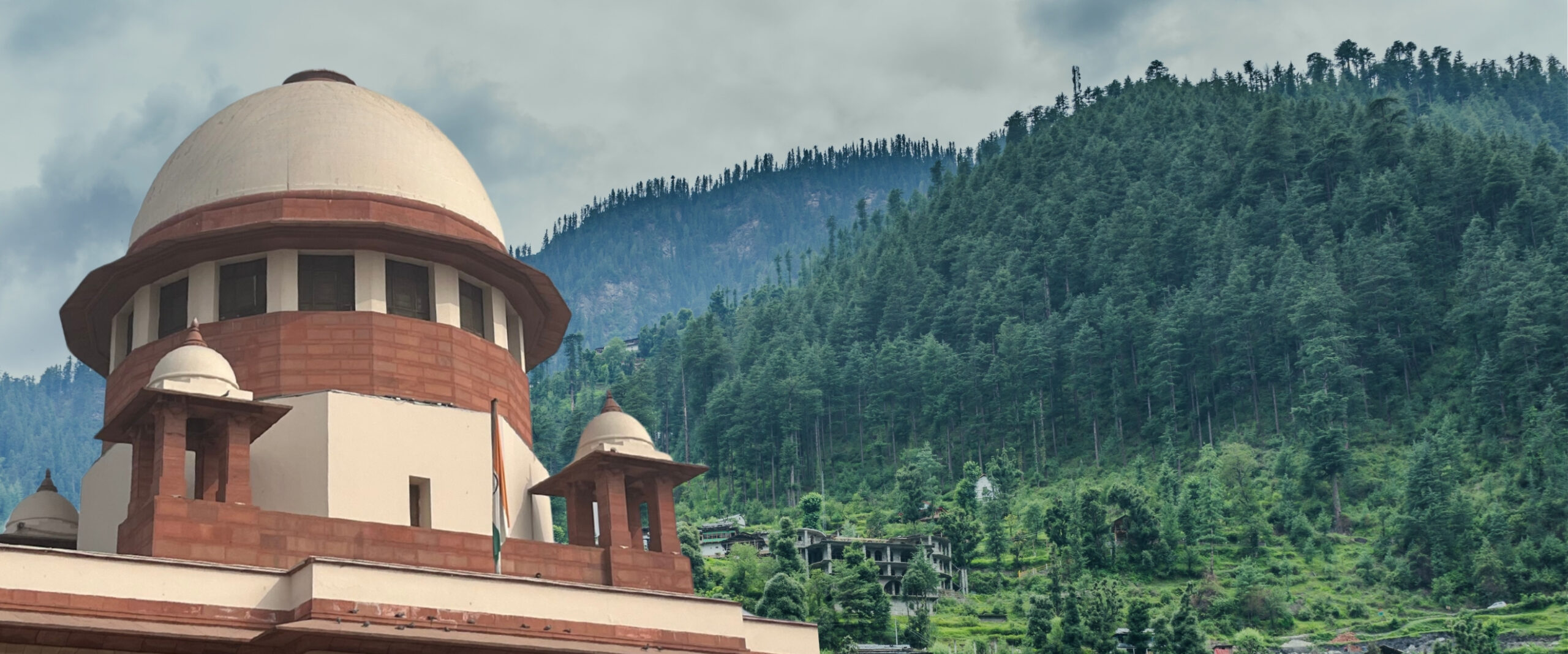
A year ago, the Supreme Court warned that Himachal Pradesh could “vanish in thin air from the map of the country” if unregulated development continued. In a subsequent hearing on 30 July, the Court concluded that the state’s own account of its ecology could not be trusted. A Bench of Justices Vikram Nath and Sandeep Mehta has now passed the inquiry to the Central Empowered Committee (CEC), a body created for an altogether different forest case two decades ago. The order also folds in a fresh challenge over construction in Shimla’s green belt, reviving a dispute the Court thought it had settled in 2024.
How a hotel dispute became a state-wide inquiry
The case did not begin as an inquiry into the state’s ecology. It began as a Special Leave Petition filed by a hotel developer, challenging a Himachal Pradesh High Court judgement which refused to entertain the company’s challenge to a notification declaring Sri Tara Mata Hill, near Shimla, a green area barred from construction. The High Court held that the company lacked locus, since it had never sought nor received permission to buy agricultural land in the state.
The Supreme Court agreed and dismissed the plea. The Bench, then comprising Justices J.B. Pardiwala and R. Mahadevan, used the occasion to address a broader crisis. Noting the hundreds killed in that year’s floods and landslides, the Court observed that hydro power projects, four-lane highways, deforestation and unplanned multi-storey construction had pushed the state to the brink of self-inflicted ecological collapse. Rather than dispose of the matter, the Bench instructed the Registry to register a fresh suo moto writ petition in public interest, to examine the state’s ecology as a whole.
A year of questions, and a year of silence
What followed was a familiar pattern in India’s suo moto environmental litigation: an early burst of judicial urgency followed by a long institutional pause. Within a month, the Court appointed Senior Advocate K. Parmeshwar as amicus curiae, and by September 2025 it recorded his exhaustive questionnaire. The questionnaire set out nine broad areas for the state to answer, each backed by an affidavit from its Principal Secretary for Forests:
- Zoning: Which areas of the state permit construction and which, like the green area at Sri Tara Mata Hill, do not.
- Forest and tree cover: The extent of green cover across the state and the pace at which it is being lost.
- Compensatory afforestation: Whether replacement plantations required when forest land is diverted for projects are actually being carried out.
- Climate change: Rising temperatures, retreating glaciers such as Lahaul Spiti’s Bara Shigri, and increasingly erratic rainfall.
- Disaster management:The state’s preparedness for the landslides, cloudbursts and floods that have repeatedly killed residents and destroyed property.
- Road infrastructure:Meaning the ecological cost of four-lane highway construction, including hill-cutting and the use of explosives.
- Hydroelectric projects:How to weigh the state;s role as a hydro power hub against reduced river flow and damage caused by dams and tunnels.
- Mining:The regulation of quarrying and illegal extraction across the hill state.
- Tourism:The unregulated growth of hotels, resorts and short-term rentals, and whether green-tax revenue is being properly used.
The state was directed to respond to each of these points before the case returned to the board.
Instead, the case vanished from the list for nearly a year. The Bench acknowledged this on 30 July, noting that the matter had been due for listing in October 2025 but simply never came up. When it finally returned, the amicus informed the Court that the state’s voluminous submissions rested on outdated data. Given the speed of Himachal’s environmental degradation, year-old data could no longer be relied upon to frame useful directions.
Shimla’s green belt returns to the Board
The 30 July hearing brought in two intervention applications filed by Yogendra Mohan Sengupta, a Shimla-based conservationist with a longer history of litigation before the Court. In 2014, Sengupta approached the National Green Tribunal (NGT), seeking to protect Shimla’s green belt. The NGT ruled in his favour in 2017, restricting construction across the Shimla Planning Area and directing the state to prepare a development plan consistent with that restriction.
The state challenged that verdict before the Supreme Court, and in State of Himachal Pradesh v Yogendra Mohan Sengupta (2024), the Court largely sided with the state. It approved a development plan covering 22,450 hectares of the Shimla Planning Area, holding that the NGT transgressed its limits and could not dictate how state legislative powers should be exercised. The judgement nonetheless preserved the green belt’s protected status and permitted only limited construction within it, a balance the Court described as adequate.
Sengupta’s new applications argue that this balance has not held. He alleges that construction, hill-cutting, topsoil removal and tree felling have continued unchecked in the green belt since 2024. He seeks a scientific assessment of the area using satellite mapping, a halt to fresh construction, and the removal of illegal structures. The Court has not ruled on these claims. It has instead sent them, along with the state’s ecology affidavit, to the CEC.
A committee built for forests takes on a state
The Central Empowered Committee was not built for a mandate this broad. It was constituted in 2002, in the T.N. Godavarman Thirumalpad case, to monitor compliance with the Court’s forest conservation orders and to flag encroachments and illegal felling. In the years since, its brief has widened considerably. It now oversees the Court’s monitoring of illegal sand mining in the National Chambal Sanctuary, and it examines the boundaries of the Aravalli hills in a separate matter. The Himachal Pradesh order extends that role further still, expanding its mandate from a single forest, river or hill range to the ecological governance of an entire state.
The amicus proposed, and the Bench accepted, that the CEC take up the nine issues three at a time, convening its own meetings with the state’s departments and submitting interim reports as it proceeds. The committee may call for any record, report, map or satellite image it considers necessary, and it may conduct field visits at the state’s expense. Both the CEC’s counsel and the state’s counsel agreed to this arrangement without demur.
What the shift signals — and what it does not resolve
The move to the CEC answers a real problem. A two-judge Bench, hearing a case alongside its ordinary docket, was never well placed to interrogate a state government’s data on hydro power output, forest cover or tourist inflows. A standing committee with technical staff and the power to convene its own meetings can do that work in a way a courtroom cannot.
But the shift does not by itself answer the question the Bench’s own remark on 30 July raised: why the case lay unlisted for close to a year while, by the Court’s own account, the state’s ecology continued to deteriorate. A committee tasked with examining nine issues three at a time, reporting in phases, is a more capable body than a Bench relying on affidavits. It is not necessarily a faster one. The first test will come on 24 August, when the Court takes up the CEC’s first interim report, the first of eight more to follow before the nine issues are exhausted.
For now, the burden of showing that the escalation was more than procedural rests with the committee, and with a Bench that has already shown it is prepared to call out administrative inertia when a year has passed and nothing has moved.
Related articles
Analysis
Supreme Court defends Himachal Pradesh’s ecology
A Division Bench expressed serious concern about the unregulated tourism industry in the hill state
Analysis
Vanashakti III restores rule and exception
A three-Judge Bench declares prior clearance mandatory, corrects the precedent record, and forgives every project already in the pipeline.
Analysis
Vanashakti Review: Demoting the law to a suggestion
In permitting retrospective environmental clearances, the Court subverts legal principles and turns the rule of precedents on its head
Analysis
T.N. Godavarman: 800 applications and a questionnaire test
The Supreme Court has set in motion an online sorting exercise before formally retiring its oldest forest petition