


Analysis
A “distinguished” anticipation
Discourse on the appointment of distinguished jurists brought back conversations on a balanced judiciary
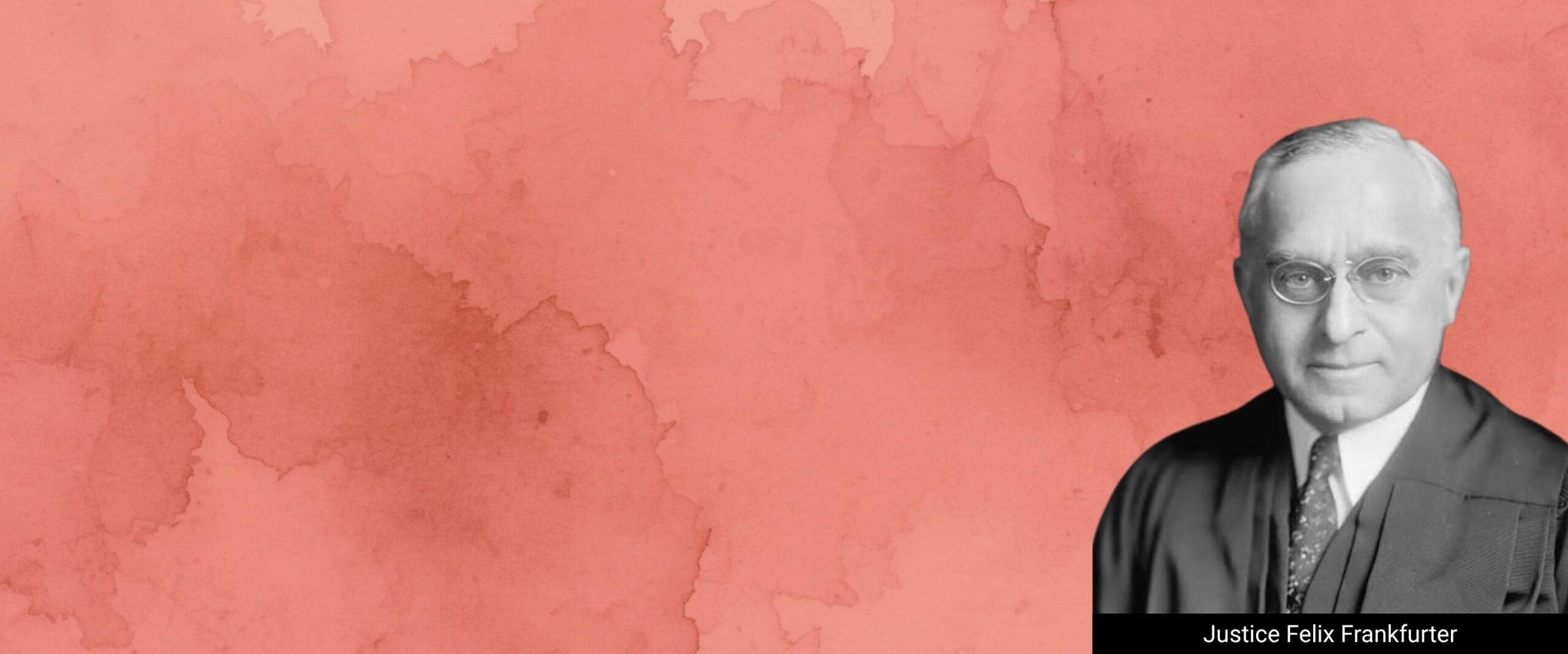
A decade ago, addressing the historical vacuum in the appointment of distinguished jurists to the Supreme Court, Professor Upendra Baxi noted “The prospect of having our own equivalent of Felix Frankfurter has been wilfully squandered”. A legal scholar-turned-judge, Justice Frankfurter spent more than two decades as an Associate Judge of the United States Supreme Court. He stands as a representative example for legal scholars who were appointed directly to the Bench for their academic insight and excellence.
On Sunday, Justice Ujjal Bhuyan questioned why no distinguished jurist has been appointed to the Supreme Court under Article 124(3)(c) so far. Such an appointment, he said, would “diversify the Bench with talented judges”. In 1949, H.V. Kamath had proposed in the Constituent Assembly (CA) that the provision would open the field for “those possessed with outstanding legal and juristic learning”.
Ananthasayanam Ayyangar agreed that “the choice of Supreme Court judges ought not to be limited to judges already in service and of ten years’ standing”, advising that non-lawyers who have fundamentally contributed to the field of law be appointed alongside career judges. He urged that the Court be opened to those who could guide its decision using their scholarly excellence. His observation that a “practising lawyer barely comes across constitutional problems” underscored the need for a scholarly presence on the bench.”
Interestingly, the Drafting Committee of the CA intentionally favoured “distinguished” over “eminent”—a conscious decision to choose persons with scholarly contribution. This was aimed at building a heightened standard of legal scholarship in the Court. Richard A. Posner, an American legal scholar, too, had observed that legal scholarship flourished when scholars shared the Bench with career judges.
Professor G. Mohan Gopal, speaking to SCO noted that Article 124(3)(c) has radical potential. “There has always been a crippling lack of social diversity on the Supreme Court bench due to its historical domination by an oligarchy of four small communities. This has had a debilitating effect on its jurisprudence. It is essential that the appointment of jurists to the court should increase representation of perspectives that have been historically denied voice in the court rather than reinforce oligarchic domination,” he remarked.
Jurisdictions such as Nepal, South Korea, Israel, Italy, Spain, Germany and Kenya also have provisions for the appointment of distinguished jurists or law professors to the Bench. Germany, Spain and Japan reserve a percentage of their seats. Law professors are often appointed to the Bench alongside judges from appellate courts in the United States.
The suggestion comes with practical challenges. Speaking to SCO, Prof. Baxi said, “I had asked two different Chief Justices as to why they did not consider the appointment of a distinguished jurist. And both of them said that there were difficulties.” Referring to the Court’s constitutional and appellate functions, he added: “The Indian Supreme Court is no doubt a Constitutional Court, but it has many other jurisdictions. There are no specialised Benches either. Every Judge has to decide admitted matters without any scope for specialisation.”
It is worth noting that the Supreme Court of Italy and Spain and the Federal Constitutional Court of Germany are explicitly divided into specialised functions, each having jurisdiction over a particular sphere including constitutional, civil, criminal, commercial, labour and administrative matters. A judicial selection committee appoints law professors to the Supreme Courts of Kenya, Nigeria and Israel.
India has resisted the idea of such a selection committee. Appointments continue through traditional pathways. Judges in the top court are appointed either from the High Court or picked from the Bar (only 11 so far). In effect, High Courts carry more weightage. The 42nd Amendment Act, passed during the Emergency, introduced a mechanism to appoint distinguished jurists to High Courts, but was subsequently repealed by the 44th Amendment Act in 1978. This ended the possibility of distinguished jurists moving to the Supreme Court with practical experience of the High Court.
There is much left to our imagination about the contribution that a distinguished jurist would make at the top court. The Court’s sitting strength has expanded twice in the last decade—mainly to tackle the pendency crisis. How does the appointment of a distinguished jurist fit into an institution facing a massive docket?
While the answer remains elusive, one wonders how our very own Felix Frankfurter would fare against the challenges of an evolving court.
Clarification: This newsletter was first sent to our subscribers on 5 September 2026 at 6pm. The website version of the newsletter has been updated to reflect a revised quote from Professor G. Mohan Gopal, at his request, to more accurately capture his intended meaning.
This article was first featured in SCO’s Weekly newsletter. Sign up now!
Related articles
Analysis
Raising a complaint
Justice Sandeep Mehta’s leaked letters present a unique opportunity for the Supreme Court to reassure public faith in itself
Analysis
Speaking out
The NALSAR row shows how judicial outreach increasingly invites dialogue, dissent and demands for transparency
Analysis
Law, history, and ideas of India
79 years into India’s independence from the British Raj, “Swadeshi jurisprudence” gains traction in courts and colleges
Analysis
Learning and unlearning
The Supreme Court’s latest report on gender asks a question that appeals rarely do: how do judges learn to write?