


Analysis
Recess report
The Partial Court Working Days revealed a balance between rest and rigour
“(I)t is time. The huge summer has gone by. Now overlap the sundials with your shadows, and on the meadows let the wind go free.”
– Rainer Maria Rilke
The end of summer coincides with the conclusion of the Supreme Court’s annual six-week Partial Court Working Days (PCWDs). The six-week period, until 2024, was simply known as an annual summer vacation. The vacation drew sharp criticism, as the six-week period sat uneasily against the mounting number of pending cases. The Court’s attempt to reconcile continuous functioning with the need for a brief period of rest led to the rebranding of “Vacation” to “Partial Court Working Days”. The Bar and the Bench have justified the break. It provides time for rejuvenation, to engage deeply with the law and author judgements.
Yet far from the tranquility one might associate with summer breaks, the PCWDs in 2026 revealed that the wheels of justice are indefinitely in motion. In June, 27 PCWD benches were constituted—six more than last year. Three to four Courts functioned throughout the month, hearing both miscellaneous matters (MMs) and regular hearing matters (RHMs). 32 judges were scheduled to take up matters on rotation across the six weeks. The five new judges appointed in June were part of these benches.
The Court identified 1453 MMs and 1384 RHMs for listing during this period. Notably, the Court took up more RHMs compared to last year—1630 MMs and 733 RHMs. On average, four to five Courts functioned on any given day. MMs were listed every Monday, Tuesday and Friday. Wednesdays and Thursdays were reserved for RHMs and urgent MMs. However, the Court did not restrict itself to hearing urgent matters alone—mentionings ranged from service laws, to contempt of court with criminal and family matters making up the majority. A total of 139 mentioning matters were listed in June.
Figures, once tallied, suggest that the Court refused to slow down on its output, despite fewer benches. The PCWDs delivered 4240 Orders in June 2026, a jump of more than 1600 Orders compared to June 2025. Notably, pronouncement of judgements did not stop during the PCWDs. The Court published 36 judgements in June 2026, compared to 24 over the 49 partial working days last year.
On 11 June, the Court, in Shishu Pal v Surjeet, allowed compensation under the heading “loss of domestic care” in the event of motor vehicle accident leading to the death of a homemaker. The next day, the Court dismissed Congress Leader Meenakshi Natarajan’s challenge against the rejection of her Rajya Sabha nomination. The Court also declared the right to walk as a facet of Article 21 in Maniyar Iliyaz v P. Ayyappan. In Kulsum Nisha v State of U.P., the Court declared that marital status cannot be grounds for a married daughter to be excluded from being eligible for welfare benefits. Further, the Court issued notice in Abbuhurera alias Munna v State of Gujarat, recording the question as whether a court can “restrain or prohibit an accused from filing a fresh bail application for a certain period”—a question that has occupied the Court in the past months.
Among the several matters that drew public attention, a few stood out for their significance. The Bench of Chief Justice Surya Kant and Justice V. Mohana, in the Union’s transfer petition, stayed proceedings in challenges against the Transgender Persons (Protection of Rights) Amendment Act, 2026 pending before High Courts. The same Bench also examined whether state welfare reaches persons living in poverty and weighed on the protection of natural ecosystems.
Still, concerns of soaring pendency persist. By the end of June, institutions in June exceeded disposals by 2635 counts—marking its reversal from April and May, where disposals steadily outran institutions. For now, the Court steers towards a period of slow return to the mighty needs of the Courtroom in a manner that suggests rest and rigour need not stand opposed.
This article was first featured in SCO’s Weekly newsletter. Sign up now!
Related articles
Analysis
Are Partial Court Working Days Benches different from Vacation Benches?
The new nomenclature for Vacation Benches has not changed the Supreme Court’s perception about its functioning during summer
Analysis
What’s in a name?
The Court’s rebranding of Vacation Benches is a response to public criticism. But the terms of the discourse need a fundamental shift
Court Data
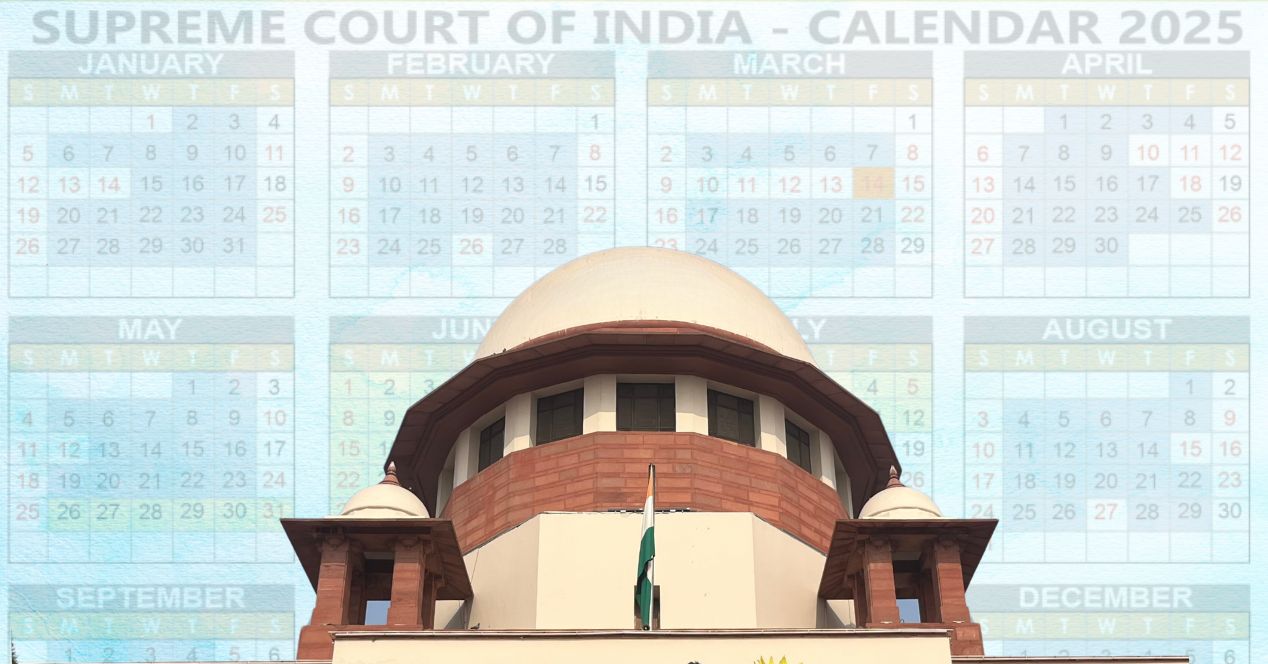
Supreme Court will work 190 days in 2025
The top court is often criticised for its long breaks. We look at the number of working days to see if the breaks are really too long
Analysis
Long SC Vacations: Wasteful or Crucial for Quality of Justice?
With 68,000+ cases pending at the SC, many criticise it for its 6-7 week summer vacation. This break, however, might be crucial for its work