


Analysis
2026 Supreme Court mid-year review: Arbitration
The first half saw the Court addressing key provisions under the Arbitration Act coupled with a reminder of limited judicial interference
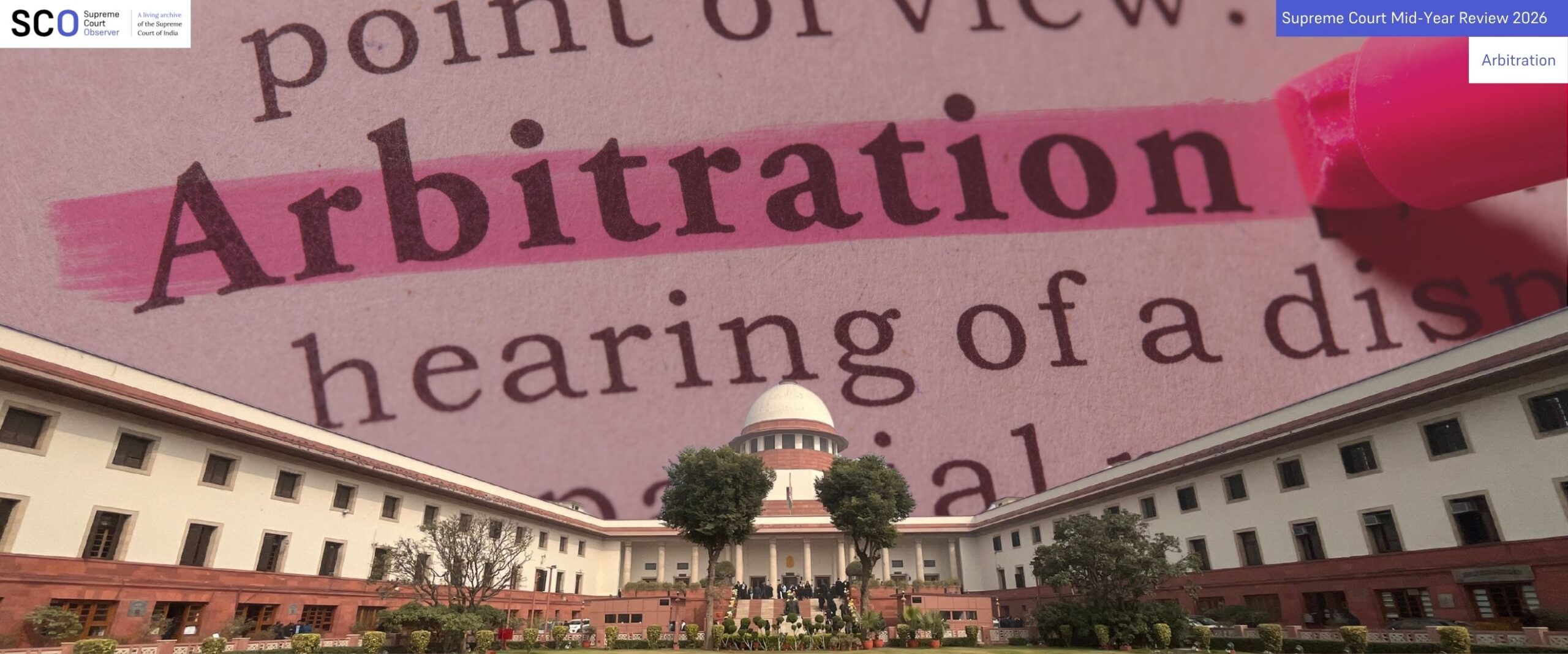
The first half of 2026 saw heavy activity from the Supreme Court in determining the scope of judicial intervention and the interpretation of key provisions in the Arbitration and Conciliation Act, 1996. From phrasing of clauses in an arbitration agreement to the role of High Courts as an appellate authority, the Court delivered nine notable decisions on arbitration. Our list compiles the key holdings.
Phrasing matters
In Nagreeka Indcon v Cargocare Logistics (2026), a bench of Justices Sanjay Karol and N.K. Singh held that the phrase “can be settled by arbitration” in a contract only indicates the possibility, not compulsion, of arbitration as a mode for dispute resolution. An application for appointment of an arbitrator under Section 11 of the Act was dismissed by the Bombay High Court on the grounds that the clause did not make it imperative for the dispute to be settled by arbitration.
On jurisdiction
A bench of Justices P.S. Narasimha and R. Mahadevan in Jagdeep Chowgule v Seema Chowgule (2026) held that any application of extension for passing an arbitral award under Section 29A of the Act must be filed before the “Court” as defined under Section 2(1)(e). A Commercial Court’s order extending the mandate for an arbitral tribunal was set aside by the Bombay High Court on the ground that it had the jurisdiction to entertain extension applications since the arbitrator was appointed by them. The Supreme Court restored the Commercial Court’s Order, stating that the High Court’s role was functus officio i.e. it has fully discharged its role.
Limitation period and scope of Section 33
On 26 May, in Gujarat Water Supply and Sewerage Board v Saryu Plastics Pvt. Ltd. Justices Narasimha and Alok Aradhe upheld the validity of arbitral proceedings, observing that the appellant could not challenge the arbitrator’s mandate after having participated in the proceedings without objection. The Bench clarified that the scope of Section 33 is confined to correcting clerical, typographical, and computational errors and does not extend to modifying substantive determinations, such as the method of calculating interest, in an arbitral award.
In National Highway Authority of India v T. Younis, the Court held that the period of limitation for challenging an arbitral award under Section 34(3) only begins after an application under Section 33 is disposed of. It noted that filing an application under Section 34 while an application is pending under Section 33 will defeat the purpose of the Act, resulting in “multiplicity of proceedings and procedural uncertainty”. If a Section 33 petition is filed and found to be “sham, frivolous, or malafide”, the Court may impose exemplary and punitive costs.
Appellate role of High Courts
In Ankhim Holdings v Zaveri Construction, the Supreme Court held that an application for seeking a substitute arbitrator does not allow a High Court to set aside previous arbitral awards. The parties had approached the Bombay High Court seeking a substitute arbitrator in a dispute involving a slum rehabilitation project in Mumbai. While the High Court agreed to substitute the arbitrator, it declared all arbitral tribunal proceedings as null given that one of the parties was under an active insolvency moratorium. The Supreme Court ruled that the High Court had exceeded its jurisdiction by acting as an appellate or review court. It noted that rulings made prior to an arbitrator’s replacement do not automatically invalidate the proceedings.
A Bench of Justices J.K. Maheshwari and A.S. Chandurkar in M/S Tarini Prasad Mohanty v M/S Sunflag Iron and Steel Ltd held that writ jurisdiction under Articles 226 and 227 of the Constitution cannot be invoked to set aside an arbitrator’s order. Upholding a High Court decision, the Bench stressed the principle of minimum judicial intervention and left open the remedy under Section 34.
The same Bench in Madhya Pradesh Road Development Corporation ltd v. M/S Jabalpur Corridor Pvt Ltd upheld the High Court’s refusal to interfere with an arbitral award, reaffirming the limited scope of judicial intervention under Sections 34 and 37. Additionally, it found that courts may not re-open issues that have attained finality between the parties, or substitute the tribunal’s interpretation with their own merely because two interpretations are available.
Seat for arbitral proceedings
In J&K Economic Reconstruction Agency v. Rash Builders India Pvt. Ltd., a bench of Justices Narasimha and Aradhe on 15 April, distinguished between the ‘seat’ and ‘venue’ of arbitral proceedings. They held that the former determines jurisdiction, while the latter is where proceedings are conducted for convenience. The Bench observed that parties’ choice of seat remains binding unless altered by agreement, and that the signing of an award at a venue different from the seat does not affect jurisdiction.
On interim relief
On 24 April, Justices Manoj Misra and Manmohan in Home Care Retail Marts Pvt. Ltd. v. Haresh N. Sanghavi held that either party to an arbitration may seek interim measures under Section 9 at any stage of arbitral proceedings, including the post-award stage. The Court observed that the expression “a party” in Section 9 draws no distinction between successful and unsuccessful parties, and that non-award holders may therefore also seek interim protection.
(Research for this article was provided by Kruthika Senthil Kumar and Charu Sabharwal, interns at the Supreme Court Observer.)
Related articles
Analysis
2026 Supreme Court mid-year review: Insolvency and Bankruptcy
Navigating structural gaps in the evolving code, the top court drew a sharp line between resolution and asset recovery
Analysis
2026 Supreme Court mid-year review: Freedom of speech and expression
Shifting uncomfortably from one voice to another, the Court’s decisions reflect increasing unease with free speech adjudication
Analysis
2026 Supreme Court mid-year review: Environmental and animal rights
The Supreme Court restructured decade-old litigations and delivered a range of firm environmental rulings in the first-half
Analysis
2026 Supreme Court mid-year review: Bail
Recognising unresolved questions in bail jurisprudence, the top court signalled its intent to arrive at uniformity