


Analysis
Justice Pankaj Mithal’s Notable Judgements
From Waqf to Sub-classification of Scheduled Caste Persons, Justice Mithal has been a part of it all
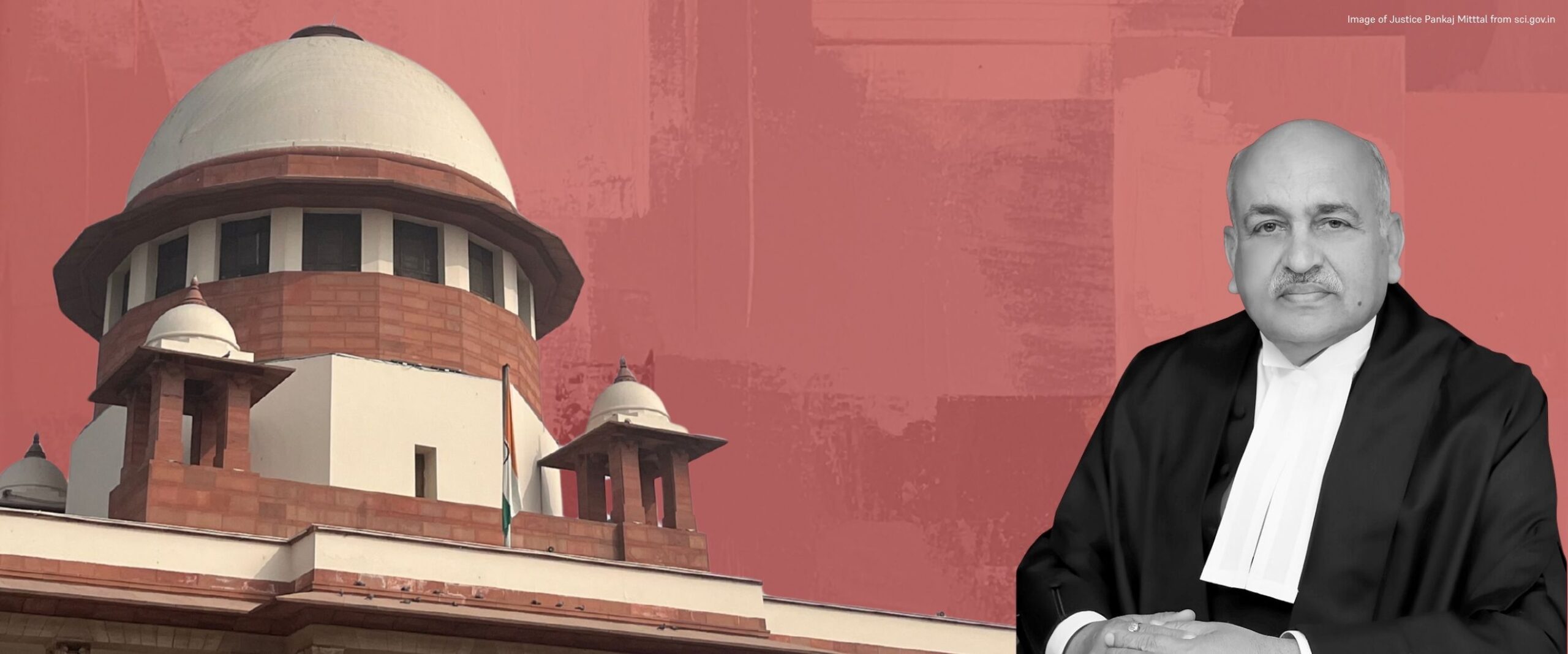
Today, Justice Pankaj Mithal retires after serving a tenure of 3 years and 4 months at the top court. Justice Mithal’s judgements often depicted his poetic candour and flare for words. In this period, he authored 127 judgements on a range of subjects including criminal, civil, property and service matters.*
Justice Mithal was recommended to the Supreme Court in December 2022 and elevated in February 2023 alongside Justices Sanjay Karol, P.V. Sanjay Kumar, Ahsanuddin Amanullah and Manoj Misra.
On the occasion of his retirement, we list some of the notable judgements he authored.
Sub-classification among Scheduled Caste Persons
In 2024, a seven-judge Constitution Bench in State of Punjab v Davinder Singh upheld the power of states to sub-classify Scheduled Caste persons for the purpose of reservations.
Justice Mithal authored a concurring opinion, expressing the need to extend the benefit of reservation to the most backward classes. He espoused the policy of identifying the “creamy layer” from the Scheduled Caste and Scheduled Tribe communities while clarifying that the existing system of reservation must prevail till a new approach is evolved.
No Automatic Vacation of Stay Orders
In 2024, Justice Mithal authored a concurring opinion as a part of the seven-judge Constitution Bench in High Court Bar Association, Allahabad v State of UP where he wrote that a stay granted would not automatically be vacated on the expiry of a particular period, unless an application to that effect is filed.
Justice Mithal endorsed a practical and pragmatic approach over a technical one in the matter.
Notification of Waqf properties
In Salem Muslim Burial Ground Protection Committee v State of Tamil Nadu (2023), a Division Bench of Justices V. Ramasubramanian and Mithal held that a valid notification of a Wakf property under Section 5 of the Wakf Act 1954 cannot be issued without a preliminary survey of the property under Section 4 of the Act.
The Bench noted that in the absence of a valid creation of a Wakf, a property may cease to be recognized as such.
Payment of honorarium to contractual teachers
In U.P. Junior High School Council Instructor Welfare Association v State Of U.P. (2026), a Division Bench of Justices Mithal and P.B. Varale directed an increase in the honorarium offered to high school teachers employed on contract. They noted that a fixed honorarium below the minimum wage amounts to forced labour, prohibited under Article 23.
Further, the Bench held that teachers who continued to work beyond their contractual period, performing duties equivalent to regular teachers, must be deemed permanent employees.
Widowed daughter-in-law as dependent
In Kanchana Rai v Geeta Sharma (2026), a Division Bench of Justices Mithal and S.V. Bhatti held that the widowed daughter-in-law is a “dependent” under Section 21 of the Hindu Adoptions & Maintenance Act, 1956. She is thus entitled to maintenance from her father-in-law’s estate. The Bench further noted that a restrictive interpretation of Section 21 would fail the test of constitutional validity under Article 14 which guarantees a right to equality.
Modification of decrees by Executing Courts
In Maurice W. Innis v Lily Kazrooni (2026), a Division Bench of Justices Mithal and Varale held that an Executing Court must execute the decree as it stands and cannot go beyond its jurisdiction to modify terms. Justice Mithal wrote that the decree must be executed “in its term and tenor” unless the decree is a nullity.
(*Data collected on 15 June from Manupatra)
Related articles
Analysis
Justice Rajesh Bindal’s Notable Judgements
Highly regarded by the Bar for his calm disposition, Justice Bindal did it all. We list his notable judgements
Analysis
10 notable judgements by CJI Gavai
Two recalls, a Presidential reference, and a stay order in a highly contentious issue of our times—a list of the outgoing CJI’s key verdicts

Analysis
Justice Sudhanshu Dhulia’s notable judgements
Highlights include a dissent in a long-pending case, a stirring verdict on language recognition and a reiteration of evidence law principles
Analysis
Justice Bela Trivedi’s Notable Judgements
Known to be ‘tough’, especially in personal liberty matters, Justice Trivedi delivered key opinions on affirmative action and POCSO issues