

Analysis
From Boston to Bhopal? The SC’s new publication on gender stereotypes
While the 2026 Report promises more practical training for judges, it may turn out less useful to tackle all kinds of gender stereotypes
An Allahabad High Court judgement in March 2025 held that an accused who “grabbed the breasts” and “tried to bring down lower garment” of a minor girl, should not be charged with attempt to rape. The High Court said it only constituted “preparation” to commit rape. Trenchant criticism followed. The Supreme Court reacted and stayed the order after taking suo moto cognisance.
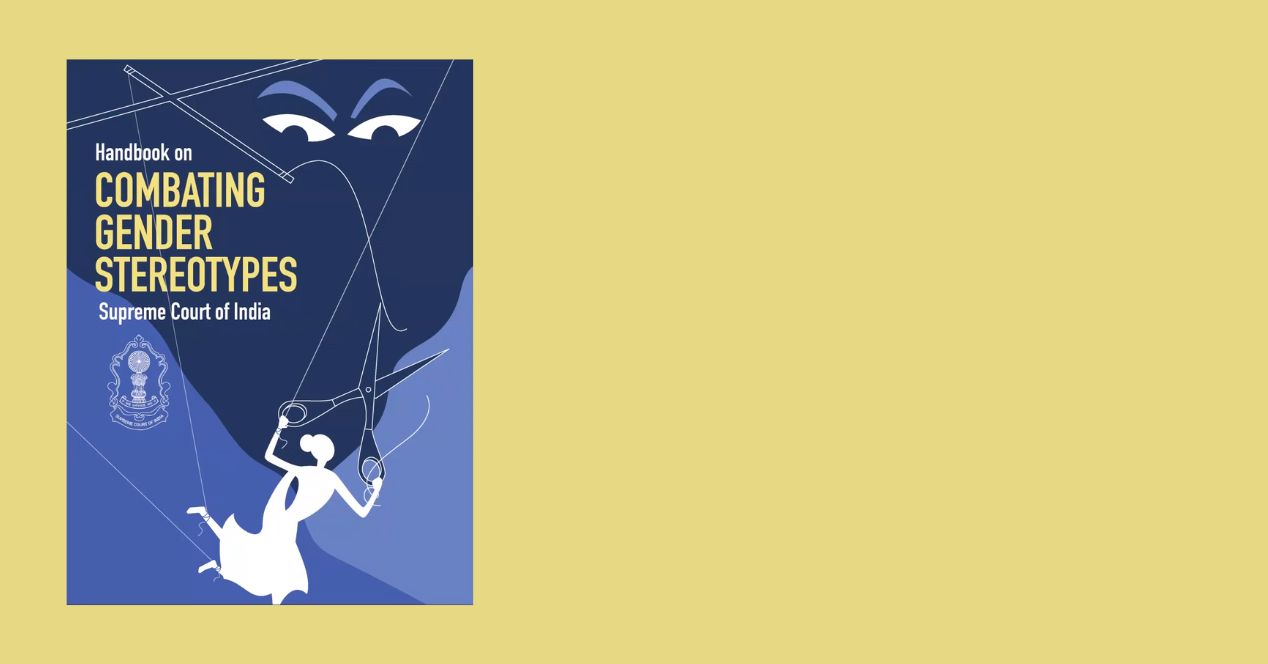
At the time, Justice B.R. Gavai observed the “total insensitivity by the judge”. Such judgments continue to arise despite repeated messages from the Supreme Court for gender-sensitive judging. The Supreme Court had even published a 2023 Handbook on Combating Stereotypes (‘2023 Handbook’) to “actively challenge and dispel harmful stereotypes” on the basis of gender.
As a result, in February 2026, CJI Surya Kant reiterated the broader problem of gender ‘insensitivity’ and issued an order to create draft guidelines for judges in sexual offences and other sensitive cases. But it was his oral remarks that grabbed attention.
CJI Surya Kant dismissed the 2023 Handbook as “too Harvard-oriented” and said that it “may not be understood by the rape survivor, her relatives or commoners”. He said that judges should receive practical training from the National Judicial Academy, Bhopal, rather than “sermonise High Court judges” from the Supreme Court. The Chief directed a Committee led by the Academy’s Director Justice Aniruddha Bose to draft a new report with guidelines.
We cannot know whether the remark about Harvard, in Boston, referred to the alma mater of former CJI D.Y. Chandrachud, who led the effort behind the 2023 Handbook, or a Harvard bias quiz linked in it.
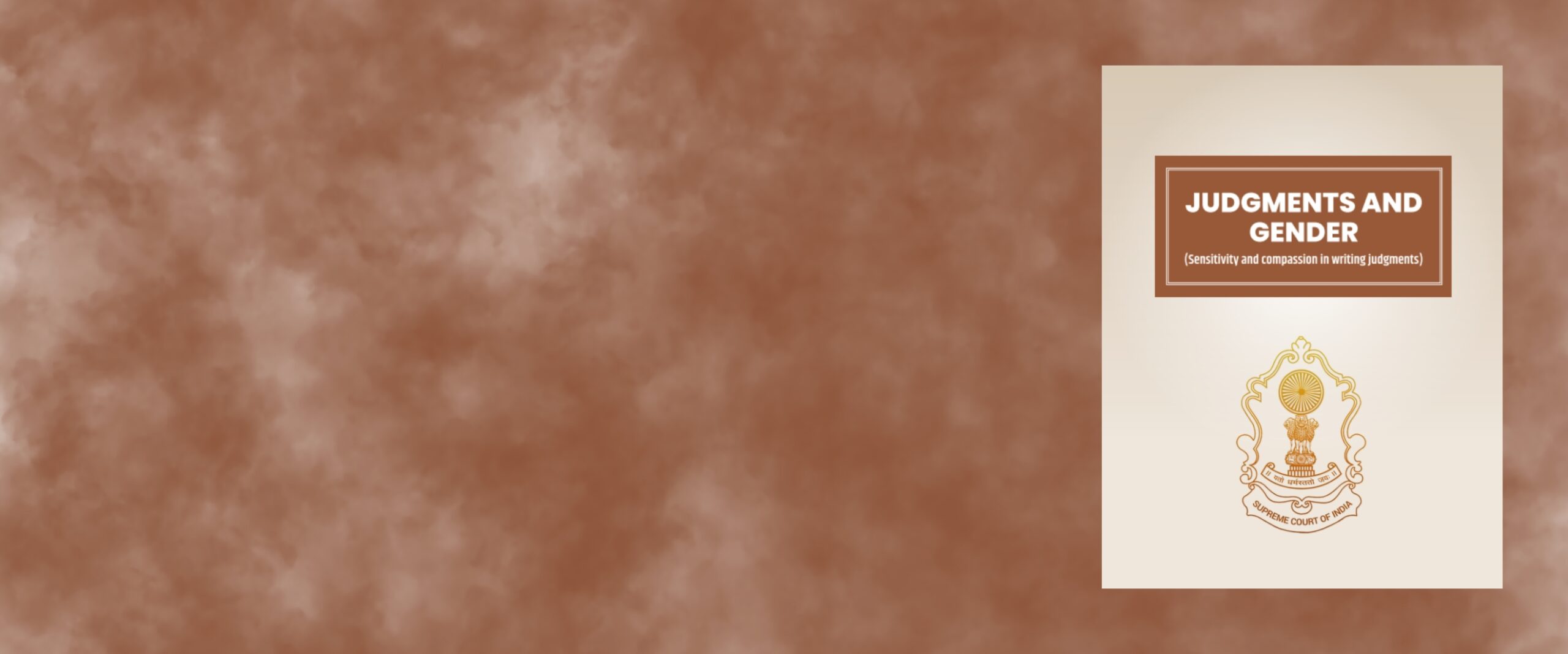
What we can look at, is the results of the order issued by CJI Surya Kant, and what is different about his approach. On 3 August 2026, the Report titled ‘Judgments and Gender (Sensitivity and compassion in writing judgments)’ (‘the Report’) was released. Will it help judges tackle gender stereotypes more effectively?
Implementing the publication: Can judges use them?
When the 2023 Handbook launched, this author wrote for the Supreme Court Observer: “If standards are being set by the administrative side of the Supreme Court, what is their judicial value?” Report or handbook; courts need to use them. To that extent, CJI Surya Kant’s intent to integrate the new Report within judicial academies might ensure that judges study it in training.
However, the 2023 Handbook, shared via a circular to every court in the country, was already making an impact. A keyword search on Manupatra, reveals that the Handbook was cited in at least 10 cases and commentaries. In three judgements it was used to dismiss arguments about the lack of injury to the complainant in sexual violence cases.
In judgements regarding compensation under the Motor Vehicles Act 1988, where the deceased was a homemaker–and not a ‘housewife’–the Handbook was used to increase the value placed on her care work. The Bombay High Court approved a Family Court’s order that used it to impose costs on lawyers for using ‘derogatory’ language in custody proceedings.
If judicial uptake of the 2023 Handbook was the main issue, why not include it in the existing academy syllabi instead of developing a new one? Structurally, the 2023 Handbook was readily usable by judges, containing tables contrasting a stereotype with the preferred approach, and a few case studies, providing some clarity.
The 2026 Report might be harder for judges to read and deploy. While it too contains a shorter table of problematic words with their alternatives, it then goes on to also provide nine overlapping ‘points for consideration’ and nine ‘terms to be avoided’ in a list form. The word “guidelines” used in CJI Surya Kant’s order commissioning the Report does not appear anywhere. The question remains open with the new Report: how should judges be using this?
Where the law hasn’t caught up
One issue this author had highlighted with the previous 2023 Handbook was it went beyond the words Indian law used. Justice G.R. Swaminathan of the Madras High Court shared this difficulty in a judgement:
“The word “concubine” is now a forbidden expression. Judges are encouraged to adopt the alternative language ie, “Woman with whom a man has had romantic or sexual relationship outside of marriage”. With respect, we may observe that this is a description and not a definitional term. In Section 18(2)(e) of the Hindu Adoptions and Maintenance Act, 1956, this expression is found. […] in several other decisions of the Supreme Court, this expression has been employed. Since an appropriate alternative expression has not been given in the Handbook, we have to reluctantly use that word. […] We need definitions for descriptions. May be the next edition of the Handbook would be more helpful.”
The 2026 Report instead suggests words like ‘partner’ or ‘girlfriend’ to replace ‘concubine’. Similarly, while ‘prostitute’ appears in the Immoral Traffic (Prevention) Act, 1956, it permits the term ‘when statutorily needed’ despite preferring ‘sex worker.’ This imperfect solution at least means the new Report does not put judges in the awkward position of choosing between a Supreme Court report and a Supreme Court judgement.
One improvement, two exclusions: Method, scope and intersectionality
Another key motivation behind the new Report was to have it be more accessible. CJI Surya Kant’s order even requested the Committee to investigate words in different languages. This does not make it into the Report, which is only in English. However, the Report does employ an empirical approach, looking at 125 trial court judgements, and circulating a questionnaire to judicial officers, witnesses and victims.
This methodology collected some rich data that comes through in parts of the Report. It details the kinds of issues and harassment women face in the justice system, and identifies new problematic phrases directly from these trial court judgements.
Despite this stronger data, the Report makes two critical omissions. First, it only considers sexual violence cases, ignoring the role of stereotypes in other contexts like families and workplaces addressed in the 2023 Handbook. If this Report seeks to overturn the Handbook, then these other areas of law might suffer. The Report would not have helped in the judgements which used the 2023 Handbook to provide a greater value to a woman homemaker’s care work.
Second, the Report overlooks intersectionality. The 2023 Handbook had tackled misconceptions that transgender individuals or women with disability cannot be victims of sexual violence. The Report does not engage with these aspects. When it mentions transgender persons, the Report surprisingly describes terms like hijra, thirunangai, thirunambi and jogappa as “implicitly pejorative” and suggests using the term “intersex”.
Intersex persons are those who have variations in their bodily sex characteristics, while transgender persons are those who express a gender identity different from the one they were assigned at birth. In fact, terms like thirunangai developed as terms of self-respect for transgender persons. Conflating these as “intersex” is a harmful stereotype the Report itself perpetuates.
Where next?
Both publications share the goal of reducing misogynistic and patriarchal judgements. Integrating the Report into judicial academies is a step forward, but the effort to translate the substance from ‘Boston to Bhopal’ falls short. It does little to include other languages, excludes stereotypes that are intersectional and pigeonholes gender as an issue in sexual violence cases alone. If every judge in the country will be reading it, maybe a third version is due.
Related articles
Analysis
Supreme Court handbook on gender stereotypes: Progressive, but will the law catch up?
A new publication from the apex court acknowledges that ‘stereotypical language’ reinforces ideas contrary to constitutional ethos

Analysis
‘Total insensitivity’: Supreme Court stays Allahabad HC judgement on attempt to rape
A Single Judge of the Allahabad HC had observed that ‘grabbing of breasts and loosening of pyjama string’ did not amount to attempt to rape
Court Data
14 percent of sitting judges in High Courts are women
Representation of women in High Courts has remained unchanged for past two years
Analysis
Perception and direction: The public engagements of Chief Justice Chandrachud
His frequent public appearances and charismatic personality invited unprecedented attention to an opaque institution