


Court Data
No Supreme Court judges elevated during CJI Surya Kant’s 122-day tenure so far
The Court is currently functioning at 33 judges, one short of its sanctioned strength of 34 judges
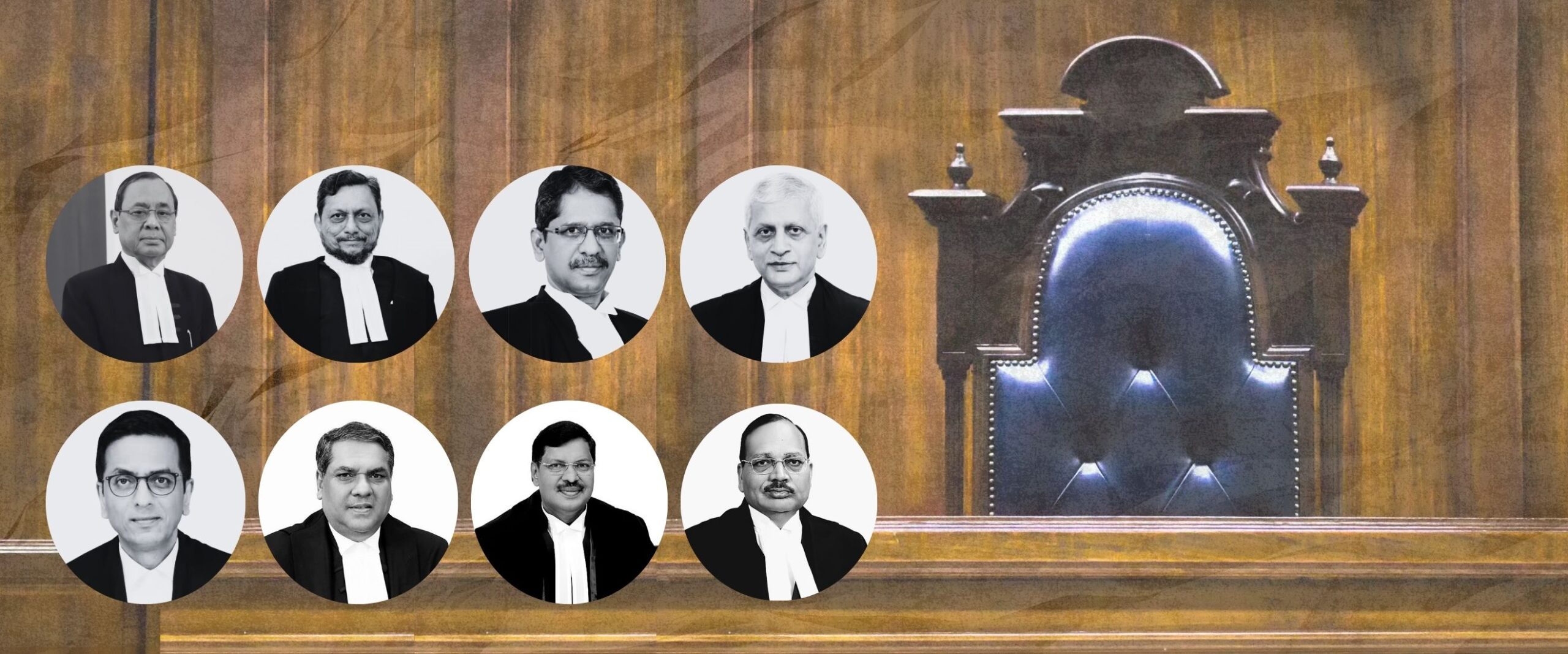
As of 24 March 2026, a single vacancy persists at the Supreme Court. Chief Justice Surya Kant, who currently leads the five-judge Collegium, took oath as the 53rd Chief Justice on 24 November 2025. He has completed 122 days in office so far.
Notably, this inactivity does not extend to the CJI Surya Kant-led Collegium for High Court appointments—a body of three seniormost judges—which has recommended judges to High Courts. It has also released a standard operating procedure for appointing Chief Justices at High Courts.
Is it unusual for the Collegium to remain inactive for so long after a new CJI takes charge? We look at the number of days taken by the Collegium to publish a recommendation for Supreme Court appointments each time a new CJI assumes office.
Since Collegium resolutions were only made available since the middle of CJI Dipak Misra’s tenure, we referred only to recommendations made by the Collegium led by succeeding CJIs: Ranjan Gogoi, S.A. Bobde, N.V. Ramana, U.U. Lalit, D.Y. Chandrachud, Sanjiv Khanna and B.R. Gavai.
Until CJI Surya Kant, the CJI Ramana-led Collegium took the longest—115 days—to recommend judges after assuming office. It recommended nine judges to the Supreme Court at the time. The CJI Gavai-led Collegium holds the record among the seven for the shortest time taken—merely 12 days. The CJI Khanna-led Collegium follows close behind at 17 days.
The 1.5 year long tenure of CJI Bobde saw no recommendations and appointments to the Supreme Court due to a reported deadlock within the Collegium over the elevation of Justice Akil Kureshi. The deadlock was never resolved.
Collegiums led by CJI Gogoi, Lalit and Chandrachud took approximately a month each to recommend judges after they assumed office.
The single vacancy question
It is possible that the Collegium is waiting for one more vacancy to arise in order to make more than one recommendation at once. This has happened before. For instance, the recommendations for Justices N. Kotiswar Singh and R. Mahadevan in July 2024 came after Justices Aniruddha Bose and A.S. Bopanna retired in April and May 2024. The Collegium did not recommend anyone after Justice Bose’s retirement and recommended two judges at once in July to restore the sanction strength back to 34.
Another possibility is that the Collegium is waiting for retirements in the High Court pool. This will enable recommendation of favoured candidates without deviating from the seniority principle and superseding senior judges.
Lack of explanation
However, there is very little information available on the Collegium’s logic, workings and its decisions. There is no explanation as to why vacancies are left unfilled and no mechanism to question the delay in restoring the Court to its sanctioned strength. For instance, the CJI Khanna-led Collegium filled only one of the two vacancies that were pending when he assumed office. The other persisted throughout his tenure.
The time taken by each CJI-led Collegium informs the belief that the workings of the Collegium are entirely on the prerogative of the Court. There is no standard procedure under which it operates or specified timeframe within which vacancies must be filled. The Court’s sitting strength was expanded in 2019 as a response to the Court’s mounting docket. As pendency continues to increase, a proactive approach in filling vacancies is a part of the cure.
Related articles
Court Data
24 percent of names proposed by Khanna Collegium for HC elevation not cleared by Union
Only six out of 51 recommendations for High Court elevation were women; no woman was proposed for Supreme Court elevation
Court Data
15 percent of names proposed by Chandrachud Collegium for HC elevation weren’t cleared by Union
The Collegium itself fared poorly on gender diversity, with no recommendations for women in the top court and only 27 out of 168 in HCs
Court Data
The Union Government cleared 96 percent names recommended by CJI Gavai-led Collegium
The rate of acceptance surpasses former CJI Chandrachud who had 4 times the tenure length and CJI Khanna who served for about 6 months
Court Data
Average tenure of CJIs past, present and future: What does the data tell us?
If the seniority principle is followed, the average tenure of the next seven Chiefs will drop to 1.4 years