

Analysis
Monthly Review: February 2026
Rather than a single, headline-making decision, February was marked with steady engagement across long-pending matters
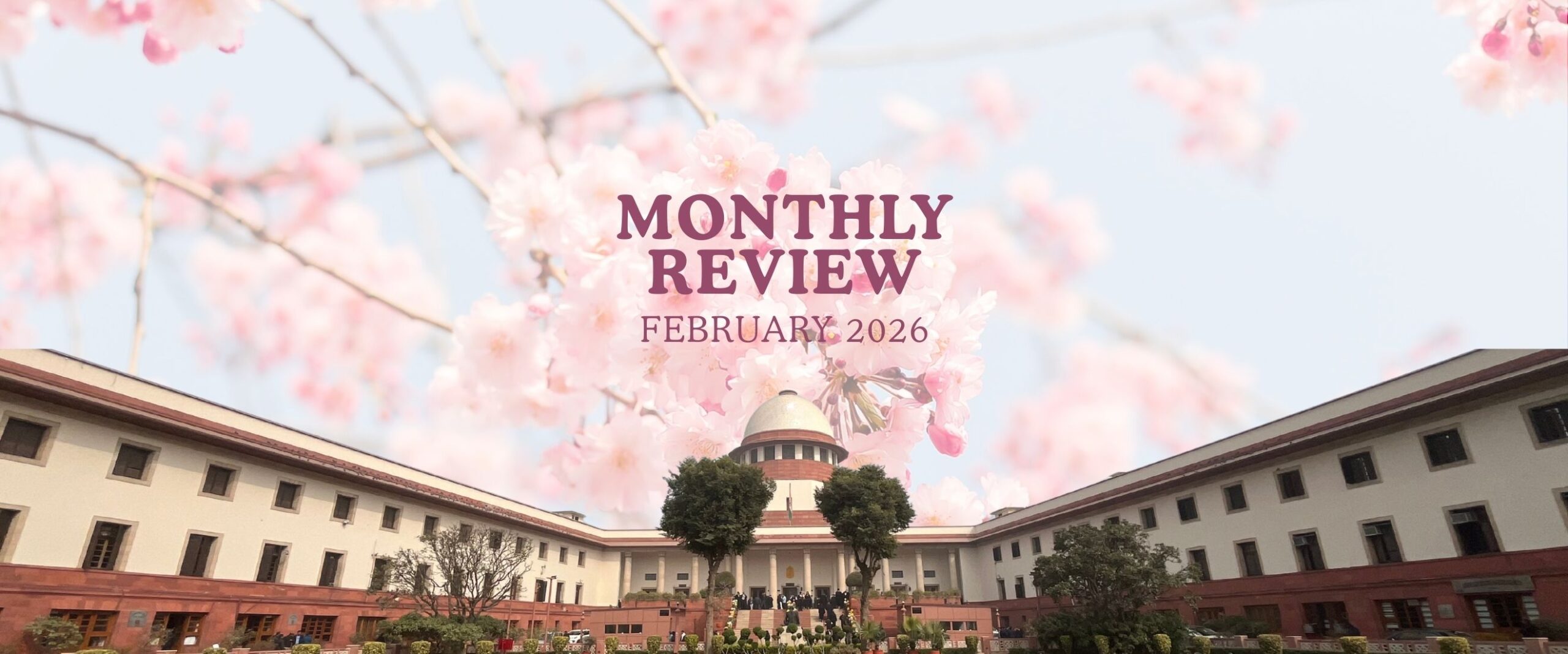
Last month, the Supreme Court continued to supervise the revision of electoral rolls in West Bengal, examined questions of digital consent and platform practices, and listed final hearing dates in the challenge to the Citizenship (Amendment) Act, 2019 (CAA). Through a series of interim directions, listings and revival of long-pending Constitution Bench references, it set the stage for significant hearings in the months ahead.
Long-pending challenges move forward
On 16 February, the Supreme Court revived two nine-judge bench cases;
- The definition of “Industry” under Section 2(j) of the Industrial Disputes Act, 1947 → Arguments will commence from 17 March and are scheduled to conclude over two days.
- The Sabarimala review → Parties supporting the review will argue between 7 and 9 April, followed by opposing parties between 14 and 16 April. Rejoinders and submissions by the amicus curiae will be heard thereafter. The composition of the nine-judge Bench is yet to be notified.
On 19 February, the Court heard a batch of petitions challenging the constitutionality of the CAA after nearly two years. It directed for pan-India concerns to be taken up first, followed by matters concerning Assam and Tripura. Petitioners will be heard on 5 and 6 May, and respondents on 7 May.
Digital content and free speech
In the first week of February, a Bench of Chief Justice Surya Kant and Justices Joymalya Bagchi and V.M. Pancholi questioned WhatsApp’s “take it or leave it” privacy policy. They were hearing WhatsApp and Meta’s appeal against a National Company Law Appellate Tribunal (NCLAT) order which partly upheld the Competition Commission’s penalty for anti-competitive practices with regard to their 2021 privacy policy.
At the outset, CJI Surya Kant remarked, “You cannot play with the right of privacy of this country in the name of data sharing.” The Bench questioned whether user consent could be regarded as genuine when continued access to the platform depended on their acceptance of the policy. It made it clear that an undertaking was expected from the companies regarding non-sharing of user data. On 23 February, the Court recorded that WhatsApp and Meta had withdrawn their applications for interim stay and decided to comply with the NCLAT’s directions by 16 March. It directed the companies to file a compliance affidavit before the Competition Commission of India.
The first week also saw a two-judge Bench of Justices J.B. Pardiwala and Vijay Bishnoi dismiss a special leave petition filed by the State of Telangana. The petition challenged the Telangana High Court’s decision to quash FIRs registered against a political activist for criticising the state government on social media. The High Court had laid down “broad guidelines” requiring verification of locus standi in defamation complaints and a threshold of incitement before registration of speech-related offences.
While the Supreme Court found no reason to interfere, some questions remain unanswered: How should courts distinguish criticism from defamation and imminent threat to public order from mere potential for offence? Is the fear of prosecution enough to chill speech, regardless of procedural protections? The response from lower courts, police, and prosecutors will determine whether this verdict becomes a watershed moment for free speech in India’s digital public square.
Counting names, correcting rolls
A Bench of CJI Surya Kant and Justices Bagchi and Pancholi heard multiple days of arguments concerning the Special Intensive Revision (SIR) of electoral rolls in West Bengal. When the Court issued notice in Chief Minister Mamata Banerjee’s challenge, senior counsel for the State submitted that 1.36 crore voters had been placed in the Logical Discrepancy (LD) category and nearly 32 lakhs were categorised as unmapped. It was argued that reasons for inclusion were not adequately disclosed and that a large number of notices arose from minor spelling variations when Bengali names were translated into English.
The Election Commission of India maintained that the exercise required officers capable of discharging quasi-judicial functions and cited limited manpower.
On 9 February, the Court extended the SIR deadline by one week beyond 14 February and clarified that only Electoral Registration Officers may pass final orders on claims and objections. By 20 February, it indicated that serving and former judicial officers of the rank of Additional District Judge could be tasked with adjudicating pending LD claims.On 24 February, the Court suggested that assistance could be sought from the High Courts of Orissa and Jharkhand.
The final electoral rolls were published on 28 February. Pursuant to the Court’s directions under Article 142, names included in the supplementary lists were deemed part of the final rolls.
Reframing sensitivity in POCSO trials
On 10 February, the Supreme Court set aside an Allahabad High Court decision in a Protection of Children from Sexual Offences Act, 2012 (POCSO) case. The High Court had downgraded summons from attempt to commit rape to assault with intent to disrobe.
Restoring the trial court’s original summons order, the Supreme Court held that the allegations disclosed an “attempt” rather than mere “preparation”. During the hearing, counsel raised the need for guidelines to inculcate sensitivity and consistency in sexual offence trials. The Court requested the National Judicial Academy, Bhopal to constitute an expert committee chaired by Justice Aniruddha Bose to prepare a comprehensive report and draft guidelines for handling of sexual offence cases within a stipulated timeframe.
Forty years to a verdict
On 23 February, a Bench of Justices Vikram Nath and Sandeep Mehta upheld conviction of the accused in a smuggling case pending since 1985. The case concerned recovery of 777 foreign wristwatches and a fishing vessel. The conviction rested substantially on a statement recorded by customs officers under Section 108 of the Customs Act, 1962.
An FIR had been registered against the officers for murder after the confessor died due to alleged custodial torture but the Court was conspicuously silent on what became of it. The accused argued that in these circumstances, the statement could not be treated as voluntary and ought not to form the basis of conviction.
The Bench reaffirmed the settled position that a customs officer is not a “police officer” for the purposes of Sections 24, 25 or 30 of the Evidence Act, 1872, and that a confession recorded under Section 108 of the Customs Act is admissible as substantive evidence if voluntary.
Unnao custodial death appeal to be heard out of turn
On 9 February, the Supreme Court directed the Delhi High Court to hear, out-of-turn, the criminal appeal filed by former BJP MLA Kuldeep Singh Sengar in the custodial death case arising from the Unnao incident. In March 2020, Sengar had been sentenced to 10 years rigorous imprisonment for offences including criminal conspiracy and destruction of evidence in connection with the assault and subsequent death of the survivor’s father in police custody.
Senior counsel appearing for Sengar sought suspension of sentence, submitting that he had already undergone a substantial portion of the term when remission was taken into account. The Bench indicated that the appropriate course was expeditious disposal of the appeal rather than interim suspension of sentence and requested the High Court to decide the matter within a specified timeframe.
A chapter too far
Toward the close of the month, a three-judge Bench led by CJI Surya Kant ordered withdrawal of a Class 8 Social Science textbook published by the NCERT that referred to “Corruption in the Judiciary” and judicial backlog.
The Court directed seizure of physical copies, removal of digital versions and barred publication “through electronic media or alternative titles.” The CJI described the episode as a “deep-rooted, well-orchestrated conspiracy” to malign the judiciary. When informed that the chapter had been withdrawn, he remarked that “they fired a gunshot, judiciary is bleeding today.” He further described the NCERT Director’s defence of the chapter as “contemptuous and reckless”. The Union government stated that it had “utmost respect for the judiciary” and would comply with the order.
Public discourse has long engaged with questions of corruption in the judiciary—indeed, such engagement is crucial for institutional transparency. Was it, then, necessary to issue such a sweeping order over a chapter in a Class 8 social science textbook?
SCO.LR this February
In February, we published Volume 2 of the Supreme Court Observer Law Reports (SCO.LR), featuring five significant judgements from each week of the month. Read Issue 1, Issue 2 and Issue 3 here.
Reader-friendly summaries are available on our landing page, along with mind maps and HTML versions of each judgement to enhance accessibility and ease of use.
Related articles
Analysis
Monthly Review: January 2026
From UGC guidelines to AI harms, January witnessed the Court grappling with regulation and reforms
Analysis
Monthly Review: December 2025
In December, we reflected on the Court’s activity in 2025 as it continued hearing urgent matters during its winter break
Analysis
Monthly Review: November 2025
An opinion on a Presidential Reference, two Constitution Bench judgements and the beginning of a long tenure for a new CJI
Analysis
2025 Winter Session Review
This winter, the Supreme Court witnessed Presidential Reference opinion, two Constitution Bench decisions and retirement of Justice Gavai