


Analysis
100 days of CJI Surya Kant
What was promised? What has been achieved? What can we expect? A brief look at the 53rd Chief Justice’s first 100 days.
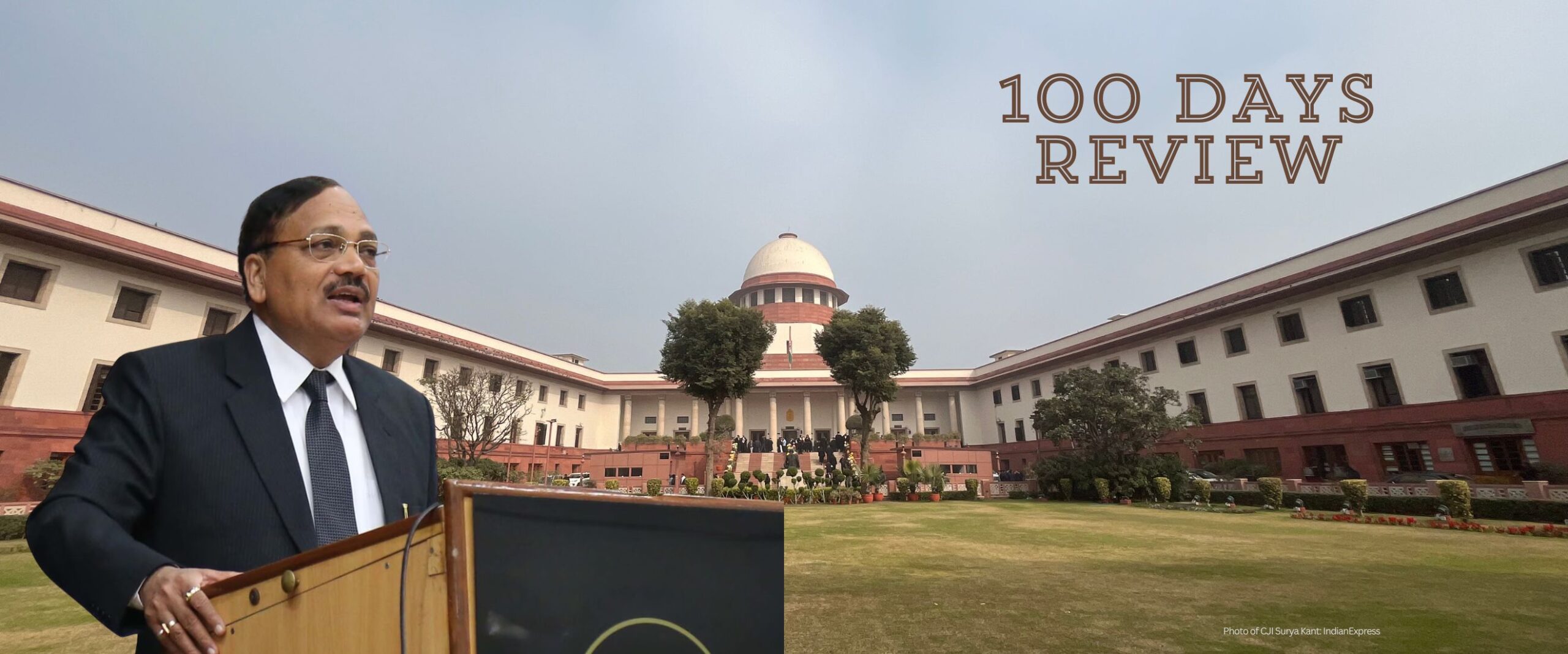
Ever since American President Franklin D. Roosevelt’s highly productive start of term in 1933, a person’s first 100 days in office is widely regarded as a make or break period.
2025 was a rapid fire round—three Chief Justices of India in quick succession. In November 2025, CJI Surya Kant took oath as the 53rd Chief Justice of India after CJIs Sanjiv Khanna and B.R. Gavai completed six month tenures. CJI Surya Kant has a 14-month tenure and 2026 all to himself. A 100 days later, what has the Chief Justice already served and what is he brewing? Here’s a snapshot.
The backlog battle
Even before his oath-taking ceremony, CJI Surya Kant flagged pendency as a priority. The Supreme Court’s docket had crossed 90,000 cases at the time, with a sharp increase of nearly 10,000 in 2025 alone. The CJI identified two areas for intervention:
- Constitution Benches → to resolve critical legal questions that have held up lower court decision-making.
- Mediation → “An easy game changer”, in the CJI’s words.
There are 25 Constitution Bench cases pending before the Supreme Court. The CJI had indicated that seven- and nine-judge cases would receive priority. While the initial plan was to list nine-judge matters in January 2026, two have now been listed for March and April 2026: the Definition of Industry and the Sabarimala Review. We are yet to hear on seven–and five–judge matters.
The CJI advocates for mediation at public forums, occasionally citing Hindu religious texts to suggest that mediation is part of an “inherited DNA”. He led a ‘Mediation Awareness Walk’ in December 2025 and recently requested state governments to increase professional fees for mediators, irrespective of whether the process was successful or not.
Has pendency reduced? The SCO monthly pendency review will take a closer look. Broadly, the case backlog grew through December and January, but February 2026 records a modest drop in pendency.*
Mention not
On many evenings these past few weeks, our court reporter Namrata Banerjee returned with stories of CJI Surya Kant’s latest emphatic rejection of oral mentionings. On his very first day, the CJI made it clear that unless life and liberty are at stake, he would not permit urgent listing through oral mention—written requests must instead be submitted to the Registrar. Within five days of taking office, a circular clarified that no mentioning of matters would be permitted in the CJI’s Court.
However, oral mention persists in other courts. Remarks from other judges suggest no consensus on a Standard Operating Procedure which caps the length of written submissions and oral arguments. That’s the elephant in the room: is CJI Surya Kant the master of Court Hall No.1 or the entire Supreme Court?
Recently, the CJI publicly pulled up the top court’s Registry for disregarding the new reforms, and confirmed his intention to set its house in order. He observed that, “There are officials in the Registry who have been here since the last 20-30 years. They think we (judges) are all here in transit and they are permanent.”
The resolution of these institutional concerns will shape the future of the Court for the rest of this decade.
Small waves on the Collegium front
After 100 days and seven meetings, 19 permanent judges and 5 ad-hoc judges were recommended for appointment at various High Courts. On 26 February, a policy decision was announced that where a High Court Chief Justice is due to retire, their replacement will be transferred two months prior to the retirement. This two month period allows the future Chief Justice to become familiar with the court before assuming charge.
Both CJIs Khanna and Gavai filled Supreme Court vacancies with alacrity within two weeks of assuming office. Surprisingly, CJI Surya Kant has not filled the one vacancy that has been pending since he took charge.
The vacancy count may rise to four in the first half of 2026 with the retirement of Justice Rajesh Bindal in April 2026, and of Justices Pankaj Mithal and J.K. Maheshwari in June 2026. How long does CJI Surya Kant plan to wait?
*Figures obtained from the National Judicial Data Grid on 3 March indicate 92,180 pending cases, a decrease of 648 from figures collected on 5 February.
**Corrections & Clarifications: An earlier version incorrectly stated that the number of pending Constitution Bench cases is 25. The correct number is 29. The final paragraph omitted reference to Justice Rajesh Bindal’s retirement in April 2026. Accordingly, assuming no new appointments, the strength of the Supreme Court will drop to 30 (and not 31) in June 2026. The errors are regretted.
This article was last updated at 4:40 pm, on 6 March 2026.
Related articles
Analysis
The CJI Surya Kant era begins
CJI Surya Kant’s first week sets the tone for his 14-month long tenure
Analysis
Timed advocacy
A new SOP caps the length of written submissions and requires counsel to state the time sought for oral arguments
Analysis
Nine-judge Summer
The much-awaited listing of the two nine-judge cases in the Supreme Court comes with a formal cap on hearing days
Analysis
Mid-term review: The CJI edition
In his term so far, B.R. Gavai has been at pains to stress equality between his office and puisne judges—and between the SC and the HCs