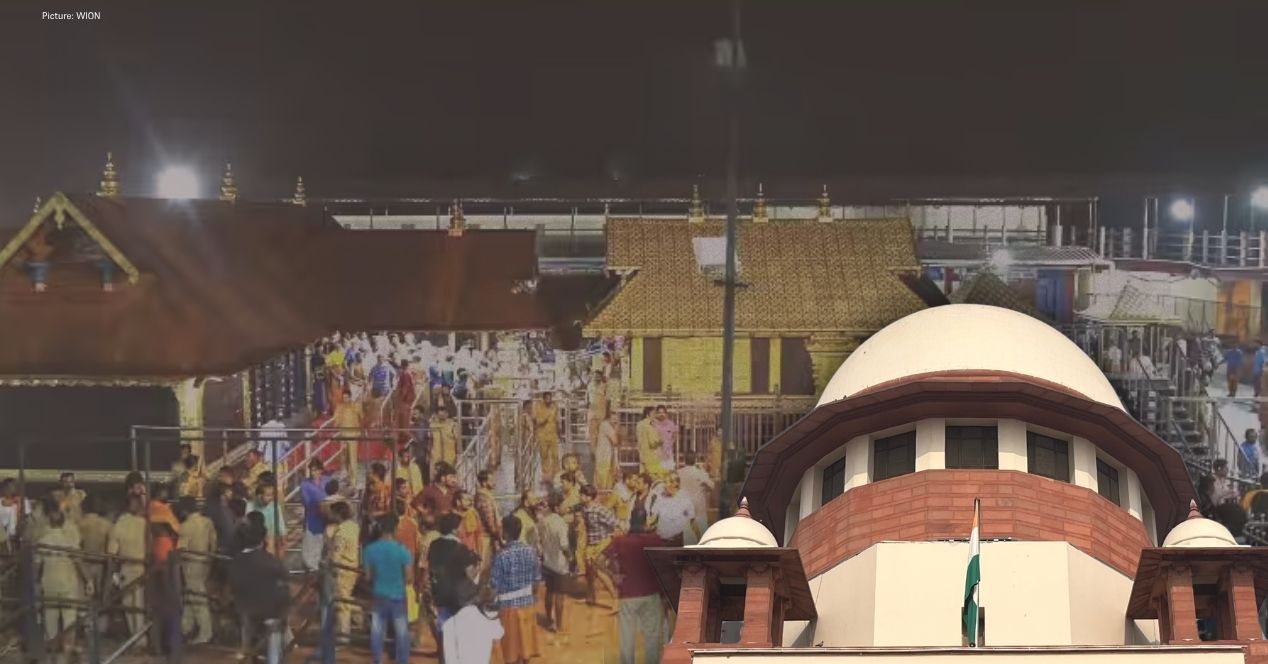

Sabarimala Reference | Day 6: “Once a practice is religious, no further inquiry?”, Bench questions scope of judicial review
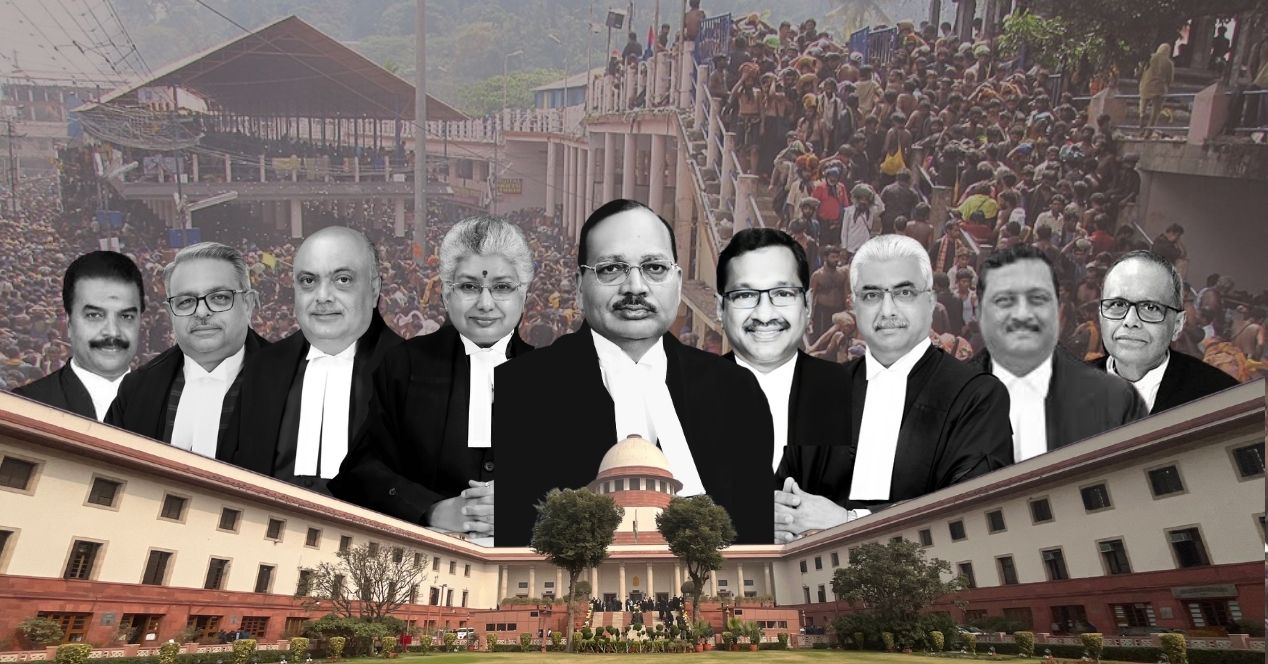
Sabarimala ReviewJudges: Surya Kant CJI, B.V. Nagarathna J, M.M. Sundresh J, Ahsanuddin Amanullah J, Aravind Kumar J, A.G. Masih J, P.B. Varale J, R. Mahadevan J, Joymalya Bagchi J
Today, the Supreme Court’s nine-judge Bench hearing the Sabarimala reference continued hearing arguments by those favouring the review.
Senior Advocates V.V. Giri, Gopal Sankaranarayanan, J. Sai Deepak and Gopal Subramanium addressed the Court on how Articles 25 and 26 are to be understood, especially where a devotee’s claim to worship comes up against the practices followed in a temple. The discussion moved between questions of denominational autonomy, the scope of social reform under Article 25(2)(b), and whether courts can examine a practice once it is said to be religious.
Background
On 28 September 2018, in Indian Young Lawyers Association v State of Kerala, a Constitution Bench of Chief Justice Dipak Misra, Justices R. F. Nariman, A. M. Khanwilkar, D. Y. Chandrachud and Indu Malhotra, in a 4:1 majority, held that the Sabarimala Temple’s exclusionary custom prohibiting the entry of women is unconstitutional. The custom barred women between the ages of 10 and 50 years old from entering the temple. The Judgment held that the said custom, and Rule 3(b) of the Kerala Hindu Places of Public Worship (Authorisation of Entry) Rules, 1965 — which allowed religious denominations to exclude women from public places of worship based on custom, violated the fundamental right to freedom of religion of female worshippers under Article 25 of the Constitution. The Bench held that the devotees of Lord Ayyappa were not a separate religious denomination and that the custom was not an essential religious practice (ERP).
More than 50 review petitions were subsequently filed by various individuals and organisations including Kantaru Rajeevaru, the Chief Priest of the Sabarimala Ayyappa Temple, the National Ayyappa Devotees (Women’s) Association, the Nair Service Society and the All Kerala Brahmin’s Association.
After CJI Misra retired, the review petition was heard on 13 November 2018 by a Bench of CJI Ranjan Gogoi, and Justices Khanwilkar, Nariman, Chandrachud and Malhotra. On 14 November 2019, the review bench by a narrow 3:2 majority decided to keep the review petitions pending and referred certain overarching constitutional questions to a larger bench. The review will be decided after the questions are clarified. The majority found that the Sabarimala judgement will have a bearing on other freedom of religion cases. Justices Nariman and Chandrachud dissented, holding that this speculation went beyond the narrow scope of a review petition. They dismissed challenges against the review.
On 13 January 2020, a nine-judge Bench led by CJI S.A. Bobde and Justices, R. Banumathi, Ashok Bhushan, Nageswara Rao, Mohan M. Shantanagoudar, S. Abdul Nazeer, R. Subhash Reddy, B.R. Gavai and Surya Kant began hearing the reference. Parties raised concerns that a review bench cannot refer questions of law to a larger bench.
On 10 February 2020, the nine-judge Bench upheld the referral order issued in the November 14 judgement. It held that the Court had the power to refer a point of law to a larger bench in a review petition, however, it did not publish any reasons for this finding at the time. On 11 May 2020, the Supreme Court published a detailed judgement substantiating the maintainability of the reference.
On 16 February 2026, a Bench of CJI Surya Kant with Justices Joymalya Bagchi and Vipul Pancholi listed the case for arguments on 7 April 2026.
Key Issues
- What is the scope and extent of judicial review with regard to a religious practice as referred to in Article 25 of the Constitution of India?
- What is the scope and extent of the word ‘morality’ under Articles 25 and 26 of the Constitution of India and whether it is meant to include Constitutional morality?
- What is the scope and ambit of right to freedom of religion under Article 25 of the Constitution of India?
- Whether the rights of a religious denomination under Article 26 of the Constitution of India are subject to other provisions of Part III of the Constitution of India apart from public order, morality and health?
- What is the meaning of expression “Sections of Hindus” occurring in Article 25 (2) (b) of the Constitution of India?
- What is the inter-play between the rights of persons under Article 25 of the Constitution of India and rights of religious denomination under Article 26 of the Constitution of India?
Giri: Idol worship and deity’s character
Appearing for the Thanthri, Giri submitted that idol worship is at the centre of Hindu religious practice. He added that an essential feature of Hindu religion is worship of idols. Once a deity is consecrated, it is treated as a living being, a juristic person with its own “characteristics.” Referring to the history of temple worship, he submitted that Shaivite and Vaishnavite temples follow distinct traditions, each governed by Agamas that prescribe how temples are constructed, how idols are installed, and how worship is to be performed. These prescriptions, he said, extend to regulating entry into spaces such as the inner sanctum.
Reading from Seshammal v State of Tamil Nadu (1970), he pointed out that rituals serve a “two-fold object”: to enable collective participation in worship and to preserve the sanctity of the deity. Any violation of these rules leads to what the tradition understands as “pollution or defilement,” affecting the divine presence itself. He argued that irrespective of what some may think about these rituals, they remain part of the religious faith and cannot be dismissed as irrational.
Giri: Article 25 and submission to the deity
Giri argued that the right under Article 25(1) is not a free-standing right to enter a temple on one’s own terms. It is a right exercised in conformity with the deity being worshipped. “A devotee subjugates himself to the divine spirit,” he said, adding that the act of worship requires acceptance of the deity’s defining characteristics. He illustrated this by saying that a person cannot go to a Shiva temple and insist that Vaishnavite rituals be performed. On Sabarimala, he submitted that the deity is a naishtika brahmachari, and the entire set of practices at the temple is aligned with that character. A devotee, he said, cannot assert a right to worship while acting “in antagonism” to that defining feature. He further asked the Court: “Why should Your Lordships protect my right under Article 25(1) to go and question the belief which is inherent in another place of worship?
Giri: Secular vs religious
Justice B.V. Nagarathna asked whether Giri’s submission effectively removes the essential religious practices test, leaving only a binary inquiry into whether a practice is secular or religious. Giri accepted that formulation and said that once a practice is found to be religious, “no further” inquiry is permissible. Justice Ahsanuddin Amanullah questioned how such a threshold is to be applied. He asked that if the Court cannot examine the practice in depth, what standard determines whether it is religious at all? Justice Nagarathna observed that under Giri’s approach, anything not strictly secular would fall within religion, raising doubts about whether courts would be left with any meaningful role. Giri responded that the nature of ceremonies and rituals must be understood from the tenets, doctrines and historical background of the religion. Relying on Commissioner, Hindu Religious Endowments, Madras v Sri Lakshmindra Thirtha Swamiar of Sri Shirur Mutt (1954), he reiterated that what constitutes an essential part of religion is to be ascertained “with reference to the doctrine of that religion itself,” and not by an external standard.
Giri: Challenge to practice and limits of Article 25
Justice Joymalya Bagchi asked whether a believer within the denomination could challenge a practice itself, especially where he claims it has no doctrinal or historical basis. Giri responded that such a situation is not ordinarily contemplated. According to him, a person who disagrees with a practice is free to follow a different path, but cannot enter a public temple and question the manner in which worship is carried out there. Justice P.B. Varale followed up by asking whether this approach leaves no room for a believer to question or reconsider long-standing practices, particularly in a society where thinking and exposure have evolved over time. Justice Amanullah then raised a situation where a devotee, despite being a believer, is denied entry or participation on the basis of birth or identity, resulting in a permanent exclusion. He asked whether, in such a case, the Constitution would not step in at all. In response, Giri accepted that a disqualification based purely on birth, such as a complete bar on becoming an archaka, would not be valid. Justice M.M. Sundresh observed that such a situation would fall within Article 25(2)(b) as a matter of social reform. At the same time, Justice Nagarathna clarified that restrictions flowing from Agamic requirements, including qualifications for performing rituals, stand on a different footing and are not to be equated with untouchability, but must be understood within the framework of the practice itself.
Sankaranarayanan: Vertical vs horizontal rights under Part III
Senior Advocate Gopal Sankaranarayanan placed Articles 25 and 26 within the structure of Part III, submitting that their scope depends on the nature of the right and against whom it is enforced. He referred to early constitutional interpretation to point out that expressions such as “existing law” under Article 13 have been treated as carrying the same meaning, with limited bearing on customs and usage. He explained that provisions such as Article 14 and Article 15(1) are directed against the state, while Article 15(2) uses the expression “no citizen shall,” extending its application to private individuals and entities. In the same way, Article 17, which abolishes untouchability and forbids its practice “in any form,” operates horizontally and binds all actors.
On Article 17, he submitted that “untouchability” cannot be extended to all forms of exclusion in religious practice and must be understood in its historical sense as referring to caste-based exclusion.Sankaranarayanan added that Article 17 must be read with Article 25(2)(b), which enables the state to open Hindu religious institutions to “all classes and sections of Hindus,” and must also be seen alongside the broader constitutional scheme, including provisions for representation and safeguards for Scheduled Castes and Scheduled Tribes.
He pointed out that while Article 25 guarantees an individual right, the key question is against whom that right can be asserted. If it is asserted against the state, it operates as a vertical right. If it is asserted against a religious body or denomination, different considerations arise. He said that much of the difficulty in the present case stems from not clearly identifying the nature of the right and the entity against whom it is claimed, and that this distinction must guide the Court’s approach.
Sai Deepak: Article 25(2) cannot limit Article 26
Senior Advocate J. Sai Deepak, appearing for Ayyappa temple bodies argued that Article 25(2) was intended only as a limitation on Article 25(1), and cannot be extended to curtail rights to manage religious affairs under Article 26. He argued that Article 26 is a distinct guarantee of collective religious freedom, subject only to public order, morality and health, and not controlled by Article 25(2)(b). Allowing Article 25(2)(b) to operate upon Article 26, he argued, would defeat denominational autonomy.
On the issue of judicial review, he argued that permitting judicial scrutiny would amount to “rewriting the rules of religion”, adding that codification of a practice does not make it amenable to challenge, since the Court would still be examining religion itself.
Chief Justice Surya Kant intervened, asking that if the state restricts a religious practice in the name of social welfare, who would examine it if not the Court, noting that “to say that there is no power at all may also be a very difficult proposition.” Deepak clarified that state action is reviewable, but maintained that religious practices themselves cannot be tested for validity, even indirectly. When Justice Nagarathna pointed out that the present case involved a law enabling entry but a rule reflecting an exclusionary custom, he responded that what “cannot be done directly cannot be done indirectly.” Justice Sundresh then asked if such practices could be tested against basic constitutional principles, Deepak maintained that even then, courts cannot use the essential religious practices test to restructure religious norms.
Subramanium: Denomination, constitutional structure and uniform application
Senior Advocate Gopal Subramanium agreed with three propositions advanced by the Solicitor General in the earlier hearings: that the Constitution maintains a separation between state and religion; that state regulation must remain minimal and narrowly tailored; and that Articles 25 and 26 apply across all religions. Against this backdrop, he said the Court must determine the true meaning of “religious denomination” in Article 26, and whether it is religion-specific or applies across faiths. Tracing the expression to Article 44 of the Irish Constitution, he pointed out that it refers to multiple religious bodies, including the Catholic Church, the Church of Ireland and Jewish congregations, alongside “other religious denominations.” From this, he submitted that each denomination is recognised within its own religion, and that the phrase “every religious denomination” in Article 26 must be read broadly. The word “every,” he stressed, cannot be ignored. If Article 25 speaks of “religion,” Article 26 extends protection to all organised forms of it.
On the relationship between the two provisions, he said Article 25(1) declares an individual right-freedom of conscience and the right to profess, practise and propagate religion, while Article 26 protects the collective dimension, enabling groups to organise and manage their affairs. The two operate at different levels and must be read together. Subramanium also drew a distinction between “faith” and “religion.” While faith is internal and subjective, he argued, religion, in the constitutional sense, includes outward expression through practices and institutions. Freedom of conscience, he said, is an inherent human right, one that “inheres in a person by virtue of being human,” and Article 25 recognises that guarantee. Placing this within the broader constitutional scheme, he referred to the development of fundamental rights through Articles 14, 19 and 21, and to provisions such as Article 17, which reflect a continuing commitment to social reform. The framers, he said, were “conscious of history,” and intended that reform remain an ongoing constitutional project. He submitted that the interpretation of “religious denomination” must not create unequal protection between denominational and non-denominational institutions, as that would raise concerns under Article 14. The Court, he said, must adopt a construction that preserves both religious freedom and constitutional equality, while ensuring uniform application across religions.
The Court will continue hearing arguments tomorrow.