
Sabarimala Review | Day 3: The Union invokes “Sampradaya” and “Sadachaar”
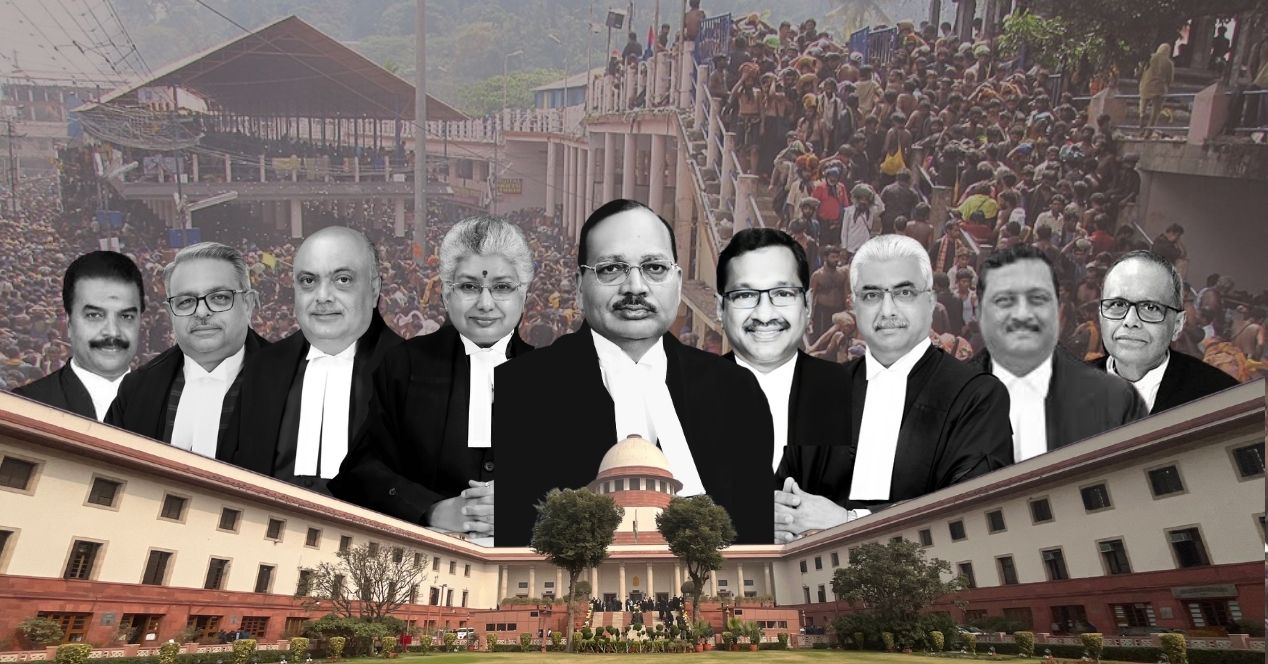
Sabarimala ReviewJudges: Surya Kant CJI, B.V. Nagarathna J, M.M. Sundresh J, Ahsanuddin Amanullah J, Aravind Kumar J, A.G. Masih J, P.B. Varale J, R. Mahadevan J, Joymalya Bagchi J
Today, Additional Solicitor General K.M. Nataraj led the Union’s submissions in the Sabarimala reference before the nine-judge bench. Focusing on Articles 25 and 26, Nataraj outed the structure of religious rights and the role of denomination. The Bench repeatedly intervened to question how far courts must refrain from adjudicating disputes over religious practices.
Background
On 28 September 2018, in Indian Young Lawyers Association v State of Kerala, a Constitution Bench of Chief Justice Dipak Misra, Justices R. F. Nariman, A. M. Khanwilkar, D. Y. Chandrachud and Indu Malhotra, in a 4:1 majority, held that the Sabarimala Temple’s exclusionary custom prohibiting the entry of women is unconstitutional. The custom barred women between the ages of 10 and 50 years old from entering the temple. The Judgment held that the said custom, and Rule 3(b) of the Kerala Hindu Places of Public Worship (Authorisation of Entry) Rules, 1965 — which allowed religious denominations to exclude women from public places of worship based on custom, violated the fundamental right to freedom of religion of female worshippers under Article 25 of the Constitution. The Bench held that the devotees of Lord Ayyappa were not a separate religious denomination and that the custom was not an essential religious practice (ERP).
More than 50 review petitions were subsequently filed by various individuals and organisations including Kantaru Rajeevaru, the Chief Priest of the Sabarimala Ayyappa Temple, the National Ayyappa Devotees (Women’s) Association, the Nair Service Society and the All Kerala Brahmin’s Association.
After CJI Misra retired, the review petition was heard on 13 November 2018 by a Bench of CJI Ranjan Gogoi, and Justices Khanwilkar, Nariman, Chandrachud and Malhotra. On 14 November 2019, the review bench by a narrow 3:2 majority decided to keep the review petitions pending and referred certain overarching constitutional questions to a larger bench. The review will be decided after the questions are clarified. The majority found that the Sabarimala judgement will have a bearing on other freedom of religion cases. Justices Nariman and Chandrachud dissented, holding that this speculation went beyond the narrow scope of a review petition. They dismissed challenges against the review.
On 13 January 2020, a nine-judge Bench led by CJI S.A. Bobde and Justices, R. Banumathi, Ashok Bhushan, Nageswara Rao, Mohan M. Shantanagoudar, S. Abdul Nazeer, R. Subhash Reddy, B.R. Gavai and Surya Kant began hearing the reference. Parties raised concerns that a review bench cannot refer questions of law to a larger bench.
On 10 February 2020, the nine-judge Bench upheld the referral order issued in the November 14 judgement. It held that the Court had the power to refer a point of law to a larger bench in a review petition, however, it did not publish any reasons for this finding at the time. On 11 May 2020, the Supreme Court published a detailed judgement substantiating the maintainability of the reference.
On 16 February 2026, a Bench of CJI Surya Kant with Justices Joymalya Bagchi and Vipul Pancholi listed the case for arguments on 7 April 2026.
Key Issues
- What is the scope and extent of judicial review with regard to a religious practice as referred to in Article 25 of the Constitution of India?
- What is the scope and extent of the word ‘morality’ under Articles 25 and 26 of the Constitution of India and whether it is meant to include Constitutional morality?
- What is the scope and ambit of right to freedom of religion under Article 25 of the Constitution of India?
- Whether the rights of a religious denomination under Article 26 of the Constitution of India are subject to other provisions of Part III of the Constitution of India apart from public order, morality and health?
- What is the meaning of expression “Sections of Hindus” occurring in Article 25 (2) (b) of the Constitution of India?
- What is the inter-play between the rights of persons under Article 25 of the Constitution of India and rights of religious denomination under Article 26 of the Constitution of India?
Mehta: Sabarimala not a case of gender exclusion
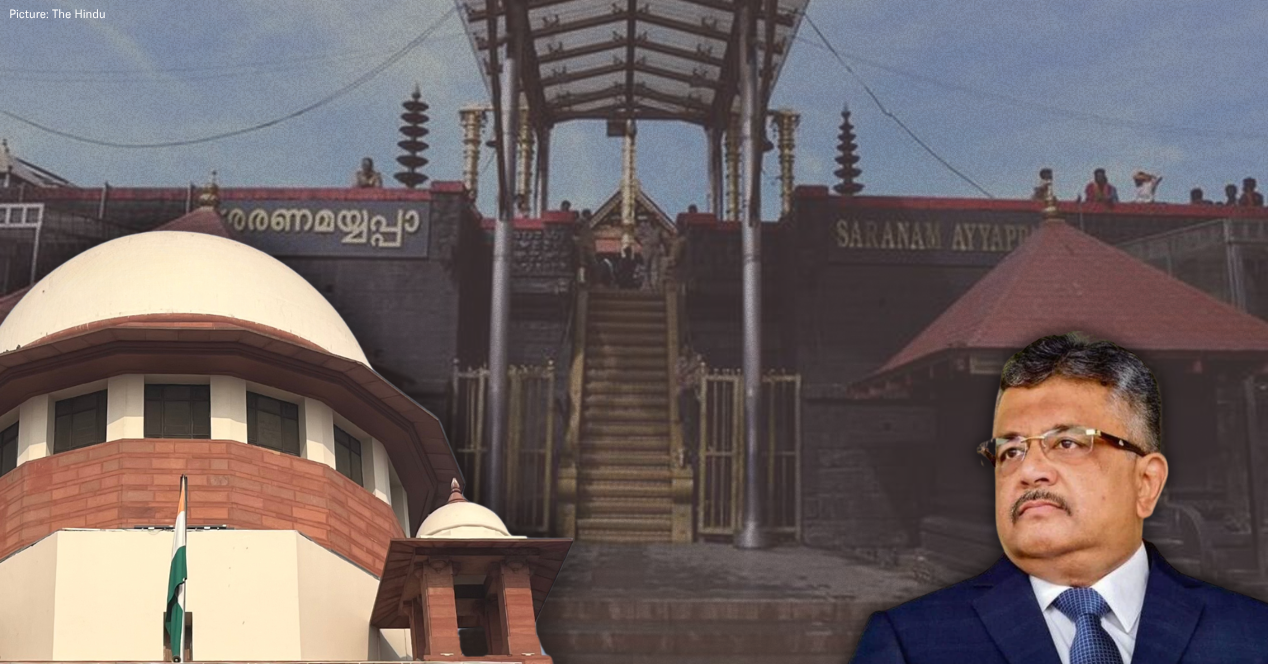
Concluding two days of arguments, Solicitor General Tushar Mehta submitted that the Sabarimala practice cannot be reduced to gender discrimination. He argued, “There are instances of temples where men are not allowed. There are temples where male priests are under a mandate to wash the feet of women devotees.” Referring to the Pushkar Brahma temple and a temple in Kerala where men enter dressed as women, he said, “It is not a question of male-centric or female-centric religious beliefs. In the present case, it happens to be woman-centric.”
Nataraj: Articles 25 and 26 as a connected scheme, subject to Part III
Nataraj submitted that religious rights under the Constitution form a “three-tier mechanism” consisting of individual rights under Article 25(1), regulatory power under Article 25(2), and institutional rights under Article 26. He argued that “Article 26 is “embedded in Article 25,” and has no independent existence of its own as a denomination is formed through collective belief of individuals. Article 25(2), he said, is “an independent enabling provision” for regulation of secular aspects and social reform.
Chief Justice Surya Kant observed that Article 25 concerns individuals while Article 26 concerns groups formed by such individuals, indicating that both provisions must be harmoniously construed. Justice B.V. Nagarathna asked whether this would effectively read Part III into Article 26 despite the absence of such language. Justice Joymalya Bagchi observed that Article 26(1)(b) operates in a narrower field than Article 25(1).
On denominational autonomy, Nataraj submitted that a person cannot insist on non-vegetarian food in a temple that follows vegetarian traditions and “has no right to invade the rights of those believers.” He also referred to temples where liquor is offered as prasad, arguing that such practices cannot be overridden by individual choice. Justice Bagchi pointed out that where the existence or content of a practice is disputed, courts would necessarily have to adjudicate.
Turning to the scope of Article 25, Nataraj argued that it protects both internal belief and its external manifestation. Justice Ahsanuddin Amanullah asked, “Does it mean whatever is your internal belief, the external manifestation is also protected?” When Nataraj agreed, Justice Amanullah pointed out that if such manifestation affects others, Articles 14 and 15 would apply. Nataraj accepted that in such cases, Part III would step in.
Justice Nagarathna then asked, “Does ‘existing law’ in Article 25(2) include customs and usages?” Nataraj replied that pre-Constitutional customs and usages would be protected if they are not inconsistent with Part III.
“Sampradaya” and the role of courts
Nataraj then submitted that “denomination” must be understood in the Indian context as “sampradaya” (the Sanskrit word for tradition), which is rooted in collective belief and may not have a rigid structure. He argued that courts cannot determine whether a particular sampradaya or its practices are correct.
“The forum is the court,” responded Justice Bagchi, referring to Section 9 of the Civil Procedure Code, 1908. He observed that where there is a dispute regarding what constitutes a tradition or its practices, adjudication becomes necessary. He added that even a non-believer may raise such a conflict. Nataraj clarified that courts may resolve competing claims based on evidence but cannot undertake an independent determination of religious correctness.
Nataraj & Banerjee: Public morality and “sadachar”
Reiterating the Union’s position from Day 2, Nataraj submitted that public morality, not constitutional morality, is the relevant standard and that the essential religious practices (ERP) doctrine is unworkable in a plural society.
He argued that the Court cannot “redefine or re-examine constitutional morality” and maintained that judicial review is limited to examining violations of Part III of the Constitution.
ASG Vikramjit Banerjee supplemented this by relying on Article 394A and submitting that the word “morality” in the Hindi version of Articles 25 and 26 is “sadachar.” He argued, “There is no scope to read constitutional morality into these provisions,” explaining that “sadachar” refers to accepted or approved conduct and operates in a different sphere from constitutional morality.
Vaidyanathan: Article 26 a substantive right, not controlled by Article 25(2)(b)
Senior Advocate C.S. Vaidyanathan, appearing for the Nair Service Society, argued that Article 26(b) is a substantive right and “cannot be controlled” by Article 25(2)(b) which is an enabling provision, introduced to address specific forms of social reform, particularly caste-based exclusion. He emphasised that it “is not a gender equality provision.”
Relying on Commissioner, Hindu Religious Endowments, Madras v Sri Lakshmindra Thirtha Swamiar of Sri Shirur Mutt (1954), Sri Venkataramana Devaru v State of Mysore (1957) and S.P. Mittal v Union of India (1982), he argued that the concept of religious denomination has been incorrectly understood through an Abrahamic framework and must be reconsidered in the Indian context. He submitted that denomination in India is better understood through “sampradaya,” which may not have a rigid or institutional structure but is grounded in shared belief and practice.
A person who chooses to enter a temple must abide by the practices of that tradition, he said. Referring to Sabarimala, Vaidyanathan pointed out that there is no absolute bar on entry, but that devotees are required to follow the 40-day vratam and associated disciplines. Justice Bagchi countered that compliance with such practices does not necessarily mean a surrender of freedom of conscience. He observed that conflicts between individual rights and denominational control may still arise, particularly where access to religious spaces is in question.
As Vaidyanathan pressed on, Justice Aravind Kumar asked whether such an interpretation would place Article 26 outside Part III. Vaidyanathan responded that the issue is not whether Article 26 is an “island provision,” but whether its core guarantee can be diluted through an enabling clause under Article 25.
Justice Nagarathna cautioned against framing the argument too broadly, observing that in practice devotees move across temples and traditions and that constitutional interpretation must reflect that reality. CJI Surya Kant added that even laws enacted under Article 25(2) may affect religious practice and have an impact on matters falling under Article 26, indicating that the relationship between the two provisions cannot be resolved in absolute terms.
Vaidyanathan: ERP doctrine has been wrongly expanded
Vaidyanathan also addressed the essential religious practices doctrine, arguing that it has been expanded beyond its original scope in Shirur Mutt. He submitted that the decision was concerned with distinguishing religious from secular matters and did not authorise courts to determine what is “essential” to a religion.
Referring to later decisions including Durgah Committee v Syed Hussain Ali (1961) and N. Adithayan v Travancore Devaswom Board (2002), he argued that courts have moved into evaluating religious practices themselves, which is impermissible.
The hearing will resume on 15 April.