Sabarimala Reference | Day 11: Denominational rights cannot overpower individual claims, respondents argue
Sabarimala ReviewJudges: Surya Kant CJI, B.V. Nagarathna J, M.M. Sundresh J, Ahsanuddin Amanullah J, Aravind Kumar J, A.G. Masih J, P.B. Varale J, R. Mahadevan J, Joymalya Bagchi J
The nine-judge Bench led by Chief Justice Surya Kant continued hearing arguments by the respondents today in the Sabarimala reference. Advocate Ravi Prakash Gupta challenged the maintainability of the reference and Senior Advocate Darius Khambata addressed the issues of entry, identity and denominational control.
Gupta argued that the reference itself was “to unsettle a settled law,” while Khambata placed the issue of exclusion of women in Parsi Zoroastrian communities at the forefront, submitting that marriage cannot determine religious identity and that denominational rights cannot override the guarantee of equality under Articles 25 and 26.
Background
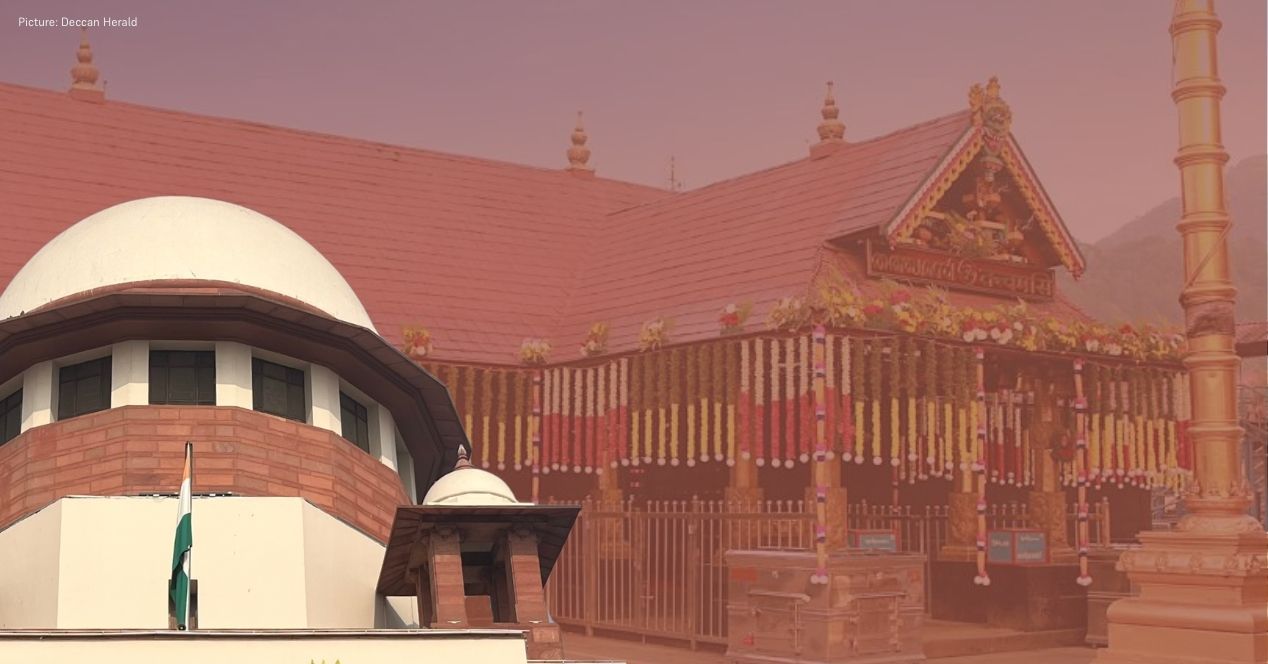
On 28 September 2018, in Indian Young Lawyers Association v State of Kerala, a Constitution Bench of Chief Justice Dipak Misra, Justices R. F. Nariman, A. M. Khanwilkar, D. Y. Chandrachud and Indu Malhotra, in a 4:1 majority, held that the Sabarimala Temple’s exclusionary custom prohibiting the entry of women is unconstitutional. The custom barred women between the ages of 10 and 50 years old from entering the temple. The Judgment held that the said custom, and Rule 3(b) of the Kerala Hindu Places of Public Worship (Authorisation of Entry) Rules, 1965 — which allowed religious denominations to exclude women from public places of worship based on custom, violated the fundamental right to freedom of religion of female worshippers under Article 25 of the Constitution. The Bench held that the devotees of Lord Ayyappa were not a separate religious denomination and that the custom was not an essential religious practice (ERP).
More than 50 review petitions were subsequently filed by various individuals and organisations including Kantaru Rajeevaru, the Chief Priest of the Sabarimala Ayyappa Temple, the National Ayyappa Devotees (Women’s) Association, the Nair Service Society and the All Kerala Brahmin’s Association.
After CJI Misra retired, the review petition was heard on 13 November 2018 by a Bench of CJI Ranjan Gogoi, and Justices Khanwilkar, Nariman, Chandrachud and Malhotra. On 14 November 2019, the review bench by a narrow 3:2 majority decided to keep the review petitions pending and referred certain overarching constitutional questions to a larger bench. The review will be decided after the questions are clarified. The majority found that the Sabarimala judgement will have a bearing on other freedom of religion cases. Justices Nariman and Chandrachud dissented, holding that this speculation went beyond the narrow scope of a review petition. They dismissed challenges against the review.
On 13 January 2020, a nine-judge Bench led by CJI S.A. Bobde and Justices, R. Banumathi, Ashok Bhushan, Nageswara Rao, Mohan M. Shantanagoudar, S. Abdul Nazeer, R. Subhash Reddy, B.R. Gavai and Surya Kant began hearing the reference. Parties raised concerns that a review bench cannot refer questions of law to a larger bench.
On 10 February 2020, the nine-judge Bench upheld the referral order issued in the November 14 judgement. It held that the Court had the power to refer a point of law to a larger bench in a review petition, however, it did not publish any reasons for this finding at the time. On 11 May 2020, the Supreme Court published a detailed judgement substantiating the maintainability of the reference.
On 16 February 2026, a Bench of CJI Surya Kant with Justices Joymalya Bagchi and Vipul Pancholi listed the case for arguments on 7 April 2026.
Gupta: Reference stretched beyond its footing
Advocate Ravi Prakash Gupta began arguments for the Indian Young Lawyers Association—the organisation behind the 2018 Sabarimala judgement. Gupta challenged the maintainability of the reference arguing that it was “made to unsettle a settled law.” He argued that the five-judge review Bench had referred the matter to a seven-judge Bench, not a nine-judge Bench, and argued that the speaking order does not refer this matter to a nine-judge bench. He submitted that a smaller Bench cannot doubt the correctness of a larger Bench and can only place the issue before the Chief Justice on the administrative side, not on the judicial side. As he pressed this point, Chief Justice Surya Kant observed, “Objection against the reference has been taken down… you are not filing a review.” The maintainability of the reference was upheld by a nine-judge bench in February 2020. Justices B.V. Nagarathna and M.M. Sundresh told him to move to relevant arguments..Justice Nagarathna responded that the issue would necessarily require consideration of the seven-judge bench decision in Commissioner, Hindu Religious Endowments, Madras v Sri Lakshmindra Thirtha Swamiar of Sri Shirur Mutt (1954) and therefore warranted a larger Bench.
Gupta argued that the reference had not been registered as a reference case under the Supreme Court Rules and compared it to the recent Presidential Reference and the Ayodhya reference, which are separately registered. Justice Joymalya Bagchi responded that the power of the Chief Justice to constitute a larger Bench has been traced to Article 32 and is not governed by the Supreme Court Rules. When Gupta persisted, Justice Sundresh remarked, “Mr Gupta, listen to us. You are looking everywhere except us.” Gupta suggested that such references ought to be separately registered and flagged the use of the same cause list, to which the Chief Justice responded that it may be “a good suggestion on the administrative side,” but not one affecting the validity of the present proceedings.
Gupta: Entry as a right, limits of denominational control
On the merits, Gupta submitted that the Constitution recognises three layers of protection: individual rights under Article 25, denominational rights under Article 26 and the State’s power to regulate. He argued that the right to practice religion under Article 25 extends to “all persons” and includes the right of entry into places of worship, provided the person complies with the rituals and practices followed there. He submitted that this right is not confined to adherents of a particular faith. Justice Nagarathna questioned this formulation, observing, “The ones who have faith in the deity will perform all that is needed.” She asked whether persons without belief could insist on entry and said that someone who says they will not follow the “niyams” cannot be encouraged by the Court.
Gupta further submitted that denominational autonomy under Article 26(b) cannot be placed beyond judicial scrutiny, stating that such rights should not be kept so high that they are beyond judicial review. He argued that Articles 25 and 26 must be harmonised and that the right under Article 25 cannot be reduced “to a husk” in the process. He also contended that exclusionary practices cannot be justified merely by labelling them religious, referring to practices such as sati and other historical customs to argue that reform has always been part of constitutional evolution.
Gupta: Bench questions locus and purpose of PIL
At several points, the Bench questioned the very basis of the petition. Justice Nagarathna asked, “How does a juristic body like yours have a belief?You do not have a conscience.”She said it could have “devastating consequences,” repeatedly asking what the objective of the PIL was and “what good has come out of it.” The Bench noted that the petition appeared to be based on newspaper reports. Justice Nagarathna observed, “It is easy to get articles written for the purpose of PIL,” while CJI Surya Kant remarked that such material “should have been thrown out outright,” adding that if there was misconduct by any individual, the proper course would have been to proceed against that person under law rather than invoke the Court’s jurisdiction through a PIL.
Gupta: Reform cannot override Article 25
Gupta submitted that the present reference raises an issue arising from the development of the essential religious practices test. He relied on Shirur Mutt to argue that what constitutes an essential religious practice must be determined by the denomination itself and contrasted this with Durgah Committee v Syed Hussain Ali (1961), where the Court assumed the power to exclude practices it considers “secular” or “superstitious.” He submitted that this shift has led courts into questions of theology and belief which were not contemplated in Shirur Mutt. Referring to the submissions of the Solicitor General, who had accepted the position except in relation to “superstitious beliefs,” Gupta argued that such a formulation cannot be used to override the protection under Article 25(1) and that labelling a practice as superstitious cannot become the basis for judicial interference. He further submitted that even where reform is invoked under Article 25(2)(b), it does not exist independently and must be read as part of the broader scheme of Article 25. He pointed out that in the Sabarimala context, the restriction on entry flowed from Rule 3(b) framed under the Kerala Hindu Places of Public Worship (Authorisation of Entry) Act, 1965, and argued that there cannot be any custom that violates constitutional guarantees.
Khambata: Marriage cannot determine religious identity
Senior Advocate Darius Khambata argued on the issue where Parsi women are stopped from entering Parsi institutions, including funeral rites, after marrying a non-Parsi under the Special Marriage Act, 1954. He argued that this practice violates Articles 14, 21 and 25.
Khambata argued that the Parsi Zoroastrian woman he appeared for was a believer and had not forsaken her religion. He argued that it would be “far-reaching” to suggest that such marriage results in a deemed conversion.Further, it would seriously undermine the dignity of women. He pointed out that a woman is required to secure a declaration from a competent court in such situations, , despite continuing to practise the faith. Moreover, there is no prohibition on a Parsi woman married outside the faith from continuing to profess and practise the religion. He contended that there was no material to show that entry into a Parsi Agyari violates an essential religious practice and that no principle in Zoroastrianism prohibits interfaith marriage. He added that Parsi men, who marry outside the faith, and their children, have been permitted entry. Justice Nagarathna asked whether marriage becomes the basis of discrimination. To this, Khambata responded in the affirmative calling it “a man-made imposition.” He added that there is no uniform practice across the community and that such exclusions stem from decisions of particular trustees rather than religious doctrine, warranting limited judicial review.
Khambata: Article 26 cannot outrun Article 25
Khambata argued that denominational rights under Article 26 are sourced from Article 25(1) —the freedom of conscience and the right freely to profess, practice and propagate religion.He submitted thats such an interpretation would result in no rights for a denomination as the words “profess, practice or propagate” religion appear only in Article 25. Justice Ahsanuddin Amanullah pointed out that individuals may practise religion privately, while denominations represent collective belief. He asked: Is there a disconnect between individual and denominational rights? Khambata responded that while denominations have organisational autonomy, they must establish that they are genuinely part of the religion and act within its framework. He argued that even if Article 26 is seen as distinct, it is at least complementary to Article 25 and cannot operate contrary to it.
Justice Nagarathna observed that Article 25(2)(b) enables the State to intervene where practices exclude classes or sections, while also noting that Article 25 reflects the constitutional understanding of organised religion. Khambata agreed, submitting that denominational rights are subject to the same limitations of public order, morality, health and other provisions of Part III. Khambata argued that there was a need for harmonisation between the provisions as primacy of denominational rights under Article 26 over individual rights would “annihilate” Article 25. Justice Bagchi observed that Article 26 rights are textually confined to establishing institutions and managing religious affairs and that institutional practices may be protected differently from individual claims. Khambata responded that denominations exercise Article 25(1) rights and are subject to its limitations. He referred to Joseph Shine v Union of India (2018) to argue that marriage does not extinguish autonomy or permit women to be treated as chattel. He submitted, “Constitutional morality is the order of the day,” and that equality is embedded in Article 25(1).
Khambata: Belief is not beyond constitutional scrutiny
Khambata stressed the meaning of “religious denomination”should not be applied rigidly. He submitted that while common organisation, common faith and common name are relevant, the Court need not be “too pedantic,” and suggested that some element of uniqueness may also be relevant. Justice Sundresh observed that adding further criteria could create uncertainty, noting that groups with common beliefs may form denominations without any distinct “uniqueness.”
Khambata submitted that while the essential religious practices doctrine has caused problems, it may still operate as an aid in determining what is integral to religion. Justice Sundresh asked whether practices are to be tested as secular or religious and Khambata responded that the ultimate test must be constitutional, giving the example of caste-based exclusion. Justice Nagarathna clarified that Article 14 does not directly enter the Article 25(1) space, but where a practice excludes a class, Article 25(2)(b) permits State intervention. Justice Kumar pointed to regulatory practices such as temple administration to illustrate that not all practices are beyond scrutiny. Khambata agreed that practices must be tested for whether they are an “integral part” of religion, but warned that without retaining judicial review, Article 26(b) could be used as “an instrument of domination” over individual rights. He reiterated that a balance must be struck between Articles 25 and 26, along with Articles 14, 15, 19 and 21, and argued that elevating denominational autonomy above this balance would distort the constitutional scheme.
The Court will continue hearing arguments tomorrow.