
Sabarimala Reference | Day 9: Petitioners wrap up amid debate on entry and religious autonomy
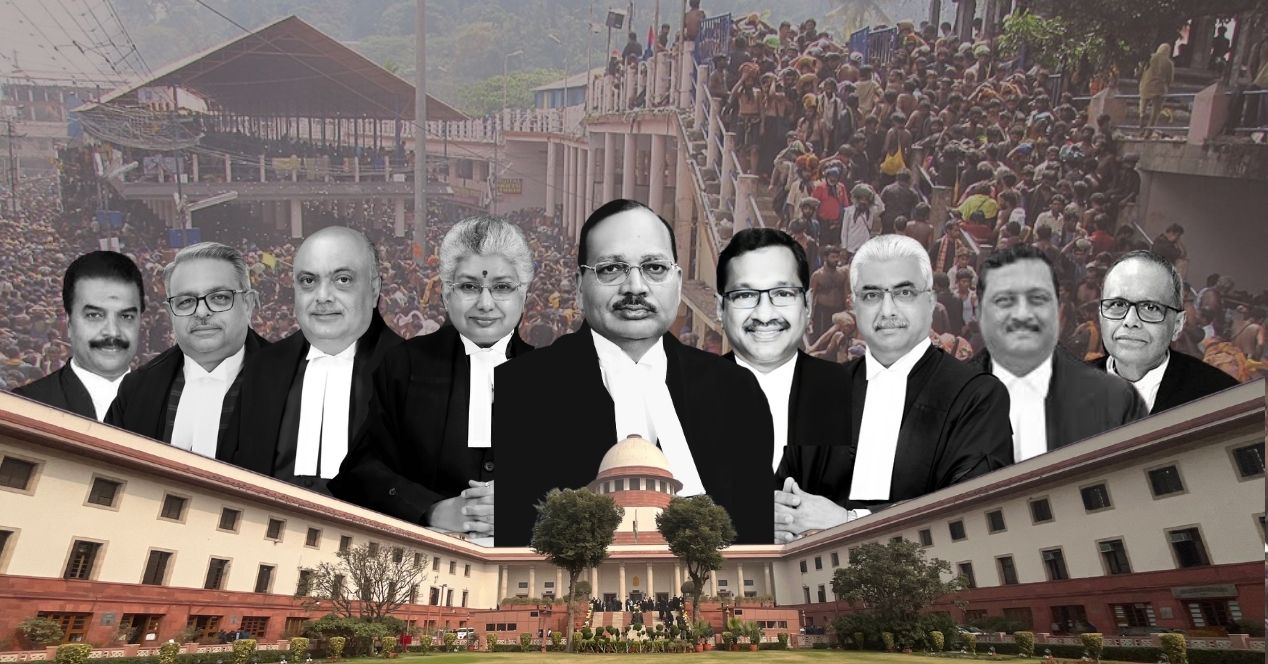
Sabarimala ReviewJudges: Surya Kant CJI, B.V. Nagarathna J, M.M. Sundresh J, Ahsanuddin Amanullah J, Aravind Kumar J, A.G. Masih J, P.B. Varale J, R. Mahadevan J, Joymalya Bagchi J
Today, parties in favour of the Sabarimala review were on their feet for the ninth day of arguments, going well past the schedule earlier set by the Supreme Court. A nine-judge Bench led by Chief Justice Surya Kant had to step in multiple times to keep arguments within the frame of reference as a series of intervenors questioned locus in religious claims, the scope of social reform, and tests for qualification of denominational rights through Article 25(2).
Background
On 28 September 2018, in Indian Young Lawyers Association v State of Kerala, a Constitution Bench of Chief Justice Dipak Misra, Justices R. F. Nariman, A. M. Khanwilkar, D. Y. Chandrachud and Indu Malhotra, in a 4:1 majority, held that the Sabarimala Temple’s exclusionary custom prohibiting the entry of women is unconstitutional. The custom barred women between the ages of 10 and 50 years old from entering the temple. The Judgment held that the said custom, and Rule 3(b) of the Kerala Hindu Places of Public Worship (Authorisation of Entry) Rules, 1965 — which allowed religious denominations to exclude women from public places of worship based on custom, violated the fundamental right to freedom of religion of female worshippers under Article 25 of the Constitution. The Bench held that the devotees of Lord Ayyappa were not a separate religious denomination and that the custom was not an essential religious practice (ERP).
More than 50 review petitions were subsequently filed by various individuals and organisations including Kantaru Rajeevaru, the Chief Priest of the Sabarimala Ayyappa Temple, the National Ayyappa Devotees (Women’s) Association, the Nair Service Society and the All Kerala Brahmin’s Association.
After CJI Misra retired, the review petition was heard on 13 November 2018 by a Bench of CJI Ranjan Gogoi, and Justices Khanwilkar, Nariman, Chandrachud and Malhotra. On 14 November 2019, the review bench by a narrow 3:2 majority decided to keep the review petitions pending and referred certain overarching constitutional questions to a larger bench. The review will be decided after the questions are clarified. The majority found that the Sabarimala judgement will have a bearing on other freedom of religion cases. Justices Nariman and Chandrachud dissented, holding that this speculation went beyond the narrow scope of a review petition. They dismissed challenges against the review.
On 13 January 2020, a nine-judge Bench led by CJI S.A. Bobde and Justices, R. Banumathi, Ashok Bhushan, Nageswara Rao, Mohan M. Shantanagoudar, S. Abdul Nazeer, R. Subhash Reddy, B.R. Gavai and Surya Kant began hearing the reference. Parties raised concerns that a review bench cannot refer questions of law to a larger bench.
On 10 February 2020, the nine-judge Bench upheld the referral order issued in the November 14 judgement. It held that the Court had the power to refer a point of law to a larger bench in a review petition, however, it did not publish any reasons for this finding at the time. On 11 May 2020, the Supreme Court published a detailed judgement substantiating the maintainability of the reference.
On 16 February 2026, a Bench of CJI Surya Kant with Justices Joymalya Bagchi and Vipul Pancholi listed the case for arguments on 7 April 2026.
Key Issues
- What is the scope and extent of judicial review with regard to a religious practice as referred to in Article 25 of the Constitution of India?
- What is the scope and extent of the word ‘morality’ under Articles 25 and 26 of the Constitution of India and whether it is meant to include Constitutional morality?
- What is the scope and ambit of right to freedom of religion under Article 25 of the Constitution of India?
- Whether the rights of a religious denomination under Article 26 of the Constitution of India are subject to other provisions of Part III of the Constitution of India apart from public order, morality and health?
- What is the meaning of expression “Sections of Hindus” occurring in Article 25 (2) (b) of the Constitution of India?
- What is the inter-play between the rights of persons under Article 25 of the Constitution of India and rights of religious denomination under Article 26 of the Constitution of India?
Pasha: Can a non-believer demand entry?
Referring to a law student who sought entry to the inner sanctum of the Hazrat Nizamuddin Dargah, Advocate Nizam Pasha said “This is one of the biggest examples of misusing the 2018 judgement.” He questioned whether “a complete third party, a non-believer, can enter a place of worship and demand that matters of faith must yield to their individual claims?” Arguing that Articles 25 and 26 do not contemplate such a right, he submitted that a place of worship is “nothing but a belief system,” and maintained that faith cannot be redefined by those who do not subscribe to it.
Pasha: Denomination decides entry
When Justice Ahsanuddin Amanullah asked whether dargahs were being placed at a “higher pedestal” as denominations, Pasha argued that Sufi dargahs, particularly of the Chishtiya order, qualify as religious denominations. Relying on Sri Venkataramana Devaru v State of Mysore (1957) he submitted that unrestricted access does not dilute denominational character, and contended that the issue was not conclusively determined in Durgah Committee v Syed Hussain Ali (1961). Pasha warned that excluding such institutions from Article 26 would lead to “absurd consequences.” Drawing a clear line between Articles 25 and 26, he argued that the former protects individual conscience while the latter secures a collective right to manage religious affairs. Entry under Article 25(2)(b), he said, is confined to the context of social reform. When Justice Joymalya Bagchi raised concerns about the limits of such protection, Pasha accepted that even religious practices remain subject to public order, morality and health but contended that social reform is also limited to the same.
On the structure of Article 25, Pasha submitted that clause (2) was originally conceived as an explanation, with Article 25(2)(a) indicating what falls outside religion and Article 25(2)(b) operating within Article 25(1). On constitutional morality, he submitted that the“Parliament speaks for the people,” while cautioning against majoritarian tendencies. Referring to Sardar Syedna Taher Saifuddin v State of Bombay (1962), he argued that the essential religious practices doctrine was originally protective in nature but has since been expanded beyond its textual basis. When the Bench raised concerns about who controls practices within a place of worship, he submitted, “In every single case there will be a right holder,” and that in such cases, the right lies with the denomination not with individuals who do not subscribe to the faith.
Potaraju: Limits of judicial scrutiny in matters of faith
Senior Advocate Sridhar Potaraju submitted that the starting point must be the structure of Part III, wherein “the sovereign has parted with certain powers and reserved certain powers,” and the Court is called upon to identify the scope of those retained freedoms. Asserting that his right flows from Article 25, read with 21, he asked, “If it is a fundamental right the sovereign has reserved to itself, where is the right to qualify it with tests?” Referring to India’s historical “diversity of worship” and the evolution of religious practices, Potaraju emphasised that the Constitution does not define who a Hindu is. He submitted that in examining religious belief a non-believer has to be excluded since faith cannot be assessed from an external standpoint. Any attempt to shift protections between Articles 25 and 26 is not an interpretative exercise, he said, and argued that denominational association, much like the right to associate generally, reflects an inherent autonomy in spiritual matters that must remain beyond judicial reconfiguration.
Divan: Individual faith needs institutional support
Senior Advocate Madhavi Divan, appearing for worshippers of sacred groves or “orans” in western Rajasthan, submitted that these practices reflect an ancient form of nature worship where the manifestation of divinity is the forest, marked by non-violence and customary abstinence. She argued that such communities, though loosely organised and rooted in village traditions, still fall within the protection of Articles 25 and 26. Emphasising the relationship between the two, she submitted, “In order for me to be able to enjoy Article 25… I need Article 26,” describing the rights as symbiotic. Even the most personal aspect of religious freedom, she argued, such as freedom of conscience, cannot be exercised in isolation and often requires access to spaces, institutions, and shared practices. Responding to Justice Amanullah’s concern about the breadth of such claims, particularly that it may allow communities to assert control over entire forests, she maintained that such claims are judicially determinable and pointed to comparable practices such as water temples in Uttarakhand.
Divan: Article 25 cannot depend on denomination
Divan argued that treating denominational status under Article 26 as a gateway to fully realise Article 25 would create a constitutional imbalance, since Article 25 guarantees rights to “all persons”. She posed the question: if one group satisfies the test of denomination and another does not, how will their respective rights be equally protected? She warned that an overemphasis on denominational classification risks creating “a recipe for survival of the fittest,” leading to exclusion and polarisation. Justice M.M. Sundresh observed that denomination represents the collective rights of believers and cannot override individual adherents, while Justice B.V. Nagarathna clarified that denominational autonomy under Article 26(b) is protected, but if practices affect society at large, the State may intervene under Article 25(2)(b) for social reform. Divan maintained that all persons are equally entitled to religious freedom, and that institutional support cannot be made contingent on formal denominational recognition, particularly for communities that are not structured or organised in the conventional sense.
Upadhyay: “Bharat has been divided into 25 pieces”
Advocate Ashwini Kumar Upadhyay began by arguing that “Dharma cannot be translated into religion,” and that Articles 25 and 26 are among the “most restricted” fundamental rights, both tightly controlled by public order, morality, health and the wider scheme of Part III. Moving beyond the issue being heard, he said the Court must think of consequences, reminding the Bench that “My Lords’ oath is to uphold the Constitution… Bharat has been divided in 25 pieces due to denominational conflicts…” He pressed the point further, asking what would follow if the arguments on the other side were accepted, whether “in 25 years we will become scientifically developed countries like China or countries like Pakistan or Afghanistan.” Upadhyay then submitted that Article 25 is the foundational right and Article 26 only a “species,” that anti-conversion laws proceed on the basis that religion is an individual right, and that “the root cause of the 1847 conflict was denomination v denomination.”
At this stage, the Bench began to push back. Justice R. Mahadevan stepped in first, telling him he was “going beyond the subject”. Justice Amanullah concurred. Upadhyay, however, continued on the same thread, stating that “the entire world is burning due to religious conflict.” Here, Chief Justice Surya Kant cut him short, indicating that his time was over. In a hurried closing, Upadhyay reiterated his point about Article 25 and drew an analogy that while there may be lakhs of mosques and churches, only some have distinct sanctity, just as Sabarimala does among numerous temples.
Intervenors: Social reform cannot erase religious freedom
Multiple intervenors reiterated earlier positions. Advocate Aniruddh Sharma relied on S.R. Bommai v Union of India (1994) to argue that Articles 25 to 28 form a single scheme. Advocate Fauzia Shakil submitted that social reform cannot “obliterate” rights under Article 25 and must remain proportionate. On her submission that courts may assess whether a belief is genuinely held, the Bench immediately pointed out that this would require entering theological questions. Accepting this, Shakil limited it to testing genuineness, adding that petitions must be brought by persons actually aggrieved, not by those with abstract claims.
Counsel for Hindu Dharma Sabha, argued that the test of “religious denomination” has become overly rigid, and that requiring groups to prove exclusivity is inconsistent with constitutional protection. Other intervenors echoed that communities have been stripped of the ability to define their own practices. At this point, Justice Nagarathna clarified: a temple cannot block public roads during a festival since that raises public order concerns and the State can regulate such secular aspects. But what constitutes a religious practice lies within denominational autonomy, and the Court cannot sit in judgement over it. Advocate Gauri Subramanium argued that if individual hardship becomes the standard, every boundary will become negotiable.
Dwivedi: Article 25 cannot control Article 26
Advocate Eklavya Dwivedi confined his submissions to the central concern: can Article 25(2) be used to control denominational rights under Article 26? He argued that the constitutional text and drafting history clearly indicate that the two provisions operate in separate fields. While Article 25(1) is expressly made “subject to” other provisions of Part III, including Article 26, there is no corresponding limitation in Article 26. This, he submitted, is deliberate. He pointed to the evolution of the draft provisions, and the conscious omission of an earlier formulation that would have made denominational rights subject to the rest of the chapter.
Nedumpara: Sabarimala is a void Judgement
Concluding the day’s submission on a high note, Advocate Mathews Nedumpara directly attacked the validity of the Sabarimala judgement, arguing, “It is liable to be recalled or reviewed ex debito justitiae.” He submitted that while judicial review is well recognised, the authority of judgements rests on “respect and acceptance out of reverence,” and not because they operate as res judicata against those who were not parties. “The fundamental principle,” he claimed, “is that I am not bound by a judgement in a proceeding to which I was not a party at all,” since binding a person without a hearing would violate basic principles of natural justice.
He then questioned whether numerical strength alone determines binding value. Drawing a distinction between res judicata and precedent, he argued that while the former binds parties regardless of correctness, precedent must rest on principle, not numbers. He criticised the approach of attaching weight to bench strength, stating, “The precedential value of a judgement lies in the principle and not in the numbers.
With that, the Court rose for the day. Arguments from parties opposing the reference are scheduled to commence tomorrow.