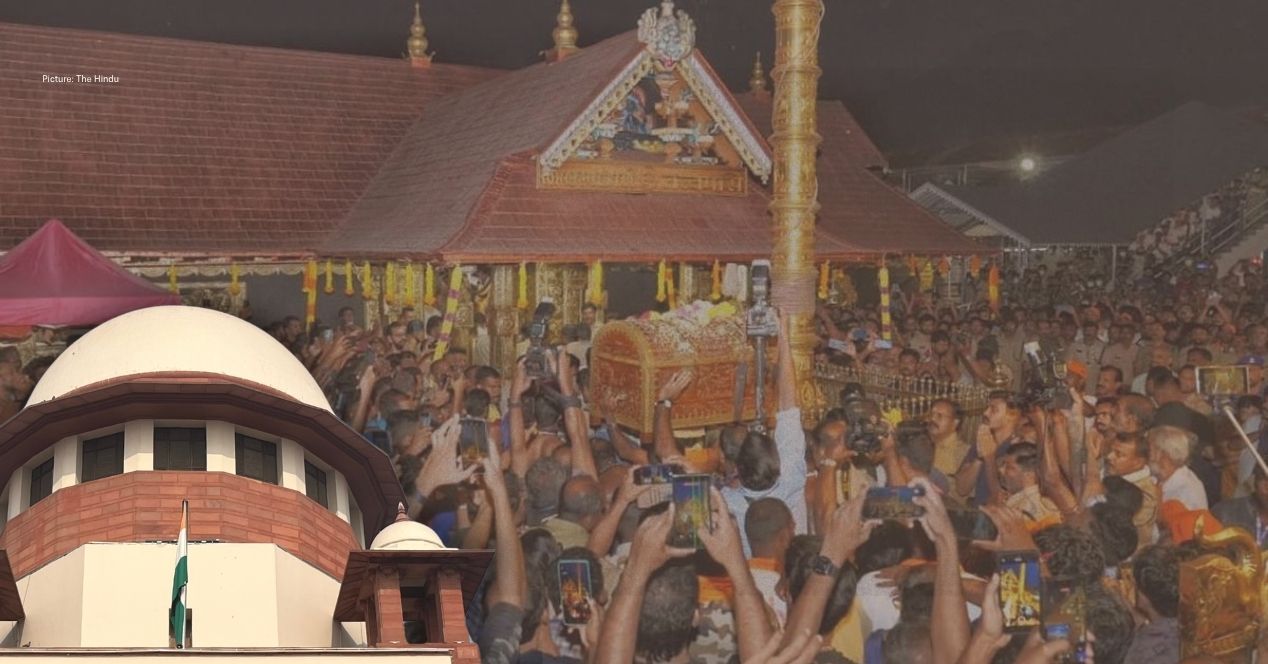
Sabarimala Reference | Day 7: Social welfare legislation cannot eviscerate denominational rights, review petitioners argue
Sabarimala ReviewJudges: Surya Kant CJI, B.V. Nagarathna J, M.M. Sundresh J, Ahsanuddin Amanullah J, Aravind Kumar J, A.G. Masih J, P.B. Varale J, R. Mahadevan J, Joymalya Bagchi J
Today, the nine-judge Constitution Bench led by Chief Justice Surya Kant continued hearing arguments in the Sabarimala reference.
The review petitioners argued that laws framed for social welfare cannot extend into matters of worship or alter the internal functioning of denominations. The Bench repeatedly raised questions on exclusion, the role of courts in examining religious practices and the limits of state intervention.
Background
On 28 September 2018, in Indian Young Lawyers Association v State of Kerala, a Constitution Bench of Chief Justice Dipak Misra, Justices R. F. Nariman, A. M. Khanwilkar, D. Y. Chandrachud and Indu Malhotra, in a 4:1 majority, held that the Sabarimala Temple’s exclusionary custom prohibiting the entry of women is unconstitutional. The custom barred women between the ages of 10 and 50 years old from entering the temple. The Judgment held that the said custom, and Rule 3(b) of the Kerala Hindu Places of Public Worship (Authorisation of Entry) Rules, 1965 — which allowed religious denominations to exclude women from public places of worship based on custom, violated the fundamental right to freedom of religion of female worshippers under Article 25 of the Constitution. The Bench held that the devotees of Lord Ayyappa were not a separate religious denomination and that the custom was not an essential religious practice (ERP).
More than 50 review petitions were subsequently filed by various individuals and organisations including Kantaru Rajeevaru, the Chief Priest of the Sabarimala Ayyappa Temple, the National Ayyappa Devotees (Women’s) Association, the Nair Service Society and the All Kerala Brahmin’s Association.
After CJI Misra retired, the review petition was heard on 13 November 2018 by a Bench of CJI Ranjan Gogoi, and Justices Khanwilkar, Nariman, Chandrachud and Malhotra. On 14 November 2019, the review bench by a narrow 3:2 majority decided to keep the review petitions pending and referred certain overarching constitutional questions to a larger bench. The review will be decided after the questions are clarified. The majority found that the Sabarimala judgement will have a bearing on other freedom of religion cases. Justices Nariman and Chandrachud dissented, holding that this speculation went beyond the narrow scope of a review petition. They dismissed challenges against the review.
On 13 January 2020, a nine-judge Bench led by CJI S.A. Bobde and Justices, R. Banumathi, Ashok Bhushan, Nageswara Rao, Mohan M. Shantanagoudar, S. Abdul Nazeer, R. Subhash Reddy, B.R. Gavai and Surya Kant began hearing the reference. Parties raised concerns that a review bench cannot refer questions of law to a larger bench.
On 10 February 2020, the nine-judge Bench upheld the referral order issued in the November 14 judgement. It held that the Court had the power to refer a point of law to a larger bench in a review petition, however, it did not publish any reasons for this finding at the time. On 11 May 2020, the Supreme Court published a detailed judgement substantiating the maintainability of the reference.
On 16 February 2026, a Bench of CJI Surya Kant with Justices Joymalya Bagchi and Vipul Pancholi listed the case for arguments on 7 April 2026.
Key Issues
- What is the scope and extent of judicial review with regard to a religious practice as referred to in Article 25 of the Constitution of India?
- What is the scope and extent of the word ‘morality’ under Articles 25 and 26 of the Constitution of India and whether it is meant to include Constitutional morality?
- What is the scope and ambit of right to freedom of religion under Article 25 of the Constitution of India?
- Whether the rights of a religious denomination under Article 26 of the Constitution of India are subject to other provisions of Part III of the Constitution of India apart from public order, morality and health?
- What is the meaning of expression “Sections of Hindus” occurring in Article 25 (2) (b) of the Constitution of India?
- What is the inter-play between the rights of persons under Article 25 of the Constitution of India and rights of religious denomination under Article 26 of the Constitution of India?
On relationship between Articles 25 and 26
Continuing his arguments from the previous day, Senior Advocate Gopal Subramanium argued that Article 25(1) is at the centre of the constitutional scheme as it represents the “expanse of religious freedom.” He submitted, “All persons are equally entitled to freedom of conscience and the right freely to profess, practice and propagate religion,”. These words, he contended, must be understood in an expansive and fundamental manner before interpreting the concept of denomination under Article 26. According to him, Article 25(1) covers four aspects: the doctrinal or philosophical content of a faith, the practices associated with that philosophy, the right of worship, and the extent of belief. He added that these rights are subject to public order, morality and health and to other provisions of Part III. He also distinguished between conscience and religion, submitting that conscience is internal and may exist even in an agnostic or atheistic individual, whereas religion is a system of beliefs with a doctrinal foundation.
Senior Advocate Aryama Sundaram submitted that Articles 25 and 26 must be read together. He disagreed with the position that Article 26 stands apart, and argued that the State’s power under Article 25 extends to denominations, but only within the framework of “classes and sections” and for purposes of social welfare and reform. He submitted that Article 25(2)(a) deals with secular activities and not religious matters. On Article 25(2)(b), he argued that the expression “classes and sections” does not include gender. According to him, the power to throw open religious institutions on the basis of gender is not traceable to Article 25(2)(b).
Sundaram argued that where a form of worship is based on the nature of the deity, for instance as a naishtik brahmachari and that reasoning is not arbitrary, illogical or reprehensible, the Court ought not to interfere merely because a claim is made under Article 14. He added that Article 26(b) is “nothing but an elaboration of a right already granted under Article 25(1).”
Justice Amanullah asked whether Sundaram’s position creates a contradiction, since Article 25(2)(b) speaks of “throwing open” institutions to “all classes and sections.” Sundaram responded that “classes and sections” refers to those similarly placed. Sundaram submitted that many Muslim places of worship are not thrown open to persons outside the faith, whereas Hindu temples, including Sabarimala, are generally open, subject to compliance with certain requirements. Justice Amanullah observed that in dargahs, “anybody can go,” to which Sundaram agreed, while stating that this may not apply to all mosques. Justice Bagchi noted that while there may not be a bar on entry of non-Muslims into mosques, the question is whether they can participate in worship. He also observed that while non-Hindus may enter temples, specific religious practices may still be restricted. In response, Sundaram clarified that Sabarimala does not permit the offering of “namaz” within the temple.
Senior Advocate Rakesh Dwivedi submitted that the expression “classes and sections” in Article 25(2)(b) must be linked to caste-based exclusion and must be read with Articles 17 and 15(2), which address untouchability and access to public spaces. Referring to the Poona Pact, 1932 and the Government of India Act, 1935, he submitted that the identification of such classes was tied to those historically treated as untouchables, with categories differing across provinces. He pointed out that this approach continues under the Constitution through Articles 341 and 342, where Scheduled Castes and Scheduled Tribes are notified state-wise.
Dwivedi submitted that extending Article 25(2)(b) beyond this context would affect denominational rights under Article 26(b). He raised the question whether “Hindu religious institutions of a public character” refers only to entry into temples or to the institution as a whole, submitting that a broader reading could impact the right of denominations to manage their own affairs.
On rights of religious denominations
Subramanium submitted that denominational rights are not divorced from individual rights under Article 25(1). He explained that when individuals come together in an institutional setting, they continue to exercise Article 25(1) rights, but in a collective form that attracts protection under Article 26—the freedom to manage religious affairs. Justice Joymalya Bagchi asked whether there can be proponents and opponents within a denomination. Subramanium responded that a denomination is not an “inert” body and that there can be discussion and debates, as multiple schools of philosophy exist within the same faith.
At the same time, Subramanium submitted that while Article 25(1) allows an individual to navigate matters of religion, once a person adopts a creed and associates with a denomination, he is expected to function within its discipline. He submitted that it is not ordinarily open to such a person to enter a denomination and seek to alter its doctrine from within.
On essential religious practices
Justice B.V. Nagarathna observed that an impression has been created that only essential practices are protected. Subramanium responded that the doctrine should not be discarded. He submitted that it serves as a tool to identify claims that are “masked” as religious but do not in fact belong to religion. Justice Nagarathna further observed that the court cannot sit in judgment as to what is an essential religious practice, while Justice Sundresh stated that the doctrine may still have relevance in judicial review, particularly where Article 25(2)(b) is invoked. Subramanium submitted that courts are not precluded from examining what constitutes religion, its tenets, and how a belief is asserted, so long as the inquiry remains within constitutional limits. He stated that the only area beyond scrutiny is the inner realm of faith of a devotee.
Sundaram argued that conscience “is a moral compass within which each one lives.” He questioned the relevance of the essential religious practices doctrine, submitting that once a practice is religious and protected by freedom of conscience, and does not infringe on the rights of others, a person is entitled to follow it. He argued that the essentiality test turns the issue into a question of fact for courts, even as courts say they will not enter ecclesiastical matters. According to him, the correct inquiry is whether the practice is in the form of religious worship. He said such forms may be found in shastras, long-standing custom, usage, or the manner in which a group chooses to worship a deity.
On social welfare legislations by State
On Article 25(2)(b), Subramanium submitted that social welfare and reform cannot be used to invade denominational rights under Article 26(b). There must be scrutiny to determine whether a law genuinely advances social reform. Justice Nagarathna posed a hypothetical question on temple entry, asking whether permitting entry in the name of social reform would amount to an invasion. Subramanium responded that courts would have to examine whether the exclusion is based on custom or usage and whether it fundamentally takes away the rights of devotees.
On constitutional morality, Justice Ahsanuddin Amanullah asked whether it can be a ground for judicial review. Subramanium responded, “It cannot be an exclusive factor in judicial review,” and said it cannot operate as an independent test to strike down legislation. He submitted that provisions for equality and abolishment of untouchability under Article 14 and Article 17 themselves embody moral principles. However, constitutional morality must be rooted in the text of the Constitution and cannot be used as a standalone doctrine.
Justice Sundresh asked how far the State’s power to legislate extends when a religious practice conflicts with other provisions of Part III. Subramanium submitted that Articles 25(2)(a) and (b) enable legislation in specific areas, but such power must be exercised carefully. He said that while social reform laws may have a wide scope, they must have a direct nexus with the objective sought to be achieved and must not eviscerate denominational rights under Article 26. He added that otherwise Article 25(2)(b) would become an overarching intrusion into religious freedom.
Sundaram argued that the restrictions under Article 25(2)(b) is not an absolute power. The State must show that any action is in furtherance of social welfare or reform and cannot simply open temples without examining whether such action meets that objective.
Senior Advocate Mukul Rohatgi submitted that the fundamental right to religion under Article 25(1) is “subject to several restrictions” such as public order, health, morality, other provisions of Part III, and Article 25(2). He argued that morality must be interpreted with the same high threshold as applied to public order and health. Further, morality must be seen “through the lens of religion” and not “general morality.” Further, he argued that constitutional morality cannot be a ground to curtail rights. Moreover, it cannot be a new restriction under Article 25 and 26
Dwivedi: “Public character” under Articles 27 and 28
Dwivedi pointed out that Article 27 provides that no person shall be compelled to pay taxes for the promotion or maintenance of any particular religion or denomination, and Article 28 bars religious instruction in institutions wholly funded by the State. He submitted that the question of “public character” arises when State funds are involved.
He submitted that funding, as given to Devaswoms under Article 290A may give a Hindu religious institution a public character. He argued that in such a situation, either the institution itself chooses to open up, or the question of State involvement arises. Otherwise, he submitted, the institution continues as that of a private religious denomination.
Kaul: Validity of excommunication law
Senior Advocate Neeraj Kishan Kaul, appearing for the Syedna of the Dawoodi Bohra community, traced the reference to the challenge to the Bombay Prevention of Excommunication Act, 1949, which had prohibited excommunication and was struck down in Sardar Syedna Taher Saifuddin v State of Bombay (1957) for violating denominational rights under Article 26(b). He submitted that the present reference raises the question whether such a law can be sustained under Article 25(2)(b), and how it interacts with the rights of a denomination under Article 26(b). He submitted that Sardar Syedna Taher Saifuddin was reopened through a writ petition under Article 32.
Justice Nagarathna questioned how such a route could be used to revisit a Constitution Bench judgement. She observed that “there will be no finality” if such practices are permitted. Kaul responded, “I completely agree… but I am here because I have been sent here.” Justice Nagarathna noted that the Court was now dealing with questions of practice as well as law. The Chief Justice observed that the Court may examine, “as a general principle”, whether it can revisit its own judgements in exercise of jurisdiction under Articles 32 or 226.
The Court will continue hearing the matter tomorrow.