Sabarimala Reference | Day 13: Religious authority cannot extend to bodily autonomy, respondents contend
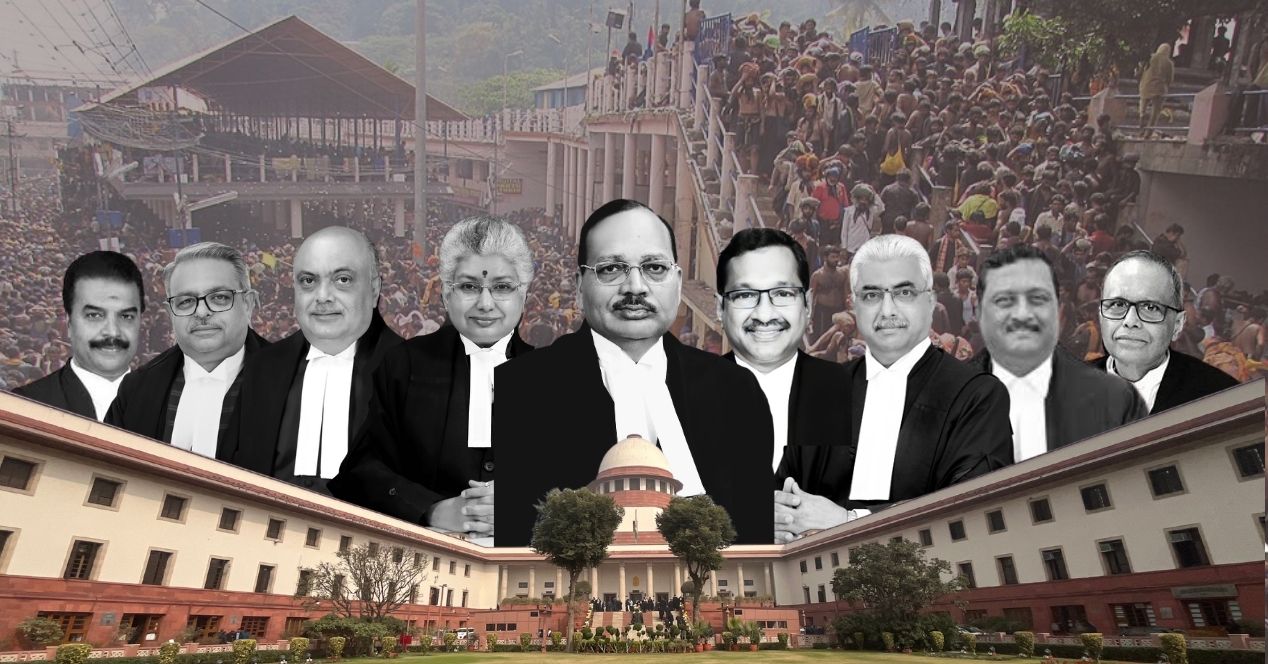
Sabarimala ReviewJudges: Surya Kant CJI, B.V. Nagarathna J, M.M. Sundresh J, Ahsanuddin Amanullah J, Aravind Kumar J, A.G. Masih J, P.B. Varale J, R. Mahadevan J, Joymalya Bagchi J
A hearing that began with questions on denominational autonomy and essential religious practices gradually narrowed into something far more intimate: the power of religious communities over individual bodies.
Today, as the nine-judge Bench led by Chief Justice Surya Kant continued hearing the Sabarimala Reference, Senior Advocate Raju Ramachandran described excommunication as a form of “civil death”. Senior Advocate Siddharth Luthra argued that practices involving genital mutilation of seven-year-old girls could not survive constitutional scrutiny merely because they were asserted in the language of faith. Through the day, the Bench grappled with a common issue: whether Article 26 protects religious authority even when its consequences affect dignity, autonomy, sexual health and individual conscience.
Background
On 28 September 2018, in Indian Young Lawyers Association v State of Kerala, a Constitution Bench of Chief Justice Dipak Misra, Justices R. F. Nariman, A. M. Khanwilkar, D. Y. Chandrachud and Indu Malhotra, in a 4:1 majority, held that the Sabarimala Temple’s exclusionary custom prohibiting the entry of women is unconstitutional. The custom barred women between the ages of 10 and 50 years old from entering the temple. The Judgment held that the said custom, and Rule 3(b) of the Kerala Hindu Places of Public Worship (Authorisation of Entry) Rules, 1965 — which allowed religious denominations to exclude women from public places of worship based on custom, violated the fundamental right to freedom of religion of female worshippers under Article 25 of the Constitution. The Bench held that the devotees of Lord Ayyappa were not a separate religious denomination and that the custom was not an essential religious practice (ERP).
More than 50 review petitions were subsequently filed by various individuals and organisations including Kantaru Rajeevaru, the Chief Priest of the Sabarimala Ayyappa Temple, the National Ayyappa Devotees (Women’s) Association, the Nair Service Society and the All Kerala Brahmin’s Association.
After CJI Misra retired, the review petition was heard on 13 November 2018 by a Bench of CJI Ranjan Gogoi, and Justices Khanwilkar, Nariman, Chandrachud and Malhotra. On 14 November 2019, the review bench by a narrow 3:2 majority decided to keep the review petitions pending and referred certain overarching constitutional questions to a larger bench. The review will be decided after the questions are clarified. The majority found that the Sabarimala judgement will have a bearing on other freedom of religion cases. Justices Nariman and Chandrachud dissented, holding that this speculation went beyond the narrow scope of a review petition. They dismissed challenges against the review.
On 13 January 2020, a nine-judge Bench led by CJI S.A. Bobde and Justices, R. Banumathi, Ashok Bhushan, Nageswara Rao, Mohan M. Shantanagoudar, S. Abdul Nazeer, R. Subhash Reddy, B.R. Gavai and Surya Kant began hearing the reference. Parties raised concerns that a review bench cannot refer questions of law to a larger bench.
On 10 February 2020, the nine-judge Bench upheld the referral order issued in the November 14 judgement. It held that the Court had the power to refer a point of law to a larger bench in a review petition, however, it did not publish any reasons for this finding at the time. On 11 May 2020, the Supreme Court published a detailed judgement substantiating the maintainability of the reference.
On 16 February 2026, a Bench of CJI Surya Kant with Justices Joymalya Bagchi and Vipul Pancholi listed the case for arguments on 7 April 2026.
Key Issues
- What is the scope and extent of judicial review with regard to a religious practice as referred to in Article 25 of the Constitution of India?
- What is the scope and extent of the word ‘morality’ under Articles 25 and 26 of the Constitution of India and whether it is meant to include Constitutional morality?
- What is the scope and ambit of right to freedom of religion under Article 25 of the Constitution of India?
- Whether the rights of a religious denomination under Article 26 of the Constitution of India are subject to other provisions of Part III of the Constitution of India apart from public order, morality and health?
- What is the meaning of expression “Sections of Hindus” occurring in Article 25 (2) (b) of the Constitution of India?
- What is the inter-play between the rights of persons under Article 25 of the Constitution of India and rights of religious denomination under Article 26 of the Constitution of India?
Ramachandran: Excommunication amounts to “civil death”
Reading from the N.P. Nathwani Commission report, Ramachandran referred to instances of marital breakdown, social ostracization, loss of employment and exclusion from family burial grounds due to pressure from the Syedna. In one instance, he said a woman was asked to condemn her husband as a “kafir” after he contested elections against candidates supported by the Syedna. He contended that fear of reprisal prevents victims from approaching courts.
Justice M.M. Sundresh responded that the question before the Court is how far it can intervene, while Justice B.V. Nagarathna pointed out that the Bombay Prevention of Excommunication Act, 1949 had already been repealed in Sardar Syedna Taher Saiffuddin Saheb v State of Bombay (1962). Ramachandran replied that the five-judge bench in that matter had specifically recorded that the validity of excommunication remained unresolved.
Justice Joymalya Bagchi noted that the Maharashtra Prohibition of Social Boycott (Prevention, Prohibition and Redressal) Act, 2016 had not been challenged, but clarified that the present Bench was concerned only with the interplay between Articles 25 and 26 and whether a practice can survive social reform legislation. CJI Surya Kant added that the Court was not examining individual disputes but the constitutional questions arising from them.
Ramachandran: Article 26 cannot extinguish individual conscience
Tracing the history of the dispute, Ramachandran argued that while the 1949 legislation was upheld in civil proceedings initiated by an excommunicated member, Sardar Syedna arose from an Article 32 petition filed by the Syedna. He questioned why directly affected members of the community were not heard. Justice Nagarathna and the CJI agreed that the community was a “direct stakeholder.” The CJI remarked, “The manner in which the writ petition was entertained is questionable.”
Ramachandran argued that Article 25 protects individual freedom of conscience, while Article 26 is only an expression of those rights through denominations. Referring to the Preamble’s guarantee of “liberty of thought, expression, belief, faith and worship” and fraternity assuring “the dignity of the individual,” he submitted that denominations cannot be granted extraordinary status over individuals. Adopting Senior Advocate Darius Khambata’s submissions, he argued, “Article 25 can stand alone but Article 26 cannot.”
When asked by Justice Nagarathna, Ramachandran submitted that excommunication extinguishes rights under Article 25(1) by preventing members from entering mosques, attending religious gatherings and remaining within the community.
Justice Nagarathna: India is a civilisation deeply connected to religion
Ramachandran then said that while religions may impose discipline, courts must intervene where the consequences destroy dignity and liberty. Justice Amanullah questioned whether courts could examine “proportionality” once a practice carried even a slight religious element and warned against dilution of Article 26 protection. Justice Nagarathna asked whether excommunication is ultimately a secular or a religious act. Ramachandran responded that even where the trigger for excommunication appears religious, courts can intervene if its impact disproportionately affects dignity and liberty. Referring to Commissioner, Hindu Religious Endowments, Madras v Sri Lakshmindra Thirtha Swamiar of Sri Shirur Mutt (1954), he argued that practices which are “mainly secular” fall outside both provisions.
Justice Nagarathna repeatedly expressed concern over the wider implications of judicial review in matters of religion, observing that India remains a civilisation deeply connected to religion. She warned that the Court’s approach could open the door to hundreds of petitions questioning religious practices. Ramachandran responded, “We are a civilisation under the Constitution,” and argued that courts cannot adopt a judicial “hands off approach” where there is a clear violation of fundamental rights.
Ramachandran: Constitutional morality is “a tool, not a test”
Relying extensively on then CJI B.P. Sinha’s dissent in Sardar Syedna, Ramachandran argued that Article 25(1) protects individuals against coercive denominational practices on pain of penalties like excommunication. He submitted that the 1949 legislation was intended to prevent persons from being reduced to “pariahs” within their own community and pointed to CJI Sinha’s observation that the consequences of excommunication resembled untouchability. Constituent Assembly debates were cited to argue that Article 25(2)(b) was consciously introduced to permit curtailment of harmful practices.
“If the word constitutional morality is irritating, use constitutional ethos,” submitted Ramachandran, emphasising that what matters are the core constitutional values that guide interpretation. He added that questioning constitutional morality is akin to questioning the basic structure doctrine. When Justice Bagchi observed that constitutional morality could not become the “touchstone” to test either legislation or religion and that courts must instead identify violations of specific constitutional guarantees. Ramachandran agreed.
He strongly objected to the maintainability issue occupying the nine-judge Bench’s time. Calling the maintainability issue “a note of protest,” Ramachandran strongly urged the Bench to refrain from engaging with the question as time limits have already been crossed.
Luthra: A denomination cannot become an “empty shell”
Luthra, argued that Article 26 cannot override the fundamental rights of the very individuals who constitute the denomination. Describing India as a country of “diametric plurality,” he submitted that constitutional adjudication must account for inter and intra-individual plurality or the coexistence of multiple and overlapping religious influences. Referring to Article 26(b), he said denominations are entitled to frame institutional rules governing internal affairs, but cannot extend control of the spiritual lives of its members in contravention of their fundamental rights. According to him, if individuals are excluded for non-conformity, what remains is merely an empty shell of the denomination. He submitted that Article 25 does not require “doctrinal purity”, and must be read alongside the limitations of public order, morality, health and the other provisions of Part III.
Luthra: “Mutilation of a vital organ” cannot claim constitutional protection
Luthra argued that certain practices necessarily fall foul of constitutional limitations. Referring to FGM, he submitted that the procedure involves removal of the skin surrounding the clitoris at the age of seven, affecting a part of the body containing around 10,000 nerve endings. Justice Bagchi described FGM as mutilation of a vital organ affecting reproductive health and sexual autonomy, while Justice Nagarathna added that it also implied morality. Luthra agreed, pointing out that the practice was not confined to one community and historically predated organised religion, existing among sections of Sunni Muslims in Kerala, Coptic Christians and elsewhere across the world.
Justice Amanullah observed that the very expression indicates distortion of human anatomy and serves “no beneficial purpose”. Agreeing, Luthra added that the issue becomes more serious because it is performed on minors incapable of consent. While no specific Indian legislation bans FGM, around 59 countries have prohibited the practice and courts in countries such as Egypt and Australia had also passed judicial orders against it.
When Justice Amanullah asked whether he was moving “a bit off track”, Luthra replied that the thread connecting FGM with excommunication is the consequence of non-compliance. Justice Bagchi then observed that the real issue is whether FGM can be treated as a protected religious practice and asked whether parents who refuse to comply face excommunication.
Advocate Nizam Pasha, who appeared on behalf of review petitioners, denied that any worldly or religious sanction attached to non-observance and argued that the practice was not “mutilation” but a symbolic form of circumcision. Justice Bagchi responded that male circumcision could not be equated with “genital cutting involving the clitoris,” while Justice Amanullah remarked: “If FGM is compulsory we have to adjudicate on the basis of that”.
Luthra: Articles 25 and 26 cannot override Part III
Referring to minors subjected to FGM, Luthra submitted that the issue involved unequal “power relations,” similar to those recognised in sexual offence jurisprudence and Vishaka v State of Rajasthan (1997). Justice Amanullah and CJI Surya Kant observed that Luthra appeared to be advancing a “novel proposition” that Articles 25 and 26 could not be given an overriding effect where they violate individual rights. Luthra clarified that he was not treating those rights as absolute and that courts would still need to adjudicate on a case-to-case basis. Justice Nagarathna suggested that necessary limitations already existed within Article 25(1). Luthra agreed, but added that both articles are expressly subject to the other provisions of Part III.
Gupta: Accumulated constitutional wisdom must guide the reference
Senior Advocate Jaideep Gupta appeared for the State of Kerala. Relying on the doctrine of precedent, he argued that the Court must not depart from “accumulated constitutional wisdom” developed over 75 years. Referring to the House of Lords decision in Bourne v Keane, later accepted in Indian jurisprudence, Gupta submitted that courts may only depart from precedent if it is plainly erroneous or produces injustice or inefficiency. He stressed that when courts interpret Articles 25 and 26, they do so in the context of governance and constitutional policy rather than theology.
Gupta: Essential religious practices are determined through evidence
Religion need not be exhaustively defined in the Constitution, said Gupta, submitting that courts receive sufficient guidance on a case-by-case basis. He contended that the essential religious practices (ERP) doctrine is not an addition to the Constitution but an exercise in interpretation. Repeating a question at the heart of these hearings, Justice Nagarathna asked who ultimately decides whether a practice is “essential”? Referring to Shirur Mutt and Durgah Committee, Gupta replied that courts have long determined essentiality through evidence and expert testimony. Justice Nagarathna observed that the exercise resembled proof of custom and usage, to which Gupta agreed.
When Gupta interpreted Article 25 to mean “nobody’s right is higher than the other’s right,” Justice Bagchi remarked that the constitutional scheme similarly provides that nobody’s conscience is superior to another’s. Illustrating the operation of the ERP test, Gupta then referred to disputes concerning cow slaughter, Ram Janmabhoomi, Parasnath Hill and the Kamakhya Temple. Responding to questions from the Bench on conflicts between rights, Gupta said that some principle of resolution becomes necessary, such as that of harmonious construction adopted in Sri Venkataramana Devaru v The State of Mysore (1957).
Arguments will resume on 12 May.