
Sabarimala Reference | Day 14: Constitution envisages reform within religion, respondents argue
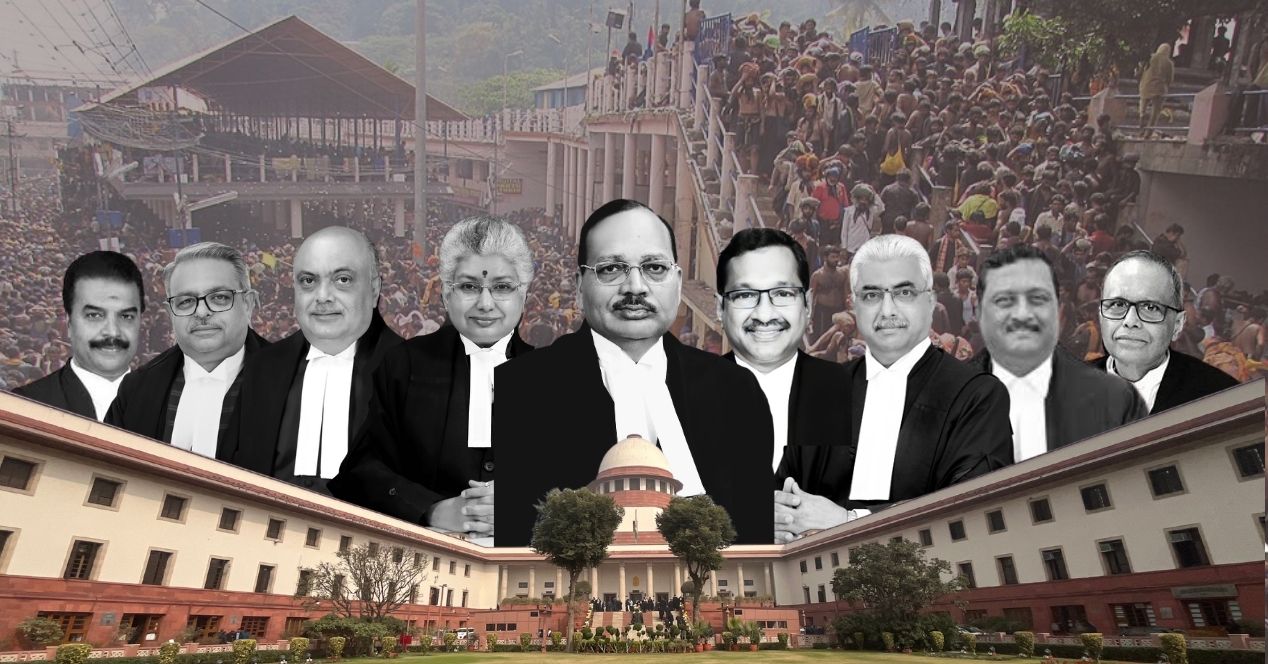
Sabarimala ReviewJudges: Surya Kant CJI, B.V. Nagarathna J, M.M. Sundresh J, Ahsanuddin Amanullah J, Aravind Kumar J, A.G. Masih J, P.B. Varale J, R. Mahadevan J, Joymalya Bagchi J
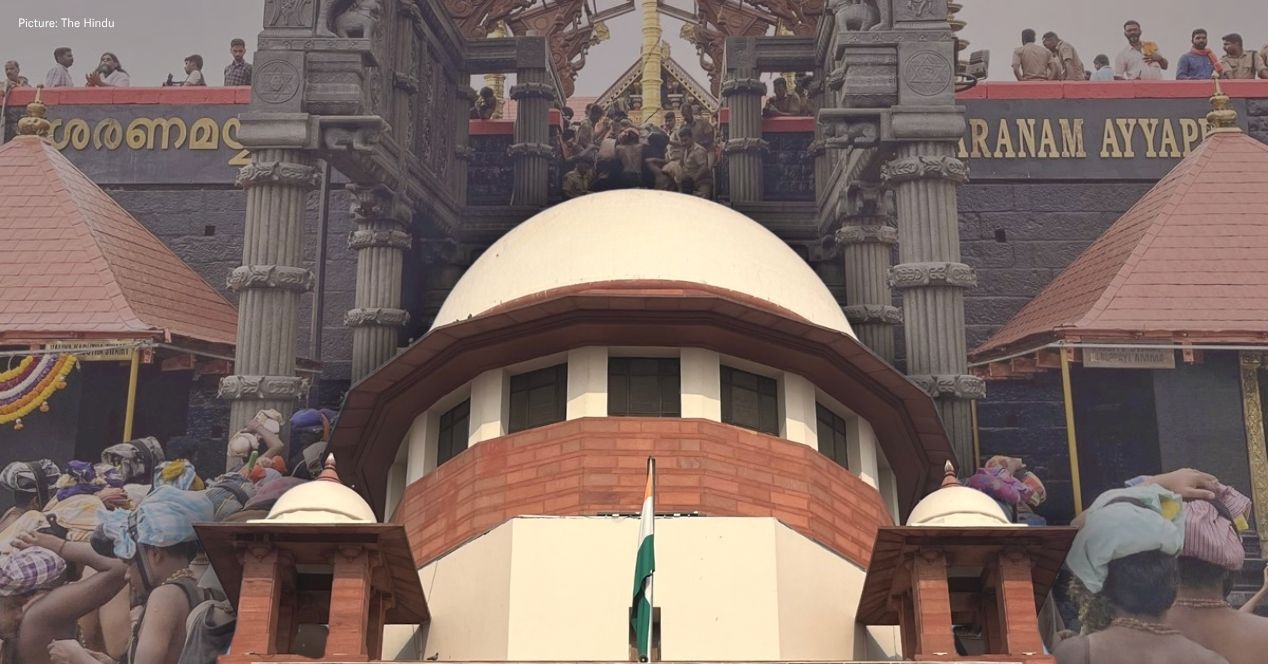
Today, the nine-judge Bench led by Chief Justice Surya Kant continued hearing the Sabarimala Reference, with arguments centering on the Constitution’s relationship with social reform.
Senior Advocate Menaka Guruswamy argued that the Constitution was framed with the confidence to reform entrenched practices within religion itself. Senior Advocate Sanjay Hegde located the dispute within the history of anti-caste struggles such as the Vaikom Satyagraha, contending, “It is not the god which discriminates but man does.” Senior Advocate Shadan Farasat questioned whether prevailing social attitudes could define morality at all and urged the Court to discard the essential religious practices (ERP) doctrine. Submissions were also made by Senior Advocates Jaideep Gupta and Vijay Hansaria, and Advocate Shradha Deshmukh.
Background
On 28 September 2018, in Indian Young Lawyers Association v State of Kerala, a Constitution Bench of Chief Justice Dipak Misra, Justices R. F. Nariman, A. M. Khanwilkar, D. Y. Chandrachud and Indu Malhotra, in a 4:1 majority, held that the Sabarimala Temple’s exclusionary custom prohibiting the entry of women is unconstitutional. The custom barred women between the ages of 10 and 50 years old from entering the temple. The Judgment held that the said custom, and Rule 3(b) of the Kerala Hindu Places of Public Worship (Authorisation of Entry) Rules, 1965 — which allowed religious denominations to exclude women from public places of worship based on custom, violated the fundamental right to freedom of religion of female worshippers under Article 25 of the Constitution. The Bench held that the devotees of Lord Ayyappa were not a separate religious denomination and that the custom was not an essential religious practice (ERP).
More than 50 review petitions were subsequently filed by various individuals and organisations including Kantaru Rajeevaru, the Chief Priest of the Sabarimala Ayyappa Temple, the National Ayyappa Devotees (Women’s) Association, the Nair Service Society and the All Kerala Brahmin’s Association.
After CJI Misra retired, the review petition was heard on 13 November 2018 by a Bench of CJI Ranjan Gogoi, and Justices Khanwilkar, Nariman, Chandrachud and Malhotra. On 14 November 2019, the review bench by a narrow 3:2 majority decided to keep the review petitions pending and referred certain overarching constitutional questions to a larger bench. The review will be decided after the questions are clarified. The majority found that the Sabarimala judgement will have a bearing on other freedom of religion cases. Justices Nariman and Chandrachud dissented, holding that this speculation went beyond the narrow scope of a review petition. They dismissed challenges against the review.
On 13 January 2020, a nine-judge Bench led by CJI S.A. Bobde and Justices, R. Banumathi, Ashok Bhushan, Nageswara Rao, Mohan M. Shantanagoudar, S. Abdul Nazeer, R. Subhash Reddy, B.R. Gavai and Surya Kant began hearing the reference. Parties raised concerns that a review bench cannot refer questions of law to a larger bench.
On 10 February 2020, the nine-judge Bench upheld the referral order issued in the November 14 judgement. It held that the Court had the power to refer a point of law to a larger bench in a review petition, however, it did not publish any reasons for this finding at the time. On 11 May 2020, the Supreme Court published a detailed judgement substantiating the maintainability of the reference.
On 16 February 2026, a Bench of CJI Surya Kant with Justices Joymalya Bagchi and Vipul Pancholi listed the case for arguments on 7 April 2026.
Key Issues
- What is the scope and extent of judicial review with regard to a religious practice as referred to in Article 25 of the Constitution of India?
- What is the scope and extent of the word ‘morality’ under Articles 25 and 26 of the Constitution of India and whether it is meant to include Constitutional morality?
- What is the scope and ambit of right to freedom of religion under Article 25 of the Constitution of India?
- Whether the rights of a religious denomination under Article 26 of the Constitution of India are subject to other provisions of Part III of the Constitution of India apart from public order, morality and health?
- What is the meaning of expression “Sections of Hindus” occurring in Article 25 (2) (b) of the Constitution of India?
- What is the inter-play between the rights of persons under Article 25 of the Constitution of India and rights of religious denomination under Article 26 of the Constitution of India?
Gupta: Courts must decide essential religious practices
Gupta continued his submissions for the State of Kerala, arguing that courts cannot avoid determining ERPs merely because religion is involved. While restraint must be exercised by courts, it does not substitute theological views and only assesses evidence. He relied on Adi Saiva Sivachariyargal Nala Sangam v Government of Tamil Nadu (2015), where the Court described determination of ERPs as a constitutional duty performed by courts acting as “the Constitutional arbiter”. Referring to Ratilal Panachand Gandhi v State of Bombay (1954), he argued that there is no exhaustive test to distinguish religious practices from secular activities associated with religion and that common sense will have to be applied.
Gupta: Social reform may require interference with religion
Gupta argued that Article 25(2)(b) was included in the Constitution to enable restriction of social practices that had become sanctified as religious. “If you want to reform social rules, you will have to touch religious practice,” he submitted. He argued that social rules were often raised to the platform of religious rules, referring to exclusion from temples and public tanks on caste lines. Justice Aravind Kumar asked why courts or the State should deprive communities of practices followed for centuries. Justice B.V. Nagarathna observed that reforms cannot “hollow out” religion or breach protections guaranteed under Article 25(1). Gupta agreed that the “entirety of religion” cannot be destroyed, but argued that Article 25(1) remains expressly subject to Article 25(2)(b).
Referring to the issue of temple entry, he submitted that the right to worship forms an essential aspect of Hindu religion and exclusion violates Article 25(1). Gupta argued that “religious denomination” under Article 26 cannot be reduced to a rigid formula and that sections of Hindus under Article 25(2)(b) would include women. Gupta submitted that denominations arise when groups gather around common religious beliefs and practices, but are not identical to religion itself. Justice Joymalya Bagchi observed that courts must determine the extent to which a social welfare legislation under Article 25(2)(b) may encroach upon denominational rights under Article 26(b). Gupta responded that it would be a “doomsday scenario” if the Court accepted every argument against judicial review.
Hansaria: Courts share responsibility for social reform
Appearing for three women who were denied entry into the Sabarimala temple, Hansaria argued that if Article 26 is treated as a manifestation of Article 25(1), legislation enacted for social welfare or reform would necessarily prevail over denominational rights. He submitted that Article 26 does not have supremacy over other constitutional provisions as a “notwithstanding” clause is absent. Hansaria then described menstruation as a continuing social taboo and referred to observations made by Justice R. Mahadevan in Jaya Thakur v Union of India. Justice Nagarathna responded that this would depend upon the perspective of the devotee, while Justice M.M. Sundresh observed that no similar restriction exists in other temples. Hansaria argued that social reform legislation under Article 25(2)(b) cannot be invalidated merely because a group claims protection as a religious practice. Justice Nagarathna pointed out that it was the Court and not the State which struck down the practice in the Sabarimala matter. Hansaria submitted that courts nevertheless bear a responsibility to remove taboos and argued, “Opposing a social reform is an immoral act.” Hansaria added that any classification excluding women would still have to satisfy the twin tests under Article 14. When he pointed out that such exclusion was absent in almost all other major Ayyappa temples, Justice Nagarathna observed that women could “wait till 50” and enter other Ayyappa temples until then.
Hegde: Religion must pass through the “filter of reason”
Hegde began with what he described as a “rationalist perspective”. He clarified that rationalists are “not necessarily atheists” but those who believe that everything, including religion, has to go through the filter of reason. Hegde argued that many “accretions to religion” claiming religious sanction had historically been used to justify oppression and ought not to receive constitutional protection. He placed Articles 25 and 26 within a larger history of social reform, tracing the origins to the Vaikom Satyagraha, where oppressed castes were denied access not only to temples but even to surrounding roads. He submitted that social reform legislation may intervene once practices move beyond the sanctum and acquire a broader public character.
Hegde: God does not discriminate, man does
Hegde argued that Article 25(1) protects the right to “freely profess, practice and propagate religion,” without tying individuals permanently to any one faith. Justice Ahsanuddin Amanullah responded that such an interpretation could become an “absurdity” if a person claimed to belong to different religions at different times of the day. Justice Nagarathna remarked that Indians are often “eclectic” in matters of belief. Hegde submitted that denominational rights arise only after individuals “collect and congregate”. They are subject to Part III, Article 13 and constitutional limitations on social reform. According to him, the Constitution protects religious autonomy in religious matters and not secular matters. Referring to the 2018 Sabarimala judgement, he argued that complete exclusion of women runs foul to the Constitution as “a man-made rule cannot survive in a constitutional scheme.”
Guruswamy: The Constitution envisages reform within Hinduism
Appearing in an intervention application filed by Swami Agnivesh, Guruswamy argued that the Constitution accommodates social change within structures of faith. She submitted that unlike in the United States or Germany, India’s constitutional ethos does not adopt a strict non-interference model in matters of religion. “The State is religiously agnostic, but it also reforms,” she argued, describing India as a “classical welfare state”. Referring to Articles 15, 16 and 17, Guruswamy submitted that the Constitution deliberately intervenes in entrenched structures of caste and gender discrimination. Justice Sundresh observed that reform concerns society as much as religion. Justice Nagarathna pointed out that Article 25(2) is not confined only to Hindus. Guruswamy submitted, “Sections of Hindus under Article 25(2)(b) necessarily include women of all age groups.” Referring to temple entry laws and the Hindu Code reforms enacted alongside the Constitution, she argued that the framers consciously envisioned “a land of faith” capable of self-reform. Quoting Constituent Assembly debates, she submitted that conscience must sometimes support reform even where “a large majority” may disagree. Justice Nagarathna responded that such reform measures had not directly reached Article 25(1), to which Guruswamy replied that reform was already “envisaged” within Article 25.
Guruswamy: Article 26 grants a power to “manage”, not “control”
Guruswamy argued that the use of the word “manage” in Article 26, rather than “control,” reflects a conscious constitutional limitation on denominational autonomy. Justice Amanullah observed that “control” and “management” operate in different legal contexts, noting that institutions may be controlled through broader corporate structures but merely managed in day-to-day affairs. Guruswamy responded, “Management under Article 26 reflects a lesser degree of autonomy than control.” Justice Nagarathna gave the example of succession within a religious mutt, observing that the State cannot interfere in the selection of disciples or religious heads. Justice Sundresh remarked that “manage” has to be given a restricted meaning because denominations cannot exercise powers beyond what Article 26 confers. Guruswamy argued that constitutional civilisation is not preserved through rigidity but through reform and contended, “Civilisations are reformed when balance is upset.” Relying on Devaru and Riju Prasad Sharma v State of Assam (2015), she urged for harmonious construction of the conflicting provisions..
Guruswamy: Codified religion must be tested against constitutional values
Guruswamy’s next point was that restrictions on individual rights must be tested against the constitutional objective sought to be achieved. She submitted that restrictions must pursue a legitimate aim, remain necessary, adopt the least restrictive measure and avoid disproportionate impact. Guruswamy argued that codification freezes social practices in time and creates difficulty when courts continue to interpret norms captured decades ago. “Tradition itself is not stagnant. Codified law is stagnant,” she submitted, arguing that constitutional values provide the only workable interpretive lens in such cases. Referring to Article 51A(h), she added that the Constitution imposes a duty to renounce practices derogatory to the dignity of women. A restrictive interpretation of “sections of Hindus” would effectively wipe out Hindu women’s right to worship despite their inclusion within the statutory definition of Hindus, she argued.
Farasat: Constitutional morality cannot be separated from public morality
Appearing for two professors from Scheduled Caste communities who had entered into an inter-caste marriage, Farasat argued that constitutional morality and public morality cannot be treated as mutually exclusive concepts. Quoting the Preamble, Farasat argued, “Values of justice, liberty, equality and fraternity were given to ourselves by the people of India and therefore necessarily formed part of public morality.” Referring to a 2025 survey recording opposition to inter-caste and inter-religious marriages, he argued that prevailing social attitudes may often reflect prejudice. CJI Surya Kant warned against reliance on surveys “tailored” with preconceived academic agendas and observed that responses could vary among parents, grandparents and younger persons. Justice Nagarathna remarked that every individual has a right to marry a person of their choice and questioned why prejudice should matter at all. Farasat responded that public attitudes change over time and that constitutional morality must prevail where societal prejudice conflicts with constitutional values. Referring to the basic structure doctrine, he argued that constitutional morality cannot be dismissed merely because it is not textually defined.
Farasat: ERP test “should go”
According to Farasat, the ERP doctrine casts a “shadow” over Article 25(1) and has become such a “narrow bottleneck” that “nothing goes into the bottle.” He argued that the test be discarded entirely and urged the Court to instead examine sincerity of belief alongside competing constitutional interests. Constitutional protection does not depend upon proving that a practice is “essential,” he said. Justice Sundresh observed that the Constitution distinguishes only between secular and religious practices and does not speak of “essential” or “integral” practices. Farasat agreed, submitting that once a sincere religious belief falls within Article 25(1), restrictions must be tested against competing constitutional rights and legitimate State interests.
On the phrase “sections of Hindus” in Article 25(2)(b), Farasat argued that “sections” cannot be equated with “classes” because the Constitution consciously uses both expressions. He submitted that excluding women from the expression would produce a discriminatory interpretation. Referring to Article 25’s use of the phrase “all persons,” he argued that the constitutional guarantee extends not merely to individuals but to denominations and groups as well, a position reflected in the Constituent Assembly debates on draft Article 19.
Deshmukh: The Constitution protects individual faith, not every religious custom
Distinguishing individual faith from community customs, Deshmukh submitted that saptapadi may constitute a religious practice within Hinduism, but the manner in which a person chooses to solemnise or practise that faith remains an individual right under Article 25. Referring to Article 27, she argued that while it grants an individual right against taxation on promotion of religion, it remains connected to Article 26 because both provisions use the expression “manage.” She submitted that Articles 15, 16 and 29(2) recognise individual rights and argued that minority rights under Article 30 to establish educational institutions substantially mirror protections available to denominations under Article 26. AlthoughArticle 26 is not expressly subject to Part III, she said it must still be read harmoniously. Deshmukh argued that the ERP doctrine has evolved over time and cannot operate as a rigid or “straightjacket” formula. Referring to sati, she submitted that even if a practice were claimed to be “essential”, it would still have to yield where it violates fundamental rights. Justice Nagarathna responded that sati was not a religious practice but a social one.
The Court will continue hearing arguments tomorrow.