
Sabarimala Reference | Day 16: Supreme Court reserves judgement
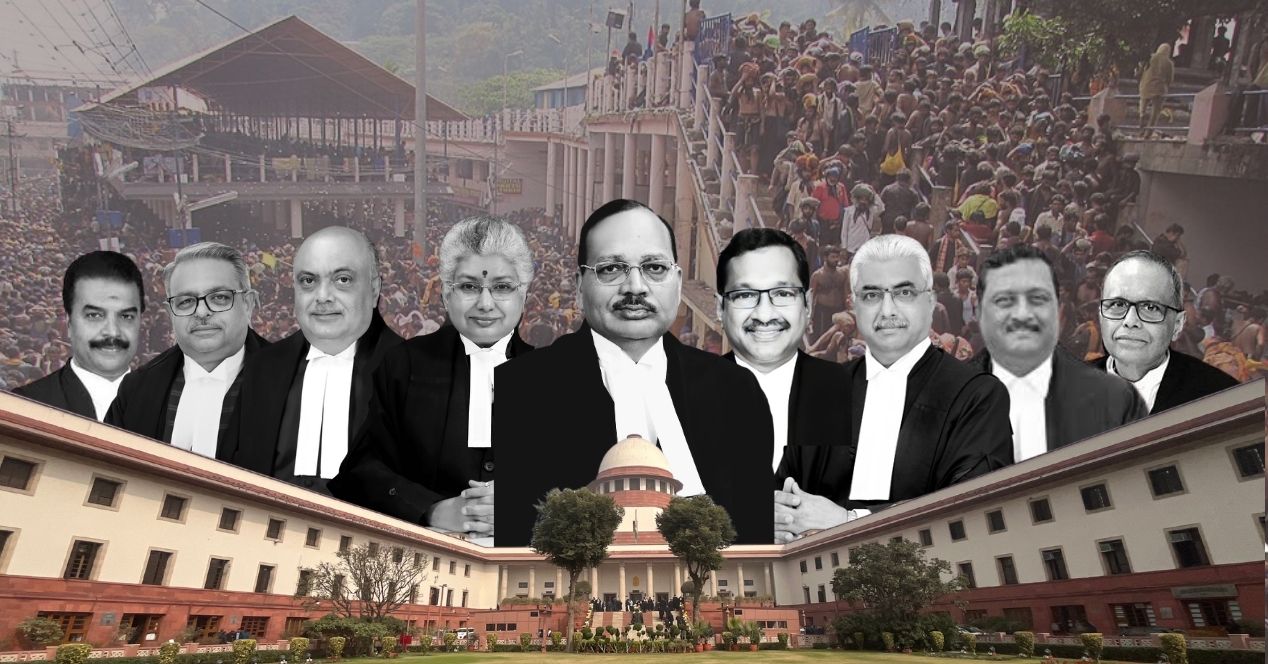
Sabarimala ReviewJudges: Surya Kant CJI, B.V. Nagarathna J, M.M. Sundresh J, Ahsanuddin Amanullah J, Aravind Kumar J, A.G. Masih J, P.B. Varale J, R. Mahadevan J, Joymalya Bagchi J
Today, the Supreme Court reserved judgement in the Sabarimala Reference after 16 days of hearings on denominational autonomy, temple entry, constitutional morality and the future of the essential religious practices (ERP) doctrine.
Background
On 28 September 2018, in Indian Young Lawyers Association v State of Kerala, a Constitution Bench of Chief Justice Dipak Misra, Justices R. F. Nariman, A. M. Khanwilkar, D. Y. Chandrachud and Indu Malhotra, in a 4:1 majority, held that the Sabarimala Temple’s exclusionary custom prohibiting the entry of women is unconstitutional. The custom barred women between the ages of 10 and 50 years old from entering the temple. The Judgment held that the said custom, and Rule 3(b) of the Kerala Hindu Places of Public Worship (Authorisation of Entry) Rules, 1965 — which allowed religious denominations to exclude women from public places of worship based on custom, violated the fundamental right to freedom of religion of female worshippers under Article 25 of the Constitution. The Bench held that the devotees of Lord Ayyappa were not a separate religious denomination and that the custom was not an essential religious practice (ERP).
More than 50 review petitions were subsequently filed by various individuals and organisations including Kantaru Rajeevaru, the Chief Priest of the Sabarimala Ayyappa Temple, the National Ayyappa Devotees (Women’s) Association, the Nair Service Society and the All Kerala Brahmin’s Association.
After CJI Misra retired, the review petition was heard on 13 November 2018 by a Bench of CJI Ranjan Gogoi, and Justices Khanwilkar, Nariman, Chandrachud and Malhotra. On 14 November 2019, the review bench by a narrow 3:2 majority decided to keep the review petitions pending and referred certain overarching constitutional questions to a larger bench. The review will be decided after the questions are clarified. The majority found that the Sabarimala judgement will have a bearing on other freedom of religion cases. Justices Nariman and Chandrachud dissented, holding that this speculation went beyond the narrow scope of a review petition. They dismissed challenges against the review.
On 13 January 2020, a nine-judge Bench led by CJI S.A. Bobde and Justices, R. Banumathi, Ashok Bhushan, Nageswara Rao, Mohan M. Shantanagoudar, S. Abdul Nazeer, R. Subhash Reddy, B.R. Gavai and Surya Kant began hearing the reference. Parties raised concerns that a review bench cannot refer questions of law to a larger bench.
On 10 February 2020, the nine-judge Bench upheld the referral order issued in the November 14 judgement. It held that the Court had the power to refer a point of law to a larger bench in a review petition, however, it did not publish any reasons for this finding at the time. On 11 May 2020, the Supreme Court published a detailed judgement substantiating the maintainability of the reference.
On 16 February 2026, a Bench of CJI Surya Kant with Justices Joymalya Bagchi and Vipul Pancholi listed the case for arguments on 7 April 2026.
Key Issues
- What is the scope and extent of judicial review with regard to a religious practice as referred to in Article 25 of the Constitution of India?
- What is the scope and extent of the word ‘morality’ under Articles 25 and 26 of the Constitution of India and whether it is meant to include Constitutional morality?
- What is the scope and ambit of right to freedom of religion under Article 25 of the Constitution of India?
- Whether the rights of a religious denomination under Article 26 of the Constitution of India are subject to other provisions of Part III of the Constitution of India apart from public order, morality and health?
- What is the meaning of expression “Sections of Hindus” occurring in Article 25 (2) (b) of the Constitution of India?
- What is the inter-play between the rights of persons under Article 25 of the Constitution of India and rights of religious denomination under Article 26 of the Constitution of India?
Rohatgi: Challenge to excommunication ruling has lost its basis
Senior Advocate Mukul Rohatgi defended the Constitution Bench ruling in Sardar Syedna Taher Saifuddin Saheb v State of Bombay (1957), which had struck down legislation curbing the powers of the religious head to excommunicate members.
Disputing suggestions that excommunication remains an active or arbitrary practice, Rohatgi submitted that there had been “no excommunication at all” in the last 75 years. Referring to Privy Council decisions from the 1930s and 1940s, he argued that disputes concerning excommunication historically involved questions of natural justice and not arbitrary exercises of power. According to him, the religious head does not possess some “diabolical authority” threatening routine excommunication.
Subramanium: Articles 25 and 26 operate in distinct constitutional spheres
Senior Advocate Gopal Subramanium identified three central questions arising in the reference: whether religious freedom is fundamentally located in Article 25(1) or whether Article 26 possesses an independent and self-sustaining existence, whether Articles 25 and 26 must be read together in the same assimilative manner as Articles 14, 19 and 21, and whether “religion” and “religious denomination” carry distinct constitutional meanings. According to him, religion refers to an established doctrine of faith such as Hinduism, Islam or Sikhism, whereas a denomination consists of persons who organise themselves into a distinct body within that broader faith. Subramanium argued that Articles 25 and 26 may overlap but are capable of operating in “distinct constitutional spheres.” He submitted that harmonisation does not mean that one right eclipses the other or assumes constitutional precedence over it. Subramanium argued that the scope of judicial review under Articles 25 and 26 is not the same as Article 14. According to him, irrationality may invalidate State action under Article 14, but the standards of rationality are not the same in matters concerning religion.
Subramanium: “Belief and disbelief” both fall within Article 25
Subramanium argued that the nature of individual freedom under Article 25(1) is not the same as denominational freedom under Article 26. He submitted that an individual need not belong to a denomination and may still move through belief and disbelief, meditate differently over time, read different spiritual literature or move “from one teacher to another”.According to him, denominational rights arise only once persons organise around identifiable tenets and shared doctrines. They concern not merely physical institutions but the preservation and exposition of the faith itself. Justice M.M. Sundresh observed, “If both individual and collective rights ultimately trace themselves to Article 25(1), the individual right vis-à-vis the denominational right can’t be treated at par.” Subramanium responded that an individual may freely profess and propagate by himself under Article 25(1), but membership in a denomination carries obligations flowing from collective belief.
Subramanium: Courts should never “divest” themselves of judicial review
Subramanium submitted that courts should never restrict themselves from judicial review in matters concerning Articles 25 and 26, because religious freedom concerns some of the most sacred aspects of human existence. Justice P.B. Varale observed that courts cannot adopt a complete “hands off approach” because disputes within denominations may not resolve internally. Justice Joymalya Bagchi distinguished between judicial review and judicial determination, observing that courts are capable of determining the existence of faith or denomination without entering into merits or value judgement on religion. Referring to Articles 29 and 30, Justice Bagchi observed that minority rights create a constitutional balance extending beyond ordinary vertical rights against the State. Subramanium agreed and argued that the framework of “vertical” and “horizontal” rights oversimplifies religious freedom jurisprudence. Justice Bagchi further suggested that Articles 25 and 26 may operate as constitutional “subspecies” of freedoms protected under Articles 19(1)(a) and 19(1)(c).
Dhavan: Religious freedom cannot be reduced to an assimilated rights model
Senior Advocate Rajeev Dhavan argued that the opposing side’s case rests on an “assimilated” reading, where rights under Part III came to be read together as an integrated structure. He stated that such a line of reasoning had developed through decisions such as Rustom Cavasjee Cooper v Union of India (1970) and Maneka Gandhi v Union of India (1978). According to him, that approach cannot automatically be extended to Articles 25 and 26. Dhavan submitted that the Constitution repeatedly recognises collective identities through provisions concerning Scheduled Castes, Scheduled Tribes, women, children and minorities. “Article 26 is a group right. Article 29 is a group right,” he argued, warning against affording overwhelming weightage to the concept of the individual alone. Referring to social reform, Dhavan submitted that Article 25(2) reflects the Constituent Assembly’s recognition that India could not survive without reform in a deeply diverse society. Justice B.V. Nagarathna observed,” The “14, 19 and 21 triangle” cannot straightforwardly apply to religious freedom provisions because these articles involve collective considerations.” Dhavan agreed and argued that the framers consciously avoided treating rights as “silos.”
Dhavan: Essentiality cannot become a threshold that erases religious rights
Dhavan argued that the ERP doctrine becomes constitutionally dangerous once essentiality is treated as a threshold requirement for the very existence of rights under Articles 25 and 26. Referring to the Sabarimala temple entry dispute, he submitted that once a practice is declared non-essential, “Article 25 rights disappear”, and once denominational status is denied, “Article 26 disappears.”
Dhavan further argued that constitutional morality cannot operate as a free-standing ground to invalidate religious freedom claims. He submitted that even the basic structure doctrine ultimately requires linkage to a specific constitutional provision because concepts such as secularism and democracy remain broad and undefined. Justice Nagarathna questioned whether the framers, faced with India’s religious diversity, consciously subjected Article 25 to the rest of Part III because unregulated religious freedom could produce “the worst communalism.” Dhavan agreed, arguing that the Constitution protects both individual conscience and group rights and that judicial review in religious freedom cases cannot proceed through a single uniform standard.
Dwivedi: Article 25 protects both individual and collective religious freedom
Senior Advocate Rakesh Dwivedi argued that Articles 25 and 26 are fundamentally collective rights, though Article 25(1) represents the point where individual rights and group rights coalesce and stand intertwined. According to him, religion is inherently “associational” and organised religion cannot ordinarily exist in isolation. He submitted that conscience, practice and propagation may all be exercised collectively and that denominational rights have historically preserved Hinduism’s plurality and continuity. Dwivedi argued that the phrase “subject to the other provisions of this Part” in Article 25 does not mean that every Part III right automatically applies to religious freedom claims. He submitted that only provisions having a direct constitutional impact upon religion would apply. He cited Articles 17 and 23 as examples of absolute prohibitions, arguing that denominations cannot claim protection for untouchability, begar or forced labour. Articles 13, 14 and 15, however, principally operate against the State and cannot automatically govern denominational disputes.
Parameshwar: ERP doctrine is deeply elitist
Amicus Curiae Senior Advocate K. Parameshwar submitted that courts should not exclude the application of other fundamental rights in disputes involving Articles 25 and 26, particularly in cases involving bodily harm, dignity or exclusion. He submitted that Articles 14, 19 and 21 may have limited application in religious freedom cases. However, rationality under Article 14 cannot be mechanically imported into religion. Justice Nagarathna observed that constitutional scrutiny may depend on whether the challenged practice has a sufficient nexus with religion. Parameshwar agreed, arguing that Part III must receive its “full play” and that rights cannot be treated as isolated silos. According to him, courts already possess safeguards such as examining locus standi and distinguishing pure denominational disputes from cases involving dignity or bodily autonomy.
Parameshwar sharply criticised the ERP doctrine, arguing, “It privileges certain practices over others and is deeply elitist”. Referring to tribal faiths and the Bishnoi community, he argued that many traditions cannot satisfy rigid doctrinal tests despite deserving constitutional protection. Justice Nagarathna observed that ERP may function only as an aid or tool, not a conclusive constitutional test.
Parameshwar: Temple entry right flows from Article 25(1)
Parameshwar argued that the right of temple entry flows from Article 25(1) and not merely from the enabling provision under Article 25(2)(b). He submitted that the Devaru judgement showed that denomination and reform can go together. According to him, temple entry cannot be mere physical access and includes the right to pray and perform as a believer. Justice Nagarathna pointed out that women devotees between the ages of 10 and 50 were excluded in the Sabarimala temple, despite being believers. Parameshwar answered that courts must balance denominational rights with the rights of believers under Article 25(1).
Parameshwar: Denominations cannot be confined to rigid structures
Parameshwar argued against a narrow definition of “religious denomination”, submitting that many Indian traditions function without rigid institutional structures, formal names or doctrinal uniformity. Referring to the Sabarimala litigation, he argued that tests of distinctiveness, novelty and organisational identity risked denuding religious freedoms, adding that denominational character cannot be determined solely by who enters an institution. According to him, denomination ultimately arises from shared belief because the believer, the belief and the object of belief must coexist. CJI Surya Kant observed, “Constitutional courts cannot surrender their responsibility in disputes concerning religious freedom.”
Singh: Constitutional morality cannot become a standalone ground to strike down laws
Amicus Shivam Singh argued that constitutional morality may assist courts in understanding the depth of violation under constitutional provisions but cannot operate as an independent basis for invalidating legislation. He submitted that constitutional morality occupies a position “somewhere in the middle”, where it retains interpretive value without becoming a free-standing constitutional power. Drawing an analogy with the spirit of cricket, he argued that a batsman cannot be declared out merely for violating sportsmanship because cricket recognises specific legal modes of dismissal such as LBW, stumping or being caught behind. In the same manner, he explained, constitutional morality may help courts understand why constitutional provisions exist but cannot by itself invalidate legislation. Singh submitted that morality remains extremely abstract and may vary from person to person, just as different umpires may interpret the “spirit of cricket” differently.